Hiring Stone Veneer Contractors Near Me: A Complete Material Guide
Learn how to vet stone veneer contractors near me with our complete material guide. Master MSV specs, bid analysis, and masonry red flags.

Searching for 'stone veneer contractors near me' yields dozens of local masons, general contractors, and landscaping companies, but not all possess the specialized knowledge required for adhered masonry veneer. Installing stone veneer is not simply gluing rocks to a wall; it is a complex moisture-management and structural system. Homeowners who approach contractor selection without a firm grasp of material specifications risk hiring amateurs who cut corners on weather barriers, use incorrect mortar types, or ignore critical expansion joints. This guide equips you with the technical material knowledge and vetting frameworks necessary to identify, interview, and hire a qualified local masonry professional.
Material Baselines: Natural Stone vs. Manufactured Veneer
Before requesting bids, you must define your material scope. Local contractors will price natural stone and Manufactured Stone Veneer (MSV) differently due to structural preparation, weight, and labor variables.
Technical Specification Comparison
- Manufactured Stone Veneer (MSV): Weighs 6 to 10 lbs per square foot. Governed by ASTM C1670. Composed of Portland cement, lightweight aggregates, and iron oxide pigments. Requires standard 2x4 or 2x6 wood framing with minimal additional structural reinforcement.
- Natural Stone Veneer: Weighs 10 to 15+ lbs per square foot. Governed by ASTM C1242. Quarried and sliced to a 3/4-inch to 1.5-inch thickness. Often requires structural engineering sign-off for exterior load-bearing walls and specialized heavy-duty metal lath.
When evaluating local pros, ask them to specify the exact brand and product line they intend to use. Reputable masons partner with certified manufacturers like Cultured Stone, Eldorado Stone, or Coronado Stone Products, which provide comprehensive installation manuals and warranty backing.
Vetting Local Masons: Beyond Basic Review Scores
A five-star rating on a general home services platform does not guarantee masonry expertise. Adhered veneer requires specific training in water-resistive barriers (WRB) and mortar chemistry. Use this checklist to filter your local search results:
- Verify Affiliations: Look for members of the Masonry Contractors Association of America (MCAA) or contractors certified by the National Concrete Masonry Association (NCMA).
- Request Portfolio Specifics: Ask to see close-up photos of their corner detailing and weep screed installations. Amateurs hide sloppy cuts with excessive mortar; experts use manufactured corner pieces that wrap seamlessly.
- Insurance Minimums: Require proof of General Liability insurance (minimum $1,000,000) and Workers' Compensation. Masonry is high-risk work; uninsured crews expose you to severe liability.
- Differentiate Adhered vs. Anchored: Ensure the contractor explicitly understands adhered veneer (mortar-bonded to a scratch coat) versus anchored veneer (mechanically tied to a masonry backup wall). Confusing the two is a massive red flag.
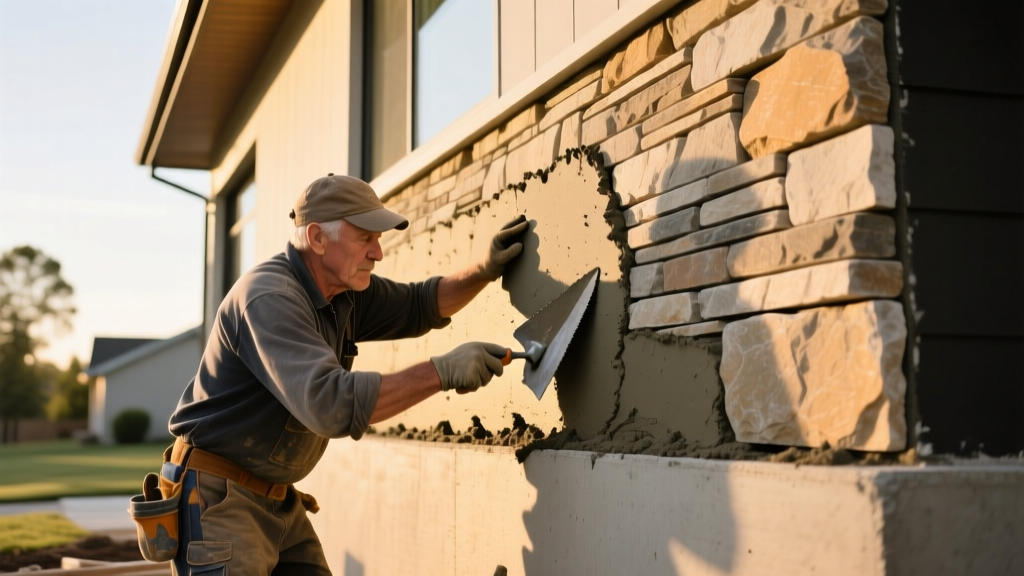
The Interview Matrix: Testing Technical Competence
When you narrow your list to two or three contractors, conduct a brief technical interview. Their answers will immediately reveal their depth of material science knowledge.
| Interview Question | Amateur / Red Flag Answer | Expert Mason Answer |
|---|---|---|
| What type of mortar do you use for the scratch coat and setting bed? | 'We just use standard Type S or whatever bagged mix is on sale.' | 'We use a polymer-modified veneer mortar compliant with ANSI A118.15, or a specific Type N/S mix blended with a latex bonding admixture for superior adhesion and flexural strength.' |
| How do you handle moisture management at the base of the wall? | 'We run the stone all the way down to the dirt or concrete patio.' | 'We install a corrosion-resistant weep screed (ASTM C1063) at least 4 inches above grade or 2 inches above paved surfaces, allowing the WRB to lap over the screed flange.' |
| Do you seal the stone after installation? | 'Yes, we roll on a thick acrylic sealer to make it shine and waterproof.' | 'We do not recommend film-forming acrylics, which trap moisture. If sealing is required for high-splash zones, we use a breathable silane/siloxane penetrating sealer.' |
Deconstructing the Bid: Material and Labor Cost Breakdown
A professional bid should not be a single lump-sum number. It must itemize the concealed materials that protect your home from water intrusion. Below is a realistic 2026 cost breakdown for a 500-square-foot exterior MSV installation.
| Project Component | Material Specifications | Estimated Cost (per sq. ft.) |
|---|---|---|
| Weather-Resistive Barrier (WRB) | Two layers of Grade D paper or fluid-applied membrane (e.g., Henry Blue Skin) | $0.80 - $1.50 |
| Metal Lath & Fasteners | 2.5 lb self-furring galvanized diamond mesh, nailed into studs (not just sheathing) | $1.20 - $2.00 |
| Scratch Coat | 1/2-inch Portland cement plaster with integral bonding agent | $1.50 - $2.50 |
| Stone Veneer Material | Mid-tier MSV flat stones and matching corner pieces | $7.00 - $14.00 |
| Setting Mortar & Labor | Expert masonry labor, scaffolding, mixing, and application | $18.00 - $32.00 |
| Total Estimated Project Cost | Comprehensive adhered system | $28.50 - $52.00 / sq. ft. |
Critical Red Flags in Masonry Proposals
Protect your investment by immediately disqualifying contractors who propose any of the following shortcuts in their written estimates.
Omitting the Weep Screed
Water will inevitably penetrate the face of the stone or enter through micro-cracks in the mortar. The WRB catches this water and directs it downward. Without a weep screed at the bottom of the assembly to eject the water, it will pool at the base plate of your wood framing, leading to catastrophic rot and mold within three to five years.
The 'Dry-Stack' Illusion on Exterior Walls
Dry-stack stone veneer (installed without visible mortar joints) is highly popular for interior fireplaces. However, applying true dry-stack methods to exterior walls in freeze-thaw climates is a primary cause of veneer failure. Water enters the unsealed joints, freezes, and expands, popping the stones off the lath. If you want the dry-stack aesthetic outdoors, the contractor must use a 'tight-fit' method where mortar is applied to the back of the stone (buttering) to create a hidden, watertight seal.
Ignoring Expansion and Control Joints
According to NCMA guidelines, adhered masonry veneer requires control joints to accommodate thermal expansion and structural deflection. If your contractor plans to run a continuous 40-foot span of stone without integrating flexible sealant joints aligned with the framing's structural control joints, the veneer will crack diagonally across the wall within the first year.
Post-Installation: Sealing and Maintenance Realities
Once the local contractor completes the installation, the maintenance protocol begins. Manufactured stone veneer is essentially colored concrete; it is porous and susceptible to efflorescence (white, powdery salt deposits) and staining from soil splash-back.
Never allow a contractor to apply a high-gloss, film-forming acrylic sealer to exterior MSV. These sealers trap moisture vapor inside the wall assembly and will peel, yellow, and degrade under UV exposure within 24 months.
Instead, specify a breathable penetrating sealer based on silane or siloxane chemistry, such as PROSOCO Siloxane PD. These products line the pores of the concrete and mortar without blocking vapor transmission, allowing the wall to 'breathe' while repelling liquid water. Application should occur no sooner than 28 days after installation to allow the Portland cement in the mortar and stone to fully cure and off-gas alkaline moisture. Reapplication is typically required every 5 to 7 years, depending on local weather exposure and UV degradation.
Written by
David NakamuraDavid Nakamura is a licensed architect (AIA) and construction technology writer focused on sustainable building methods, mass timber engineering, and high-performance building envelopes. He holds a Master of Architecture from the University of Washington and is a certified Passive House Consultant (CPHC). David spent eight years at the Seattle firm Mithun, where he led the design of three LEED Platinum projects, before founding his own practice specializing in net-zero residential design. He serves on the editorial advisory board of GreenBuilder Magazine and has authored peer-reviewed papers on cross-laminated timber (CLT) connections for the Journal of Structural Engineering. In his spare time, David teaches woodworking at Pratt Fine Arts Center and kayaks the Puget Sound.
More from David Nakamura
View all
Construction Cost
Labor Cost to Build a Deck Per Sq Ft: 2026 Installation Guide
Discover the exact labor cost to build a deck per sq ft in 2026. This installation guide breaks down contractor rates, complexity factors, and hidden fees.
Aug 4, 2026

Construction Cost
How Much Does It Cost to Build a 3 Bedroom House? Financing Guide
Learn exactly how much it costs to build a 3 bedroom house and explore 2026 financing options, construction loan types, and budget frameworks for your build.
Aug 4, 2026

Construction Cost
Cost to Build a Tennis Court: 2026 Guide
How much does it cost to build a tennis court in 2026? Breakdowns for asphalt, concrete, and synthetic surfaces plus fencing and lighting.
Jul 30, 2026