Best Stone Veneer for Fireplaces: A Buyer's Selection Guide
Discover the best stone veneer for fireplaces in our buyer's guide. Compare manufactured vs. natural stone, costs, heat ratings, and top brands.

Thermal Dynamics and Firebox Clearances
Selecting stone veneer for fireplaces requires navigating thermal dynamics, substrate limitations, and strict safety clearances. Unlike a standard accent wall, a fireplace surround subjects masonry materials to extreme temperature fluctuations. While both natural and manufactured stone veneers are inherently non-combustible—passing ASTM E136 standard testing for fire resistance—the vulnerability lies in the adhesives, mortars, and underlying substrates.
Critical Clearance Rule: According to NFPA 211 standards, combustible materials (like wood mantels or drywall) must remain at least 12 inches from the firebox opening. However, because stone veneer and its standard Type S or Type N mortar base are classified as non-combustible, the veneer itself can be installed flush against the metal flange of a zero-clearance gas insert or directly up to the masonry opening of a wood-burning firebox.
The primary thermal risk is not combustion, but spalling and delamination. Rapid heating and cooling cycles cause the metal firebox to expand and contract at a different rate than the masonry veneer. If a rigid, non-flexible mortar is used to bridge the gap between a steel insert and the stone, the sheer stress will crack the mortar joints within the first winter season. Buyers must specify a high-temperature silicone caulk or a flexible, heat-rated refractory sealant at the exact junction where the stone meets the metal firebox flange.
Material Matrix: Manufactured vs. Natural Stone
The debate between natural and manufactured stone veneer hinges on weight constraints, budget, and profile consistency. Manufactured stone (often called architectural stone) is cast from Portland cement, lightweight aggregates, and iron oxide pigments. Natural stone is quarried and sliced. Review the technical matrix below to determine which fits your fireplace framing.
| Feature | Manufactured Stone Veneer | Natural Stone Veneer |
|---|---|---|
| Weight | 8 – 12 lbs per sq. ft. | 13 – 20+ lbs per sq. ft. |
| Substrate Requirements | Standard wood framing with cement board | Often requires reinforced framing or masonry block |
| Corner Pieces | Precision-cast, uniform return lengths | Variable lengths, requires skilled mason to miter |
| Heat Tolerance d> | Excellent (concrete base handles high heat) | Excellent (geological formation withstands heat) |
| Average Material Cost | $6.50 – $12.00 / sq. ft. | $14.00 – $28.00 / sq. ft. |
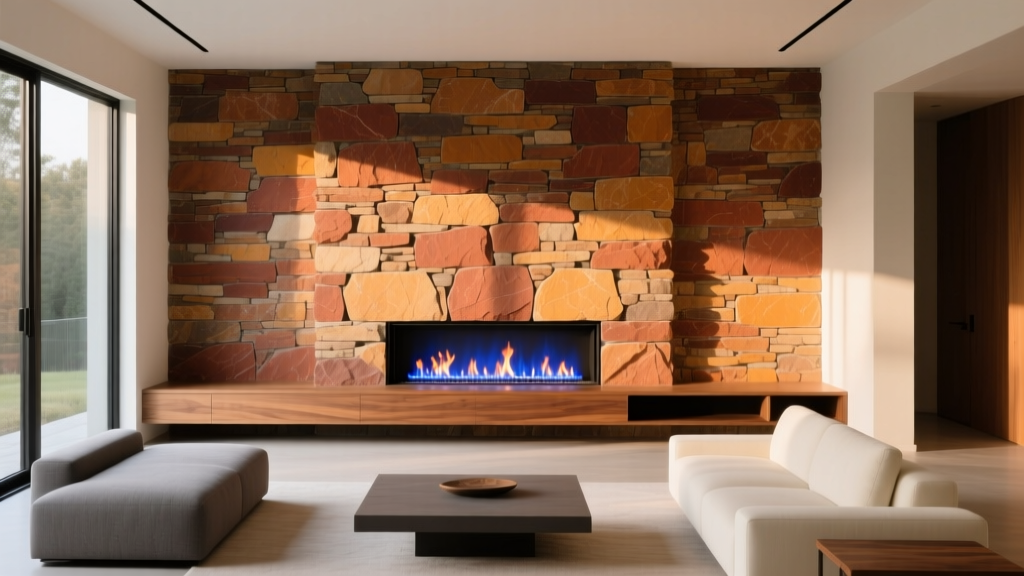
Application Methods: Traditional Mortar vs. Mortarless Systems
The visual profile of your fireplace is dictated by the installation method. Buyers must choose between traditional grouted joints and modern mortarless systems.
Callout: The Mortarless Misconception
Many buyers assume "mortarless" or "dry-stack" stone veneer can be glued directly to drywall using construction adhesive. This is a critical failure point. Even mortarless systems require a wire lath, a scratch coat of Portland cement, and a setting bed to adhere the stones to the wall. The term "mortarless" simply means no mortar is applied between the individual stones, yielding a tight, modern profile.
Traditional Grouted (Fieldstone & Cobblestone)
Best for rustic, traditional, or craftsman-style homes. Requires a 0.5-inch to 1-inch mortar joint. Type N mortar is standard for interior fireplaces, offering sufficient compressive strength (750 psi) while remaining workable enough to tool the joints smoothly.
Mortarless Dry-Stack (Ledgestone & Limestone)
Best for contemporary, transitional, and modern linear fireplaces. The stones are placed tight against one another. Because there is no mortar joint to absorb lateral movement, dry-stack veneers are slightly more prone to shifting if the house settles. A polymer-modified thin-set mortar (rated for high-heat if near the firebox) is often used as the setting bed to maximize adhesion.
2026 Brand and Product Line Recommendations
When sourcing materials, prioritize manufacturers that provide rigorous technical documentation and freeze-thaw testing data, even for interior applications, as this indicates superior cement curing and pigment stability.
- Cultured Stone (Boral) - Dressed Fieldstone: Offers a highly realistic, tumbled aesthetic with deep color variation. The interlocking shapes reduce installation time by up to 15% compared to competitors. Ideal for large, floor-to-ceiling traditional fireplace surrounds.
- Eldorado Stone - Cliffstone: A premier choice for dry-stack applications. The horizontal lines of Cliffstone draw the eye laterally, making it the perfect pairing for wide, 60-inch linear gas fireplaces. The iron oxide pigments are deeply integrated, preventing the "painted" look common in budget brands.
- Coronado Stone - Pro-Fit System: Specifically engineered for mortarless installation. The Pro-Fit ledgestone panels interlock mechanically, hiding the substrate entirely and ensuring perfectly straight horizontal lines without the need for a master mason.
Project Cost Breakdown: Materials, Labor, and Hidden Expenses
Budgeting for a fireplace veneer project extends beyond the per-square-foot cost of the stone. The following table outlines realistic 2026 pricing for a standard 50-square-foot fireplace surround (e.g., 5 feet wide by 10 feet tall to the ceiling).
| Cost Category | Manufactured Stone (50 sq ft) | Natural Stone (50 sq ft) |
|---|---|---|
| Veneer Material | $450 – $600 | $750 – $1,400 |
| Corner Pieces (Linear Ft) | $150 – $250 | $300 – $500 |
| Substrate Prep (Lath, Scratch Coat) | $120 – $180 | $120 – $180 |
| Mortar & Consumables | $80 – $120 | $80 – $120 |
| Professional Masonry Labor | $1,000 – $1,500 | $1,500 – $2,500 |
| Total Estimated Project Cost | $1,800 – $2,650 | $2,750 – $4,700 |
Common Failure Modes and Prevention
Fireplace veneers fail for specific, preventable reasons. Understanding these edge cases will inform your purchasing and installation decisions.
- Efflorescence (White Powder Staining): Caused by water-soluble salts migrating through the Portland cement base and crystallizing on the stone surface. Prevention: Ensure the mason uses a low-alkali Portland cement and avoids adding excess water to the mortar mix. For newly built fireplaces, wait 30 days for the concrete slab to fully cure before applying the scratch coat.
- Heat-Induced Spalling: Occurs when moisture trapped inside natural stone (particularly porous sandstones or limestones) turns to steam during a hot fire, causing the face of the stone to pop off. Prevention: If using natural stone on a high-BTU wood-burning firebox, specify dense stones like slate or granite, or apply a breathable, silane-based masonry sealer post-installation.
- Mortar Discoloration: Using acrylic-fortified or polymer-modified mortars too close to the firebox. The polymers melt and burn under direct radiant heat, leaving black, soot-like streaks. Prevention: Restrict polymer-modified mortars to the upper chimney chase; use standard, unmodified Type S or Type N masonry cement within 24 inches of the firebox opening.
The Buyer’s Decision Framework
Use this step-by-step framework to finalize your stone veneer selection:
Step 1: Assess the Firebox Type. If you have a zero-clearance gas insert, you are restricted by the manufacturer's specific clearance manual. If you have a traditional masonry wood-burning fireplace, you have full freedom to use any stone profile right up to the opening.
Step 2: Verify Framing Capacity. Consult your structural plans. If your fireplace chase is framed with standard 2x4s at 16 inches on center, limit your selection to manufactured stone (under 12 lbs/sq ft). If the chase is reinforced with steel studs or masonry block, natural stone is viable.
Step 3: Choose the Profile and Joint. Match the stone to the room's architecture. Select dry-stack ledgestone for modern linear inserts, and grouted fieldstone for traditional wood-burning hearths.
Step 4: Order 15% Overage. Fireplace surrounds require intricate cuts around the mantel, hearth, and gas valves. Always order 15% more square footage than your exact measurements dictate, and order corner pieces by the linear foot to wrap the edges of the chimney chase cleanly.
By prioritizing thermal compatibility, structural weight limits, and precise material specifications, you ensure your stone veneer fireplace remains a structurally sound and visually striking focal point for decades. For further technical installation parameters, always refer to the Masonry Veneer Manufacturers Association (MVMA) guidelines before finalizing your contractor agreement.
Written by
Priya KapoorPriya Kapoor is a real estate market analyst and construction economics researcher with expertise in housing affordability, development feasibility, and infrastructure investment. She holds a Master of Regional Planning from Cornell University and previously worked as a senior analyst at CBRE's Investment Properties group, where she modeled returns for $4B in mixed-use development pipelines. Priya now runs an independent research practice advising developers, municipalities, and REITs on construction cost forecasting and market timing. She publishes the quarterly "BuildMat Market Pulse" report tracking material price indices across 12 commodity categories. Based in Austin, TX, Priya serves on the board of Habitat for Humanity Austin and is a marathon runner.
More from Priya Kapoor
View all
Construction Cost
Cost to Build a 1600 Sq Ft Home in 2026: Full Breakdown
Accurate 2026 cost to build a 1600 sq ft home—material, labor, and regional pricing breakdowns included. Plan your budget with real-time estimates.
Aug 11, 2026

Wood & Lumber
Name the Types of Wood for Pressure Treatment and Preservation
Learn how to name the types of wood best suited for pressure treatment. Compare species treatability, chemical retention levels, and 2026 preservation costs.
Aug 4, 2026

Stone & Masonry
Stone Veneer Suppliers Lindenhurst: 2026 Cost Analysis
Analyze 2026 stone veneer costs in Lindenhurst, NY. Compare local supplier pricing, delivery fees, and Suffolk County installation labor rates.
Aug 4, 2026