Cultured Stacked Stone Veneer vs. Natural Stone and Faux Panels: A Buyer's Comparison
Compare cultured stacked stone veneer with natural stone and faux panels. Explore costs, weight limits, installation steps, and durability data.

The Core Contenders: Cultured, Natural, and Faux
When specifying stone cladding for interior feature walls or exterior facades, builders and homeowners typically evaluate three distinct material categories. Understanding the fundamental differences in composition, structural load, and moisture management is critical before committing to a material schedule.
- Cultured Stacked Stone Veneer (Manufactured Stone Veneer - MSV): A cementitious product cast in molds taken from natural stone. It utilizes Portland cement, lightweight aggregates (like pumice or expanded shale), and iron oxide pigments.
- Natural Stacked Stone: Quarried and sliced natural rock (slate, fieldstone, limestone, quartzite). It is a solid, dense geological material.
- Faux Stone Panels (Polyurethane): High-density polyurethane foam cast in molds, designed to mimic the visual texture of stone without the mineral weight.
Material Composition and Structural Load Limits
The most immediate differentiator between these materials is dead load, which directly dictates structural requirements, substrate preparation, and framing costs.
Cultured Stacked Stone Veneer
MSV typically weighs between 8 to 12 pounds per square foot (psf). While significantly lighter than full-bed natural stone, this weight still requires robust substrate preparation. Standard 2x4 wood framing at 16 inches on center can generally support this load without reinforcement, provided the sheathing and weather-resistant barrier (WRB) are properly detailed. However, for exterior applications exceeding 12 feet in height, structural engineers often require upgraded fastening schedules for the metal lath.
Natural Stone Veneer
Natural sliced veneer ranges from 15 to 25+ psf. This extreme weight often necessitates structural upgrades, such as doubling up rim joists, adding structural headers, or installing specialized masonry support shelves (relief angles) on commercial or multi-story residential builds. Natural stone also demands a much thicker mortar bed, adding an additional 3 to 5 psf of dead load.
Polyurethane Faux Panels
Weighing a mere 1 to 2 psf, faux panels impose virtually no structural burden. They can be screwed directly into drywall, OSB, or even existing siding without the need for cement backer boards, metal lath, or mortar. This makes them the default choice for DIYers, RV renovations, and applications over non-load-bearing partition walls.
2026 Cost Breakdown: Material vs. Installed
Pricing fluctuations in cement and freight have shifted the cost landscape for stone cladding. The table below reflects Q1 2026 market averages for a standard 200-square-foot exterior feature wall project.
| Cost Factor | Cultured Stacked Stone (MSV) | Natural Stone Veneer | Polyurethane Faux Panels |
|---|---|---|---|
| Material Cost (per sq. ft.) | $8.50 - $14.00 | $16.00 - $28.00+ | $11.00 - $18.00 |
| Prep & Mortar Materials | $2.50 - $4.00 | $3.50 - $6.00 | $0.50 (Screws/Caulk) |
| Professional Labor (per sq. ft.) | $12.00 - $18.00 | $18.00 - $30.00 | $4.00 - $8.00 |
| Total Installed Cost (per sq. ft.) | $23.00 - $36.00 | $37.50 - $64.00+ | $15.50 - $26.50 |
Installation Realities and Critical Failure Modes
The longevity of cultured stacked stone veneer relies entirely on the installation methodology. Unlike faux panels, which fail primarily through UV degradation, MSV fails through moisture intrusion and freeze-thaw cycling. According to guidelines published by the Masonry Veneer Manufacturers Association (MVMA), the vast majority of MSV failures are tied to improper water management, not the stone itself.
The Mandatory Moisture Management Stack
For exterior applications, a compliant wall assembly must include the following layers, moving from the interior out:
- Structural Sheathing: OSB or plywood.
- Weather-Resistant Barrier (WRB): Two layers of Grade D building paper or a high-performance housewrap. The MVMA mandates a dual-layer approach to create a capillary break.
- Corrosion-Resistant Weep Screed: Installed at the base of the wall with a minimum 4-inch clearance above soil grade (or 2 inches above concrete hardscapes) to allow trapped water to drain.
- Metal Lath: 2.5 lb self-furring galvanized expanded metal lath, fastened every 6 inches into the framing studs (not just the sheathing).
- Scratch Coat: A 1/2-inch layer of Type S mortar, scored horizontally to provide a mechanical key for the setting bed.
White, powdery staining (efflorescence) on cultured stone is rarely a defect in the stone; it is a symptom of water moving through the cementitious mortar, carrying soluble salts to the surface. If your cultured stone develops severe efflorescence or begins spalling (flaking) after winter, the weep screed is likely blocked, the WRB is compromised, or the mason used a mortar mix with too high a water-to-cement ratio. Never seal the face of MSV with a non-breathable acrylic sealer to 'fix' this; it will trap moisture inside and accelerate freeze-thaw destruction.
Aesthetic and Tactile Comparison
Visual authenticity is the primary driver for choosing stone cladding. Here is how the three materials perform under close scrutiny.
Cultured Stacked Stone Veneer
High-end MSV brands, such as those detailed in Eldorado Stone installation resources, utilize multi-step hand-painting techniques and molds taken directly from quarried rock. The tactile surface is identical to real stone because it is made of actual cement and aggregate. The primary aesthetic drawback is the edge profile; if the stone is cut to fit around a window casing, the uncolored concrete core is exposed. Skilled masons mitigate this by using corner wraps, mortar smearing, or specialized touch-up kits.
Natural Stone
Natural stone offers infinite variation. No two pieces are identical, and the mineral striations, fossil inclusions, and natural clefts cannot be perfectly replicated in a factory. Furthermore, when natural stone is cut, the interior matches the exterior. It is the undisputed champion of luxury aesthetics, but the irregular thicknesses require a highly skilled mason to maintain a consistent stacked profile without excessive mortar joints.
Polyurethane Faux Panels
While modern molding techniques have improved the visual texture of faux panels, they fail the tactile and acoustic tests. Polyurethane feels like dense plastic to the touch, sounds hollow when tapped, and lacks the thermal mass of real stone. Up close, the repetitive pattern of a 4x2 foot panel becomes obvious, and the interlocking seams can cast unnatural shadows in direct sunlight.
Thermal Mass and Energy Performance
An often-overlooked factor in cladding selection is thermal mass. Cultured stacked stone veneer and natural stone absorb and slowly release heat. In passive solar home designs, applying MSV to an interior wall that receives direct winter sunlight can help moderate indoor temperature swings. Polyurethane panels offer an R-value of roughly R-3 to R-4 per inch of thickness, providing a marginal insulation benefit, but they lack the thermal mass required to act as a heat sink.
Decision Framework: Which Material Wins Your Project?
Select the optimal material based on your specific project constraints using the following framework:
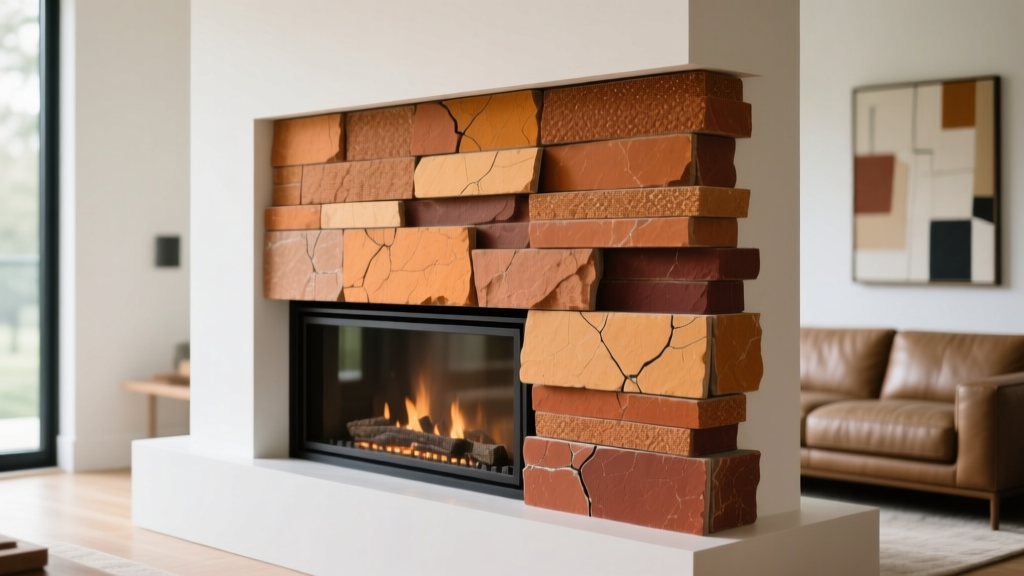
- Choose Cultured Stacked Stone Veneer if: You want the authentic look, feel, and thermal mass of real stone but need to reduce structural dead load and material costs. It is the optimal middle-ground for exterior facades, interior fireplace surrounds, and commercial accent walls where budget and weight are moderate constraints.
- Choose Natural Stone if: Budget is secondary to absolute luxury, you require custom cut-edge profiles without exposed cores, and the building's structural framing has been engineered to support 25+ psf dead loads. Ideal for high-end custom homes and historical restorations.
- Choose Polyurethane Faux Panels if: You are executing a DIY renovation, working over existing drywall or non-structural partitions, require an immediate waterproof finish for a basement or wet bar, or need to complete the project in a single weekend without mixing mortar.
By aligning your structural capacity, budget, and labor resources with the physical properties of these materials, you can avoid costly retrofitting and ensure a durable, high-performance stone installation. Always verify local building codes regarding weep screed clearances and WRB requirements with your local National Association of Home Builders (NAHB) affiliated inspector before finalizing your material order.
Written by
David NakamuraDavid Nakamura is a licensed architect (AIA) and construction technology writer focused on sustainable building methods, mass timber engineering, and high-performance building envelopes. He holds a Master of Architecture from the University of Washington and is a certified Passive House Consultant (CPHC). David spent eight years at the Seattle firm Mithun, where he led the design of three LEED Platinum projects, before founding his own practice specializing in net-zero residential design. He serves on the editorial advisory board of GreenBuilder Magazine and has authored peer-reviewed papers on cross-laminated timber (CLT) connections for the Journal of Structural Engineering. In his spare time, David teaches woodworking at Pratt Fine Arts Center and kayaks the Puget Sound.
More from David Nakamura
View all
Construction Cost
Labor Cost to Build a Deck Per Sq Ft: 2026 Installation Guide
Discover the exact labor cost to build a deck per sq ft in 2026. This installation guide breaks down contractor rates, complexity factors, and hidden fees.
Aug 4, 2026

Construction Cost
How Much Does It Cost to Build a 3 Bedroom House? Financing Guide
Learn exactly how much it costs to build a 3 bedroom house and explore 2026 financing options, construction loan types, and budget frameworks for your build.
Aug 4, 2026

Construction Cost
Cost to Build a Tennis Court: 2026 Guide
How much does it cost to build a tennis court in 2026? Breakdowns for asphalt, concrete, and synthetic surfaces plus fencing and lighting.
Jul 30, 2026