Buyer's Guide: Planning a Do It Yourself Stone Veneer Fireplace
Discover the best materials, tools, and costs for your do it yourself stone veneer fireplace. Compare manufactured vs. natural stone and plan your build.

The Core Decision: Manufactured vs. Natural Thin Stone Veneer
When planning a do it yourself stone veneer fireplace, the foundational choice dictates your budget, structural requirements, and cutting methodology. The market is divided into two primary categories: Manufactured Stone Veneer (MSV) and Natural Thin Stone Veneer. While both deliver high-end aesthetics, their physical properties demand entirely different installation approaches.
Manufactured stone is a Portland cement-based product cast in molds taken from real stone. It is significantly lighter, generally weighing between 10 and 15 pounds per square foot. More importantly for DIYers, MSV can often be scored and snapped or cut with a standard 4-inch angle grinder equipped with a dry diamond turbo rim blade. Natural thin stone, quarried and sliced to a 1-inch thickness, weighs 15 to 30 pounds per square foot and mandates a 10-inch wet saw with a continuous rim diamond blade to prevent shattering and edge chipping during cuts.
| Feature | Manufactured Stone Veneer (MSV) | Natural Thin Stone Veneer |
|---|---|---|
| Average Weight | 10 - 15 lbs / sq. ft. | 15 - 30 lbs / sq. ft. |
| Material Cost | $8.00 - $14.00 / sq. ft. | $16.00 - $35.00+ / sq. ft. |
| Cutting Method | Score-and-snap, masonry blade, or hatchet | 10-inch wet saw with diamond blade |
| Color Consistency | High (batch-controlled oxides) | Low (natural geological variation) |
| Corner Pieces | Readily available, returns 90-degree edges | Expensive, limited availability |
Substrate and Mortar Specifications: Where DIYers Fail
The most common failure point in DIY fireplace veneer projects is improper substrate preparation and mortar selection. Standard drywall (gypsum board) is entirely unacceptable as a substrate for stone veneer. The paper facing will absorb moisture from the mortar, delaminate, and cause the entire installation to collapse.
The Correct Substrate Stack
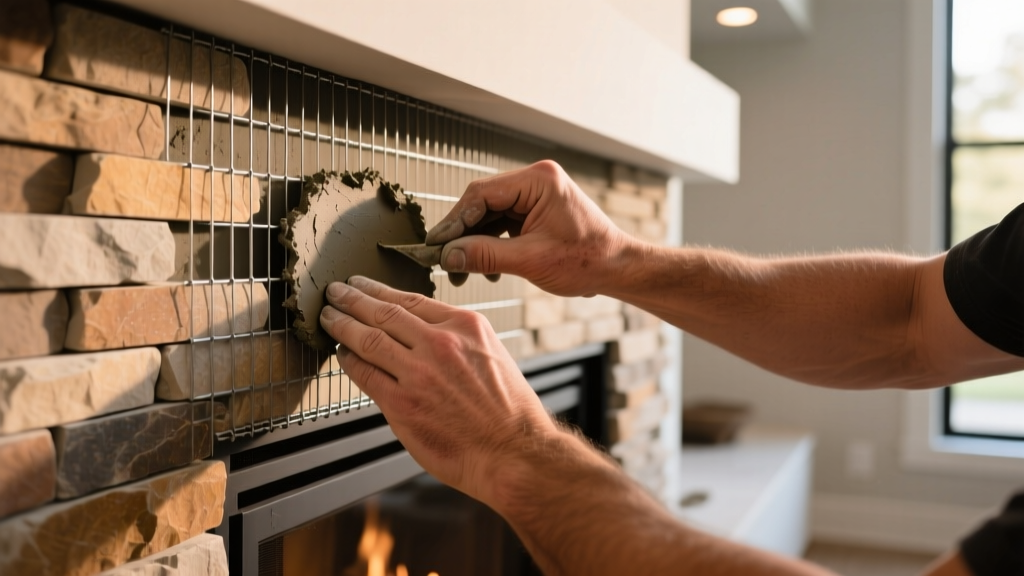
For interior fireplace surrounds, you must strip the existing drywall down to the studs. Install a minimum 1/2-inch cement backer board (such as USG Durock or HardieBacker) using corrosion-resistant cement board screws spaced 8 inches apart on the studs. Over the cement board, staple 2.5 lb self-furring galvanized metal lath. The 'self-furring' dimples hold the lath 1/4-inch away from the board, allowing the scratch coat of mortar to wrap behind the wire for a mechanical lock.
Mortar Selection: Type S vs. Polymer-Modified
Do not use standard drywall joint compound or thin-set tile adhesive. You must use a masonry veneer mortar. According to the Eldorado Stone official installation guidelines, a Type S mortar mix is the baseline requirement. Type S contains a higher ratio of Portland cement to lime compared to Type N, yielding a compressive strength of 1,800 PSI, which is necessary to support the sheer weight of vertical stone applications.
For a superior DIY experience, upgrade to a polymer-modified masonry veneer mortar (MVM) like LATICRETE MVM. These pre-blended bags contain fortifiers that increase bond strength, reduce efflorescence (white salt staining), and extend working time, which is critical when you are learning the trowel technique.
Fire Clearances and Code Compliance
Aesthetic choices must yield to fire safety. The National Fire Protection Association (NFPA) sets strict clearances for combustible materials near fireboxes. Under NFPA 211 (Standard for Chimneys, Fireplaces, Vents, and Solid Fuel-Burning Appliances), combustible materials—including wood mantels and framing—must maintain specific distances from the firebox opening. Generally, wood trim must be at least 6 inches from the firebox opening on the sides and top, and project no more than 1/8 inch for every 1 inch of clearance. Stone veneer itself is non-combustible, but the wood framing behind your cement board and the mantel shelf above it are not. Always consult your local building inspector and the specific zero-clearance fireplace manufacturer's manual before framing your surround.
Top Brand Profiles for DIY Installers
- Eldorado Stone (Pro-Fit Series): Their Pro-Fit Ledgestone system is engineered specifically for rapid installation. The stones are pre-grouped into modular, interlocking panels that install 40% faster than individual stones, making it highly forgiving for first-time DIYers.
- Cultured Stone (Dressed Fieldstone): Offers exceptional color depth and shadow lines. Best for traditional or rustic fireplaces. Requires more individual piece placement and mortar joint tooling.
- ProVia (Manufactured Stone): Known for rigorous quality control and UV-stable integral coloring. Excellent choice if your fireplace is in a sunroom or receives heavy direct sunlight, preventing the fading seen in cheaper MSV brands.
The Complete Material Purchasing Checklist
Accurate ordering prevents project delays and color-matching nightmares. Use this framework to calculate your materials:
- Calculate Flat Area: Measure the total square footage of the surround. Subtract the firebox opening. Add 10% to 15% for waste and cuts.
- Calculate Linear Corners: Measure all outside corners (where the face meets the return wall) in linear feet. Order corner pieces first; they are sold by the linear foot and dictate the layout. Add 5% for corner waste.
- Mortar Quantity: An 80 lb bag of Type S mortar covers approximately 12 square feet of veneer (including the scratch coat and setting bed). Divide your total square footage by 10 to ensure you have enough for both steps.
- Metal Lath: Rolls typically cover 50 square feet. Order one extra roll to ensure proper 2-inch overlapping at all seams.
- Sealer: Purchase a breathable, siloxane-based penetrating sealer (like Prosoco Siloxane PD). Do not use film-forming acrylic sealers, which trap moisture and cause spalling when the fireplace heats up.
Frequently Asked Questions
Do I need a scratch coat for interior fireplaces?
Yes. While some mortarless or panelized systems bypass this, traditional individual stone veneer requires a 1/2-inch scratch coat applied to the metal lath. The scratch coat must be scarified (scratched with a wire rake) while wet to provide a mechanical tooth for the final setting mortar. Allow the scratch coat to cure for a minimum of 24 to 48 hours before applying stones, as noted by Fine Homebuilding's masonry guides.
Can I install stone veneer directly over painted brick?
No. Paint creates a bond-breaker. Mortar will adhere to the paint, but the paint will peel away from the brick under the weight of the stone. You must either sandblast the brick to bare masonry or attach metal lath directly into the brick using masonry tapcon screws before applying your scratch coat.
How do I hide the cut edges of manufactured stone?
Manufactured stone reveals the concrete aggregate core when cut. Always position cut edges facing downward or inward toward the firebox where shadows hide them. For exposed cuts, use a rub stone or a masonry staining pen matched to the stone's surface color to blend the aggregate core.
Written by
Priya KapoorPriya Kapoor is a real estate market analyst and construction economics researcher with expertise in housing affordability, development feasibility, and infrastructure investment. She holds a Master of Regional Planning from Cornell University and previously worked as a senior analyst at CBRE's Investment Properties group, where she modeled returns for $4B in mixed-use development pipelines. Priya now runs an independent research practice advising developers, municipalities, and REITs on construction cost forecasting and market timing. She publishes the quarterly "BuildMat Market Pulse" report tracking material price indices across 12 commodity categories. Based in Austin, TX, Priya serves on the board of Habitat for Humanity Austin and is a marathon runner.
More from Priya Kapoor
View all
Construction Cost
Cost to Build a 1600 Sq Ft Home in 2026: Full Breakdown
Accurate 2026 cost to build a 1600 sq ft home—material, labor, and regional pricing breakdowns included. Plan your budget with real-time estimates.
Aug 11, 2026

Wood & Lumber
Name the Types of Wood for Pressure Treatment and Preservation
Learn how to name the types of wood best suited for pressure treatment. Compare species treatability, chemical retention levels, and 2026 preservation costs.
Aug 4, 2026

Stone & Masonry
Stone Veneer Suppliers Lindenhurst: 2026 Cost Analysis
Analyze 2026 stone veneer costs in Lindenhurst, NY. Compare local supplier pricing, delivery fees, and Suffolk County installation labor rates.
Aug 4, 2026