Which Granite Sealer Fits Your Countertop or Patio Best?
Match the right granite sealer to your specific application. Compare fluoropolymer and siloxane chemistries for kitchen countertops and outdoor patios.
The Science of Granite Porosity and Sealer Mechanics
Despite its reputation as an impenetrable surface, granite is a porous igneous rock. The porosity varies drastically depending on the quarry source and mineral composition; for instance, absolute black granite (gabbro) is nearly non-porous, while light-colored varieties like Kashmir White possess a dense network of micro-fissures. Furthermore, modern fabrication often involves resin-treating slabs at the factory to fill natural voids. Applying the wrong granite sealer over factory resin can result in chemical incompatibility, leading to hazing or peeling.
Penetrating sealers (impregnators) do not sit on the surface. Instead, they utilize a carrier solvent—either water or petroleum distillate—to transport active polymers deep into the stone's capillary network. Once the carrier evaporates, the polymers cross-link and bond to the cellular walls, creating a hydrophobic and oleophobic barrier. According to the Natural Stone Institute, selecting the correct polymer chemistry is entirely dependent on the environmental stressors the stone will face.
Scenario Matrix: Matching Sealer Chemistry to Application
Choosing a sealer based solely on brand recognition is a common contractor error. The chemical formulation must align with the specific threat profile of the installation environment. Below is a decision matrix for 2026 application scenarios.
| Application Scenario | Primary Threat Profile | Required Polymer Chemistry | Top Product Example (2026) | Reapplication Cycle |
|---|---|---|---|---|
| Indoor Kitchen Countertops | Cooking oils, acidic foods, wine | Fluoropolymer (Oleophobic) | Aqua Mix Sealer's Choice Gold | 3 to 5 years |
| Outdoor Patios & Facades | Freeze-thaw cycles, UV, rain | Silane/Siloxane (Hydrophobic) | Prosoco SureKlean Siloxane PD | 5 to 10 years |
| High-Traffic Commercial Floors | Foot traffic abrasion, dirt, water | Water-based Siloxane Blend | Miracle Sealants 511 Impregnator | 1 to 3 years |
| Dark/Exotic Stone Enhancing | Fading, dullness, color loss | Solvent-based Enhancing Resin | Tenax Ager Color Enhancer | 2 to 4 years |
Indoor Kitchen Countertops: Food-Safe Penetrating Sealers
Kitchen environments demand an oleophobic (oil-repelling) barrier. Standard siloxane sealers repel water but will allow cooking oils, butter, and grease to penetrate the stone, resulting in permanent dark stains. Fluorocarbon-based polymers are required to repel both water and oil molecules.
Water-Based vs. Solvent-Based Carriers
- Water-Based (e.g., Aqua Mix Sealer's Choice Gold): Utilizes a water carrier. It emits ultra-low VOCs, making it ideal for occupied homes and commercial kitchens. However, water's high surface tension limits penetration depth, requiring two coats for highly porous stones like Ubatuba.
- Solvent-Based (e.g., Miracle Sealants 511): Uses petroleum distillates. The lower surface tension allows the polymer to penetrate up to 3mm deep into dense granite. The trade-off is higher VOC output, requiring active ventilation during the 24-hour curing phase. Check current EPA guidelines on indoor VOC impacts before specifying solvent-based products in tightly sealed, energy-efficient homes.
Outdoor Patios and Facades: UV and Freeze-Thaw Resistance
Exterior granite faces an entirely different set of physics. The primary enemy is not oil, but water ingress combined with thermal cycling. When water penetrates unsealed exterior granite and drops below freezing, it expands by 9%. This hydraulic pressure exceeds the tensile strength of the stone, causing the surface to pop off—a failure mode known as spalling.
"The most catastrophic failures in exterior stonework occur when contractors apply non-breathable topical acrylic sealers outdoors. The acrylic traps moisture inside the stone during winter, guaranteeing severe spalling by the second freeze-thaw cycle."
For exterior applications, specify a silane/siloxane penetrating sealer like Prosoco SureKlean Weather Seal Siloxane PD. Siloxanes are highly breathable; they repel liquid water from entering the capillaries but allow water vapor (gas) to escape. This vapor permeability is non-negotiable for exterior masonry and stone. Furthermore, siloxanes are UV-stable and will not chalk, yellow, or degrade under direct sunlight, unlike topical coatings.
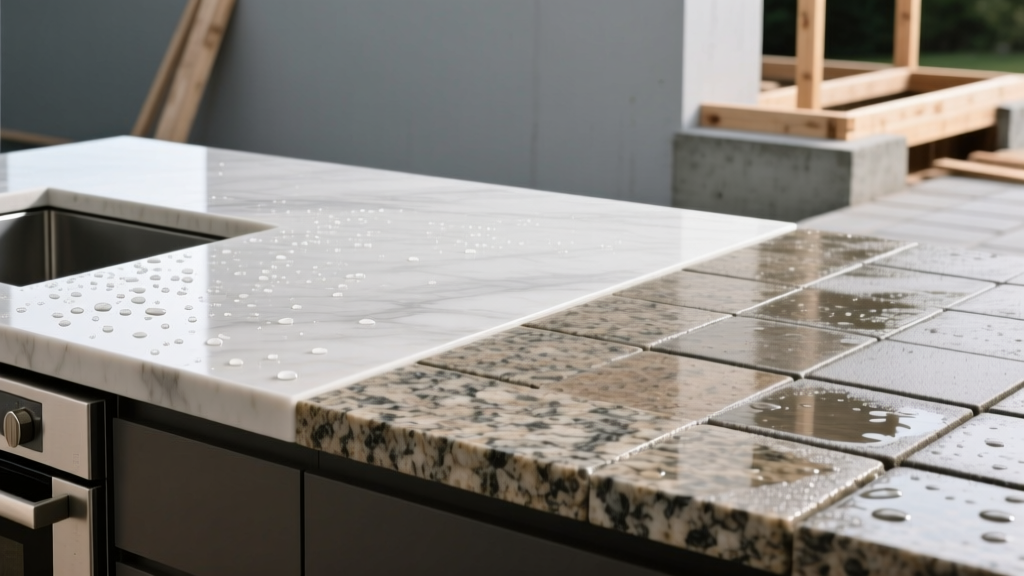
The Water Drop Test: A Field-Ready Diagnostic
Before specifying a sealer for an existing installation, perform this standardized diagnostic to determine if the stone actually requires treatment. Factory-resined granites often do not need immediate sealing.
- Clean the test area with a pH-neutral stone cleaner and let it dry completely for 2 hours.
- Place 3 to 4 drops of water on the surface in an inconspicuous area.
- Start a timer. Observe the stone for 15 minutes.
- Result A: If the water beads up and the stone color remains unchanged after 15 minutes, the stone is adequately sealed or naturally non-porous. Do not apply more sealer.
- Result B: If the stone darkens beneath the water drops within 5 minutes, the capillaries are open and absorbing moisture. A penetrating sealer is required.
Common Failure Modes and Troubleshooting
Even premium products fail if the application protocol is violated. Here are the three most common field failures and their exact remediation steps.
1. Surface Hazing and Cloudiness
Cause: The applicator flooded the surface and failed to buff off the excess sealer within the critical 5-to-10-minute window. The carrier solvent evaporated, leaving a sticky, cloudy polymer residue on the surface.
Fix: Do not scrub with abrasive pads. Re-apply a small amount of the exact same liquid sealer over the hazy area. The fresh solvent will re-emulsify the dried residue. Immediately buff it aggressively with a dry, clean microfiber cloth until the surface is completely clear.
2. Peeling and Flaking (Topical Coatings)
Cause: A previous contractor applied a topical acrylic or polyurethane coating instead of a penetrant. These form a surface film that scratches, peels, and traps dirt.
Fix: Topical coatings cannot be patched; they must be entirely stripped. Apply a soy-based or dibasic ester chemical stripper (avoiding toxic methylene chloride products). Allow it to dwell for 45 minutes, agitate with a soft nylon brush, and extract the slurry with a wet vac. Rinse thoroughly, let dry for 48 hours, and apply a proper penetrating impregnator.
3. Uneven Absorption and Dark Spotting
Cause: Applying sealer to a stone that contains hidden moisture or residual fabricator's resin that hasn't fully cured.
Fix: The stone must be bone-dry. Use a moisture meter to verify the internal moisture content is below 4% before application. If dark spots appear, use a poultice powder mixed with acetone to draw the trapped oils and uneven sealer out of the micro-fissures.
Cost Breakdown and ROI Analysis (2026 Estimates)
Budgeting for granite sealing requires distinguishing between material costs and professional labor rates. The ROI of professional application lies in the warranty and the guarantee of proper surface preparation.
| Cost Category | DIY Application (Per Sq. Ft.) | Professional Service (Per Sq. Ft.) | Notes & Variables |
|---|---|---|---|
| Material / Chemical | $0.45 - $1.20 | Included in labor | Solvent-based and color-enhancers are at the higher end of the material cost spectrum. |
| Labor & Prep | $0.00 (Your time) | $1.50 - $3.50 | Includes deep cleaning, resin stripping, and pH-neutralizing the stone prior to sealing. |
| Total Estimated Cost (50 sq. ft. kitchen) | $22 - $60 | $125 - $235 | Professional services typically include a 3-to-5-year warranty against staining. |
Ultimately, matching the correct granite sealer to the specific environmental scenario prevents costly remediation. Specify fluoropolymers for oil-heavy indoor kitchens, breathable siloxanes for exterior freeze-thaw environments, and always verify porosity with a water drop test before committing to a chemical treatment.