Thin Veneer Stone NJ: Design & Architectural Style Guide
Explore thin veneer stone NJ design trends. Match regional architectural styles, review 2026 pricing, and master installation specs for Garden State homes.

The Architectural Shift in Garden State Exteriors
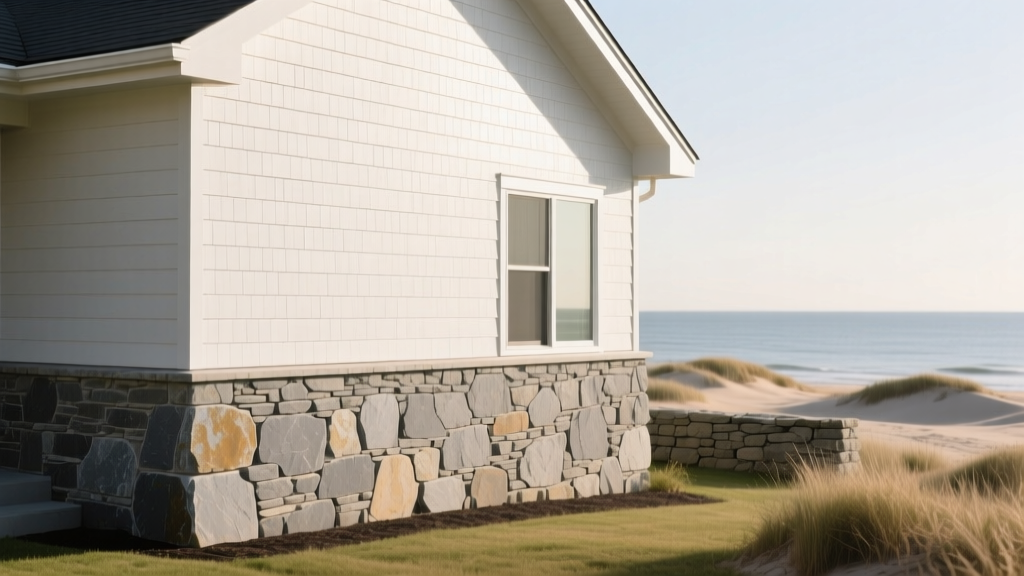
New Jersey’s architectural landscape demands materials that bridge historical charm and modern structural resilience. From the salt-air environments of the Jersey Shore to the severe freeze-thaw cycles of the Sussex County mountains, exterior cladding must perform flawlessly under environmental stress. When specifying thin veneer stone, NJ architects and builders increasingly favor it over traditional full-bed masonry. It delivers the authentic mass, texture, and mineral variation of natural stone while eliminating the need for costly structural footings and wall reinforcements.
Thin veneer stone typically measures between 0.75 inches and 1.5 inches in thickness and weighs roughly 10 to 15 pounds per square foot. This dramatic reduction in weight—compared to the 40+ pounds per square foot of full-bed stone—allows for direct application over properly prepared wood or steel stud framing, making it the premier choice for both new construction and complex residential retrofits across the Tri-State area.
Regional Style Matrix: Matching Stone to NJ Architecture
New Jersey is not a monolith; its housing stock varies wildly by county. A profile that enhances a Cape Cod in Ocean County will look entirely out of place on a Tudor revival in Bergen County. Below is a design framework for pairing thin veneer profiles with regional architectural styles.
| Architectural Style | Primary NJ Region | Ideal Stone Profile | Color Palette & Mortar |
|---|---|---|---|
| Shore Colonial / Cape Cod | Ocean, Cape May, Monmouth | Weathered Limestone Ledgestone | Sandy tans, driftwood grays / Raked joint |
| Craftsman / Tudor Revival | Bergen, Essex, Morris | Granite Fieldstone / Mosaic | Charcoal, rust, deep browns / Dry-stack or tight |
| Modern Farmhouse | Hunterdon, Somerset, Mercer | Clean-Cut Ashlar | Crisp whites, slate grays / Flush or struck joint |
| Rustic Estate / Lodge | Sussex, Warren, Passaic | Heavy Mossy Fieldstone | Earth tones, moss greens / Wide, overgrouted |
Technical Specifications & Material Performance
For homeowners researching thin veneer stone, NJ's diverse climate zones dictate strict material performance requirements. The state experiences severe temperature fluctuations, meaning the stone and the mortar matrix must withstand repetitive expansion and contraction without spalling or delaminating.
Natural vs. Manufactured Thin Veneer
- Natural Stone Veneer: Sliced from real quarried stone (granite, limestone, slate). It offers unmatched mineral variation and UV stability. According to the Natural Stone Institute, natural stone must meet specific ASTM standards for absorption and density to survive northern freeze-thaw cycles. Expect natural variations in thickness, requiring a skilled mason to adjust the mortar bed depth on the fly.
- Manufactured Stone Veneer (MSV):strong> Cast from Portland cement, lightweight aggregates, and iron oxide pigments. High-end MSV weighs slightly less than natural stone and offers uniform thickness, speeding up installation. However, cheaper MSV can suffer from pigment fading or chipping that reveals the aggregate core.
Mortar Selection for Freeze-Thaw Resilience
Do not use standard Type N mortar for exterior thin veneer in North Jersey. Type N lacks the compressive strength and bond retention required for severe freeze-thaw environments. Specify Type S mortar for all exterior applications. Type S provides higher flexural bond strength, allowing the mortar to absorb microscopic thermal movements without cracking. For coastal areas (within 5 miles of the Atlantic), integrate a silane-based water repellent admixture into the mortar mix to resist wind-driven salt spray.
2026 NJ Market Pricing & ROI Analysis
Labor rates in New Jersey consistently rank among the highest in the nation, making the lightweight nature of thin veneer a significant cost-saver on structural engineering and foundation pouring. Below is the current cost breakdown for professional installation in the Tri-State market.
| Cost Category | Manufactured Veneer | Natural Stone Veneer |
|---|---|---|
| Material Cost (per sq. ft.) | $7.50 - $11.00 | $10.00 - $18.00 |
| Prep & Lath (per sq. ft.) | $3.00 - $4.50 | $3.50 - $5.00 |
| Masonry Labor (per sq. ft.) | $14.00 - $19.00 | $18.00 - $26.00 |
| Total Installed Cost | $24.50 - $34.50 | $31.50 - $49.00 |
Note: Complex geometries, multiple corner returns, and working above the first story (requiring scaffolding) will push labor costs toward the higher end of these ranges.
Critical Installation Details & Code Compliance
The most common failure mode for stone veneer is not the stone itself, but moisture entrapment behind the cladding. The International Masonry Institute (IMI) emphasizes that drainage and ventilation are non-negotiable for veneer systems, particularly in regions with heavy, wind-driven rain like the Northeast corridor.
Never allow mortar to squeeze through the lath and make direct contact with the weather-resistant barrier (WRB). If mortar bridges the gap, capillary action will draw moisture directly into the wood sheathing, causing rot. Always use a dimpled drainage mat or a specialized weep-screed system that maintains a minimum 1/4-inch air space behind the lath.
The NJ Uniform Construction Code (UCC) Checklist
When pulling permits for exterior cladding, local NJ building inspectors will verify compliance with the International Residential Code (IRC) as adopted by the state. Ensure your contractor's plans include:
- Weather-Resistant Barrier (WRB): Two layers of Grade D building paper or a high-performance fluid-applied membrane over the OSB/plywood sheathing.
- Corrosion-Resistant Lath: Minimum 2.5 lb/sq yd self-furring galvanized steel lath, fastened with corrosion-resistant nails or staples penetrating the studs by at least 1 inch.
- Weep Screeds: A code-mandated weep screed installed at the base of all walls, extending a minimum of 4 inches above grade or 2 inches above paved surfaces to allow trapped water to escape.
- Flashing Integration: Kick-out flashings at all roof-to-wall intersections must be integrated behind the WRB and over the stone veneer to prevent water from funneling behind the cladding system.
Designing for Longevity and Curb Appeal
Thin veneer stone is an investment in the architectural permanence of a home. By aligning the stone profile with the regional vernacular, specifying Type S mortar for freeze-thaw resilience, and enforcing strict moisture-management protocols during installation, NJ homeowners can achieve a facade that is both visually striking and structurally impervious. Prioritize masons who specialize exclusively in veneer systems rather than general hardscaping, as the tolerances for lath preparation and mortar consistency require specialized expertise.
Written by
Marcus ChenMarcus Chen is a licensed structural engineer (PE) and building materials analyst with over 12 years of experience across residential, commercial, and industrial construction. He holds a Master of Science in Civil Engineering from UC Berkeley and spent six years at Thornton Tomasetti before transitioning to independent consulting and technical writing. Marcus specializes in material selection for seismic-prone regions, concrete reinforcement strategies, and lifecycle cost analysis. His work has been cited by the American Concrete Institute (ACI) and the Structural Engineers Association of California (SEAOC). When he is not on a job site or at his desk, you will find him hiking the Sierra Nevada or restoring a 1920s craftsman bungalow in Oakland, CA.
More from Marcus Chen
View all
Construction Cost
How Much Did the Eiffel Tower Cost to Build?
How much did the Eiffel Tower cost to build in 1889? We adjust for inflation and compare its budget to modern skyscraper construction.
Aug 4, 2026

Fire Resistance
What Is a Fire Resistant Material? Testing & Certification Guide
Discover what is a fire resistant material through ASTM and UL testing. Learn how fire ratings, certifications, and assemblies work in construction.
Aug 4, 2026

Construction Cost
How Much Did the Burj Khalifa Cost to Build?
How much did the Burj Khalifa cost to build? We break down the $1.5B project and extract 5 money-saving strategies for your next build.
Jul 30, 2026