Stone Veneer Grout Types Compared: Sanded vs Mortar vs Urethane
Compare stone veneer grout types including Type N mortar, sanded cement, and urethane. Expert specs, joint widths, and failure prevention for 2026.

The Structural Role of Stone Veneer Grout
Selecting the correct stone veneer grout is not merely an aesthetic decision; it is a critical structural and weatherproofing requirement. In 2026, building codes and manufacturer warranties strictly dictate the jointing materials used for both natural and manufactured stone veneer (MSV). Using the wrong material—such as applying rigid Type S mortar to a flexible framed wall, or using interior sanded grout in 1-inch exterior joints—leads to catastrophic failure modes including spalling, shrinkage cracking, and severe efflorescence.
The term 'grout' in the stone veneer industry is often used interchangeably with 'mortar,' but they possess distinct chemical compositions, compressive strengths, and application limits. According to the Brick Industry Association (BIA) Technical Notes, the compressive strength of the jointing material must be carefully matched to the veneer unit and the substrate's expected movement. Below, we break down the exact specifications, use cases, and failure risks of the primary stone veneer grout types available on the market.
Master Comparison Matrix: Grout & Mortar Types
| Material Type | Compressive Strength | Ideal Joint Width | Primary Use Case | Efflorescence Risk |
|---|---|---|---|---|
| Type N Mortar | 750 PSI | 1/2' to 2' | Exterior Natural & MSV | Moderate (Manageable) |
| Sanded Cement Grout | 2,000+ PSI | 1/8' to 1/2' | Interior / Tight Joints | Low (Polymer-modified) |
| Type S Mortar | 1,800 PSI | 3/8' to 1' | Structural / Below-Grade | High |
| Urethane Grout | N/A (Flexible) | 1/16' to 1/2' | High-Moisture Interior | Zero |
Type N Mortar: The Exterior Industry Standard
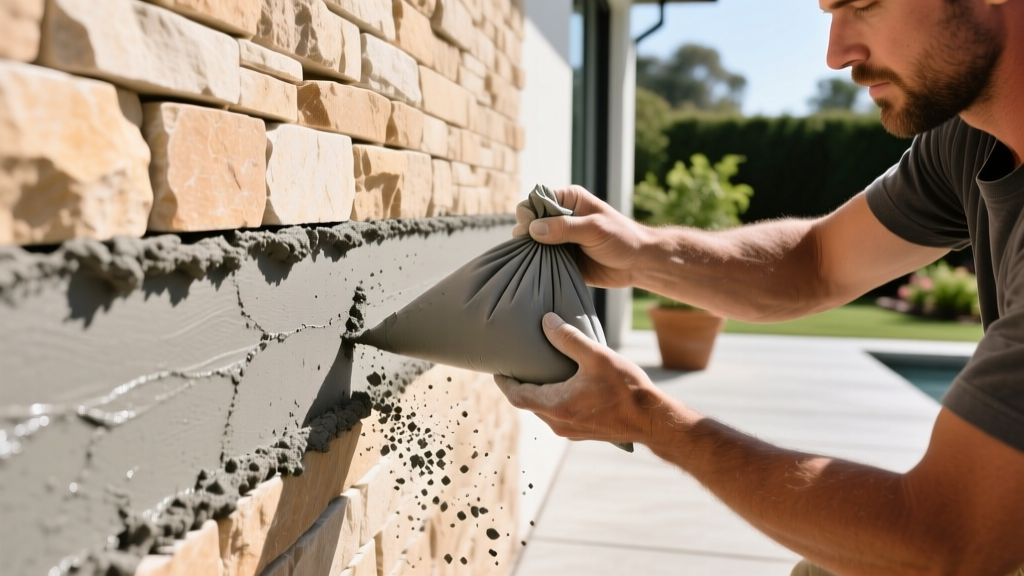
For 90% of exterior stone veneer applications, Type N mortar is the mandated standard. It offers a balanced 750 PSI compressive strength, providing enough structural integrity to support the stone while remaining flexible enough to absorb thermal expansion and substrate deflection without cracking the stone faces.
Exact Proportion Specifications
According to ASTM C270 standards, a proper Type N mix requires precise volumetric ratios:
- Portland Cement: 1 part
- Hydrated Lime (Type S): 1/2 to 1-1/4 parts
- Masonry Sand: 2-1/4 to 3 parts (measured in a damp, loose condition)
Never omit the hydrated lime in a site-mixed Type N mortar. Lime provides crucial workability and water retention, allowing the mortar to cure slowly and properly. More importantly, lime enables 'autogenous healing'—a chemical process where free lime dissolves in moisture and recrystallizes to seal microscopic shrinkage cracks over time.
Leading manufacturers like Eldorado Stone explicitly require a Type N or Type S mortar for their exterior MSV profiles, but Type N is heavily preferred for wood-framed residential construction due to its superior flexibility.
Sanded Cementitious Grout: Interior & Tight Joints
When installing manufactured stone veneer with tight joints (typically 1/8' to 1/2'), or when working on interior feature walls where a clean, uniform joint is desired, polymer-modified sanded grout is the correct choice. Products like Custom Building Products Polyblend or Mapei Keracolor S are formulated with fine sand and acrylic polymers.
Application Limits and Shrinkage Risks
Sanded grout relies on a specific sand-to-cement ratio to prevent shrinkage. If you attempt to use sanded grout in a joint wider than 1/2' (or 5/8' for specific high-performance brands), the water content required to hydrate the cement will cause massive volumetric shrinkage as it evaporates, resulting in deep center-line cracking.
Standard cementitious sanded grouts are highly porous. If used on exterior veneer in climates with freeze-thaw cycles, water will penetrate the grout line, freeze, expand, and pop the grout out of the joint. For exterior applications, always default to Type N mortar or a specialized exterior-grade urethane.
Specialty Options: Type S Mortar and Urethane
Why Type S is Usually the Wrong Choice for Veneer
Type S mortar boasts a high compressive strength of 1,800 PSI. While this sounds superior, it is actually detrimental to standard veneer applications. The high Portland cement content makes Type S incredibly rigid. When a wood-framed wall deflects under wind loads or settles, the rigid Type S mortar will not flex; instead, it will transfer the stress directly into the stone, causing the stone itself to fracture or spall. Type S should be strictly reserved for structural masonry, below-grade retaining walls, or stone applied directly to rigid concrete foundations.
Urethane Grout for High-Moisture Interiors
For interior stone veneer installed in high-humidity environments (such as bathroom accent walls or indoor pool enclosures), urethane grout (e.g., Star Quartz StarGrout) is the premium 2026 standard. Urethane grouts are pre-mixed, contain zero Portland cement, and are entirely impervious to water. They will not effloresce, stain, or harbor mold. However, they are limited to joints under 1/2' and cost significantly more than cementitious alternatives.
Application Techniques and Failure Prevention
The 'Thumbprint' Consistency Test
The most common cause of mortar joint failure is improper water content. Mortar that is too wet will shrink and crack; mortar that is too dry will fail to bond to the stone edges. Master masons use the 'Thumbprint Test':
- Grab a handful of mixed mortar and squeeze it into a firm ball.
- Press your thumb firmly into the center of the ball.
- Pass: The ball holds its shape, and your thumb leaves a clean, distinct impression without excess water oozing out or the edges crumbling.
- Fail (Too Wet): Water squeezes out between your fingers, and the mortar slumps.
- Fail (Too Dry): The ball crumbles apart before you can press your thumb into it.
Combating Efflorescence
Efflorescence is the white, powdery salt deposit that plagues stone veneer joints. According to the Portland Cement Association, efflorescence requires three conditions: soluble salts, moisture, and a migration path. To prevent this in stone veneer grout:
- Use low-alkali Portland cement and thoroughly washed, salt-free masonry sand.
- Never add calcium chloride accelerators to the mortar mix in cold weather; these introduce massive amounts of soluble salts.
- Ensure proper flashing and weep holes are installed behind the weather-resistive barrier (WRB) so moisture does not migrate through the mortar joints from behind.
- Avoid acid-washing the stone after grouting, as acid reacts with the Portland cement to create highly visible, permanent calcium chloride stains.
Material Cost Breakdown (Per 50 Sq. Ft. Coverage)
Understanding the material costs is vital for accurate project estimating. The coverage rates below assume a standard manufactured stone veneer profile with an average 1/2' joint width and 1/2' joint depth. Natural stone with wider, irregular joints will require up to 40% more material.
| Material | Typical Unit Size | Avg. Unit Cost (2026) | Estimated Cost per 50 Sq. Ft. |
|---|---|---|---|
| Type N Mortar Mix (Pre-blended) | 80 lb bag | $12.00 - $16.00 | $18.00 - $24.00 |
| Sanded Cementitious Grout | 25 lb bag | $28.00 - $35.00 | $45.00 - $60.00 |
| Urethane Grout (Pre-mixed) | 1 Gallon Bucket | $85.00 - $105.00 | $120.00 - $150.00 |
| Acrylic Mortar Admixture | 1 Gallon Jug | $18.00 - $25.00 | $10.00 (Partial Jug) |
While Type N mortar remains the most cost-effective and structurally appropriate choice for exterior applications, interior designers and contractors working with tight-joint manufactured stone must budget for the premium pricing of polymer-modified sanded grouts or urethanes to ensure a flawless, crack-free finish.
Written by
Sarah WhitfieldSarah Whitfield is a chartered quantity surveyor (MRICS) and construction cost analyst with 15 years of experience in material pricing, procurement strategy, and project budgeting. She earned her degree in Construction Management from the University of Reading (UK) and has worked on projects ranging from $2M custom homes to $180M mixed-use developments across North America and Europe. Sarah currently leads cost estimating for BuildMat Insight, maintaining a proprietary database of 4,000+ material price points updated quarterly. She is a frequent contributor to RSMeans cost data panels and has presented at the International Cost Engineering Council (ICEC) congress. Based in Denver, CO, Sarah is an avid trail runner and volunteer mentor for Women in Construction.
More from Sarah Whitfield
View all
Wood & Lumber
What Are the Different Types of Wood? A Builder's Guide
Compare structural softwoods, finish hardwoods, and engineered lumber. Analyze Janka ratings, MOE values, and 2026 pricing for construction.
Aug 4, 2026

Walls & Panels
Steel Framing vs Wood Framing: Corrosion and Moisture Defense
Compare steel framing vs wood framing for moisture resistance. Learn about galvanized coatings, condensation risks, and corrosion protection strategies.
Jul 21, 2026

Stone & Masonry
How to Cut Stone Veneer: Wet Saw vs Grinder Comparison
Compare the best tools for cutting stone veneer. We review wet saws, angle grinders, and chop saws to help you achieve clean, chip-free cuts.
Jul 21, 2026