Labor Cost to Install Stone Veneer: 2026 Pricing Guide
Discover the true labor cost to install stone veneer in 2026. Break down mason rates, prep work, and hidden fees to budget your exterior or interior project.

The Real Breakdown: Labor Cost to Install Stone Veneer
When budgeting for a masonry facade, material costs are only half the equation. The labor cost to install stone veneer fluctuates based on substrate preparation, profile complexity, and regional mason availability. In 2026, skilled masonry labor commands a premium due to a persistent shortage of specialized tradespeople and updated building code requirements for moisture management. Unlike hanging siding, stone veneer installation is a multi-day, wet-trade process that requires precise sequencing.
This buyer's guide dissects the exact labor rates, mandatory prep phases, and hidden variables that dictate your final invoice, ensuring you can evaluate contractor bids with precision and avoid catastrophic moisture failures.
Quick Cost Snapshot: 2026 National Averages
- Standard Mortared Veneer Labor: $8.00 – $15.00 per square foot
- Mortarless/Interlocking Panel Labor: $4.00 – $8.50 per square foot
- Substrate Prep (Lath & Scratch Coat): $2.50 – $4.50 per square foot
- Hourly Mason Rate: $75 – $125 per hour (plus helper at $45 – $65 per hour)
Hourly vs. Square Foot: How Masons Quote Veneer Projects
Most reputable masonry contractors will quote the labor cost to install stone veneer on a per-square-foot basis for the main wall planes, while billing linear feet for corners and hourly for unforeseen complications. Understanding this hybrid pricing model is critical for comparing bids.
A square-foot quote typically assumes a flat, unobstructed wall plane with standard 8-foot ceilings or eaves. Once a mason encounters complex architectural features, the pricing model shifts. For instance, cutting and fitting stone around HVAC penetrations, electrical outlets, or window casings is highly time-consuming. Many contractors exclude this 'detail work' from their base square-foot rate, billing it as 'time and materials' (T&M) at their hourly rate.
The 2026 Installation Pricing Matrix
| Veneer Type | Labor Cost (Sq Ft) | Installation Speed | Skill Level Required |
|---|---|---|---|
| Natural Stone (Irregular) | $12.00 – $18.00 | Slow (15-25 sq ft/day) | Master Mason |
| Manufactured Stone (MSV) | $8.00 – $14.00 | Moderate (30-50 sq ft/day) | Journeyman Mason |
| Mortarless Interlocking Panels | $4.00 – $8.50 | Fast (80-120 sq ft/day) | Carpenter / DIY |
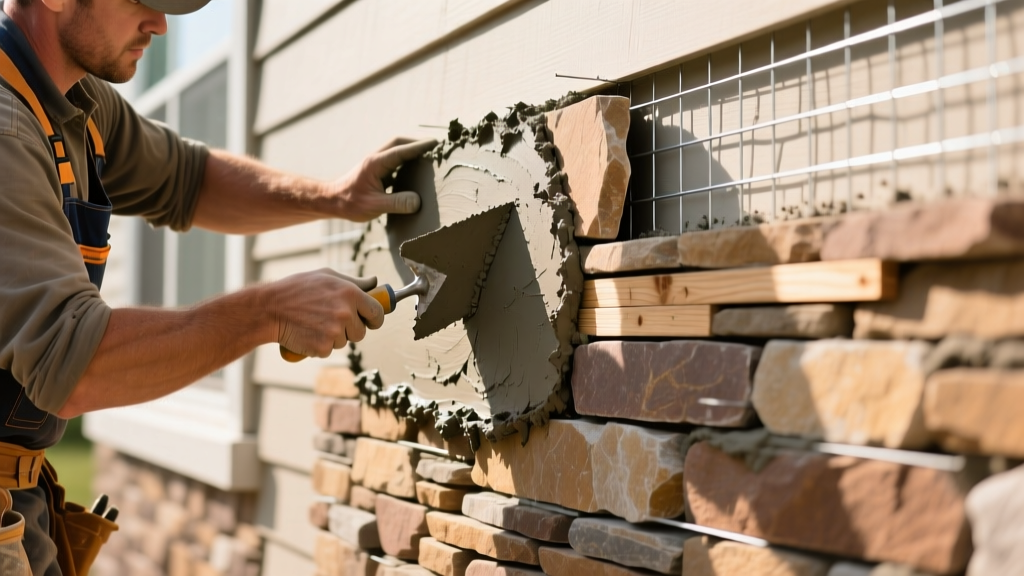
Mandatory Prep Work: Where 30% of Your Labor Budget Goes
The most common reason bids vary wildly is how contractors handle substrate preparation. Properly installing mortared stone veneer over wood or metal framing is not a one-step process. According to guidelines published by the Mason Contractors Association of America (MCAA), a compliant exterior installation requires a specific sequence of moisture management and adhesion layers.
- Weather-Resistant Barrier (WRB): If the existing sheathing lacks a code-compliant WRB (like Tyvek or a fluid-applied membrane), the crew must install one. Proper integration with window flashing is critical to prevent rot, a concept heavily emphasized by the Building Science Corporation.
- Weep Screed Installation: A corrosion-resistant weep screed must be nailed at the base of the wall. Building codes mandate a minimum clearance of 4 inches above soil grade or 2 inches above hardscape to prevent capillary water uptake and termite entry.
- Metal Lath Application: Workers must staple 2.5 lb self-furring galvanized metal lath over the WRB. The lath must be installed with the 'dimples' facing inward to create a physical gap for the mortar to lock into. Overlaps must be 1 inch on horizontal seams and 2 inches on vertical seams.
- The Scratch Coat: A 1/2-inch layer of Type S mortar is troweled over the lath and horizontally 'scratched' with a rake to create a mechanical key. Crucially, this scratch coat must cure for a minimum of 48 hours before any stone can be laid.
Because the scratch coat requires 48 hours to cure, your masonry crew must visit the site on Day 1 for prep, leave for Day 2, and return on Day 3 to begin laying stone. This double-mobilization is baked into your labor cost to install stone veneer. If a contractor promises to prep the wall and lay the stone on the exact same day, they are violating building codes and compromising the structural adhesion of the veneer.
Variables That Spike Your Installation Quote
Base square-foot rates assume ideal working conditions. The following variables will introduce line-item additions to your labor invoice:
1. Corner Pieces and Mitering
Manufactured and natural stone veneers utilize specialized 'corner pieces' that wrap around 90-degree exterior angles to hide the raw edge of the stone. While flat stone is billed per square foot, corners are billed per linear foot. Furthermore, aligning the horizontal mortar joints seamlessly around a corner requires meticulous cutting and dry-fitting. Expect corner installation labor to cost 2 to 3 times more per linear foot than flat wall installation per square foot.
2. Scaffolding and Multi-Story Access
Stone veneer is incredibly heavy. A mason cannot balance on a standard aluminum extension ladder while holding a 15-pound stone and a trowel full of mortar. For any wall exceeding 8 feet in height, OSHA-compliant scaffolding is mandatory. Erecting, renting, and dismantling pump-jack or frame scaffolding typically adds $1,000 to $3,000 to the overall labor and equipment bill, depending on the linear footage of the home.
3. Demolition and Disposal of Existing Cladding
If you are retrofitting an older home, the existing vinyl siding, wood lap, or stucco must be stripped down to the bare sheathing before the WRB and lath can be applied. Tear-down labor generally runs $1.50 to $3.00 per square foot, plus dumpster and tipping fees for the debris.
Mortared vs. Mortarless (Interlocking) Veneer Labor
For buyers strictly trying to minimize the labor cost to install stone veneer, the rise of mortarless, interlocking stone panels (such as Versetta Stone or Evolve Stone) has disrupted the traditional masonry market.
"Mortarless systems eliminate the need for metal lath, scratch coats, and mortar mixing. They are screwed directly into the structural sheathing or furring strips, allowing a skilled carpenter—or even an advanced DIYer—to install the facade at a fraction of the time."
The Trade-Off: While you save 40% to 60% on labor costs by bypassing the mason, the material cost for interlocking panels is significantly higher than standard manufactured stone veneer (MSV) bags. Additionally, mortarless panels have a more repetitive, modular appearance upon close inspection compared to the organic, randomized look of a master-laid mortared wall.
Vetting Your Mason: 3 Questions to Ask Before Signing
To ensure you are paying for skilled labor rather than cut-corner handyman work, ask these three technical questions during the bidding phase:
- "What type of mortar mix do you use for the setting bed?"
Correct Answer: Type S mortar. Type S provides a minimum compressive strength of 1,800 PSI and superior bond strength required for vertical, non-structural veneer applications. Type N (750 PSI) is too weak for most exterior veneer work. - "How do you handle flashing integration at the weep screed and rooflines?"
Correct Answer: The WRB must lap over the weep screed flange, and kick-out flashing must be installed where a roofline meets a stucco/veneer wall to divert water into the gutters, not behind the veneer. - "Do you back-butter the stones?"
Correct Answer: Yes. The mason should apply a thin layer of mortar to the back of each individual stone (back-buttering) before pressing it into the setting bed on the wall. This ensures 100% coverage and prevents hollow spots where water can pool and freeze.
Frequently Asked Questions
Does interior stone veneer installation cost less than exterior?
Yes. Interior installations (like a fireplace surround or accent wall) typically cost 20% to 30% less in labor. This is because interior jobs do not require a weather-resistant barrier, weep screeds, or extensive scaffolding. Furthermore, interior climate control eliminates weather delays and mortar freezing risks.
Can I install stone veneer directly over existing brick or concrete block?
Yes, which drastically reduces the labor cost to install stone veneer. If the existing masonry is structurally sound, unpainted, and clean, the mason can skip the WRB, lath, and scratch coat entirely. They will simply wet the existing brick and adhere the new veneer directly using a polymer-modified mortar or specialized masonry adhesive.
How long does it take to install 500 square feet of stone veneer?
For a two-person crew (one journeyman mason and one tender/helper), expect the prep work (lath and scratch coat) to take 1 to 2 days. After the 48-hour curing period, the actual stone laying will take 3 to 5 days, depending on the stone profile. Irregular, dry-stack natural stone takes significantly longer to fit than uniform manufactured ledger panels.
Written by
Marcus ChenMarcus Chen is a licensed structural engineer (PE) and building materials analyst with over 12 years of experience across residential, commercial, and industrial construction. He holds a Master of Science in Civil Engineering from UC Berkeley and spent six years at Thornton Tomasetti before transitioning to independent consulting and technical writing. Marcus specializes in material selection for seismic-prone regions, concrete reinforcement strategies, and lifecycle cost analysis. His work has been cited by the American Concrete Institute (ACI) and the Structural Engineers Association of California (SEAOC). When he is not on a job site or at his desk, you will find him hiking the Sierra Nevada or restoring a 1920s craftsman bungalow in Oakland, CA.
More from Marcus Chen
View all
Construction Cost
How Much Did the Eiffel Tower Cost to Build?
How much did the Eiffel Tower cost to build in 1889? We adjust for inflation and compare its budget to modern skyscraper construction.
Aug 4, 2026

Fire Resistance
What Is a Fire Resistant Material? Testing & Certification Guide
Discover what is a fire resistant material through ASTM and UL testing. Learn how fire ratings, certifications, and assemblies work in construction.
Aug 4, 2026

Construction Cost
How Much Did the Burj Khalifa Cost to Build?
How much did the Burj Khalifa cost to build? We break down the $1.5B project and extract 5 money-saving strategies for your next build.
Jul 30, 2026