Marble Table Side Profiles & Top Brand Collections Reviewed
Explore top brand marble side table collections and compare marble table side edge profiles, structural supports, and sealing techniques for lasting luxury.
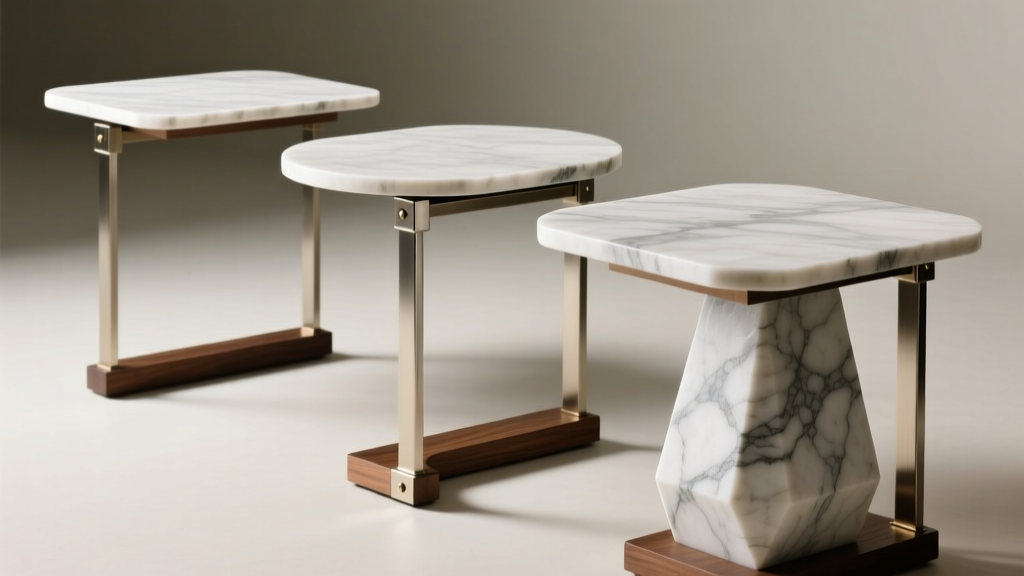
The Anatomy of a Marble Table Side: Edge Profiles & Structural Integrity
When designers and architects specify stone furniture, the focal point is often the tabletop's veining and finish. However, the true mark of craftsmanship—and the primary determinant of long-term durability—lies in the marble table side profile and its underlying structural engineering. The side edge of a marble table dictates how the stone interacts with light, how it withstands impact, and how it transfers load to the base.
In 2026, the shift toward monolithic, sculptural stone furniture has pushed fabricators to develop advanced edge treatments. A poorly executed side profile will chip, delaminate, or snap under lateral stress. Understanding the intersection of brand-specific design languages and stone fabrication limits is critical for making informed procurement decisions.
Most luxury brands utilize 3cm (1.18-inch) solid marble slabs for side tables to allow for robust edge profiling. Budget lines often use 2cm (0.75-inch) slabs laminated to a plywood or MDF sub-top. While 2cm reduces weight and cost, it severely limits the marble table side edge options, restricting designs to simple eased or beveled edges and eliminating the possibility of structural mitered waterfalls.
Brand Deep-Dive: Top Marble Side Table Collections
Different brands approach the marble table side from varying perspectives of luxury, mass production, and material authenticity. Below is an analysis of three distinct market tiers.
Minotti (Ultra-Luxury / Bespoke Fabrication)
Italian luxury house Minotti treats marble as an architectural element. In their Cesar and Dylan side table collections, the marble table side profile is typically a 45-degree mitered waterfall edge. Fabricators cut the slab at precise angles, bond the seams with color-matched epoxy resin, and clamp the joints for 24 hours to create the illusion of a continuous, seamless block of stone. Minotti exclusively uses premium book-matched slabs (such as Calacatta Gold or Emperador Dark), ensuring the veining flows uninterrupted from the top surface down the side apron.
- Typical Edge Profile: 45° Mitered Waterfall or heavy 10mm chamfer.
- Structural Support: Hidden internal steel armatures prevent the mitered side joints from bearing the full cantilevered weight.
- Price Range: $6,500 – $12,000+ per side table.
Restoration Hardware (Transitional / Heavyweight Solid)
Restoration Hardware (RH) leans into the raw, tactile nature of stone. Their marble side tables, such as the Salvago and Belgian lines, favor honed finishes over high-gloss polishes. The marble table side edge in these collections is usually a pronounced 1/2-inch bevel or a soft bullnose. This design choice is highly practical: honed marble masks etching from acidic spills, and rounded side edges resist chipping in high-traffic residential environments. RH typically utilizes 3cm solid Carrara or Nero Marquina marble mounted on heavy cast-brass or solid oak pedestals.
- Typical Edge Profile: 1/2-inch Bevel, Bullnose, or Ogee.
- Structural Support: Massive central pedestals eliminate side overhang stress entirely.
- Price Range: $1,495 – $3,500.
CB2 & West Elm (Accessible / Veneer & Solid Mixes)
Accessible modern brands like CB2 and West Elm offer the aesthetic of marble at a fraction of the cost. Their side tables often feature 2cm polished Carrara marble. To maintain structural integrity without the cost of thick slabs, the marble table side profile is kept minimal—usually a simple eased edge or a slight 1/8-inch bevel. The stone is bonded to a composite sub-top, which provides the actual lateral rigidity. While visually appealing from a distance, the side edge lacks the deep, refractive light-play of a solid 3cm profile.
- Typical Edge Profile: Eased (slightly rounded) or 1/8-inch Bevel.
- Structural Support: Plywood/MDF sub-top with localized corner bracing.
- Price Range: $399 – $899.
Edge Profile Comparison Matrix
Selecting the right side edge profile requires balancing aesthetics with household reality. Sharp edges look modern but are prone to micro-chipping; rounded edges are durable but visually heavier.
| Edge Profile | Visual Impact | Chip Resistance | Fabrication Cost Multiplier |
|---|---|---|---|
| Eased / Pencil Round | Minimalist, clean | High | Base Cost (1.0x) |
| 1/2" Bevel | Catches light, traditional | Medium-High | 1.2x |
| Bullnose (Half/Full) | Soft, organic, heavy | Very High | 1.5x |
| 45° Mitered Waterfall | Sculptural, seamless | Low (corners are fragile) | 2.5x - 3.0x |
| Ogee / Dupont | Ornate, classic luxury | Low (thin ridges snap) | 2.0x |
Structural Engineering: Managing Side Overhangs
The most common point of catastrophic failure in stone furniture is the unsupported lateral span. Marble possesses high compressive strength but relatively low flexural (bending) strength, typically ranging between 1,000 and 1,500 psi depending on the variety and veining density. Unsupported side overhangs are the primary failure point.
According to guidelines published by the Natural Stone Institute, natural stone requires rigid, continuous support. For a 2cm marble top, the side overhang should never exceed 6 inches without a hidden steel T-bar or aluminum honeycomb subframe. Exceeding this limit risks the stone snapping along a natural calcite fissure when lateral pressure is applied to the table edge.
When reviewing a brand's specifications, always check the subframe material. High-end manufacturers use powder-coated steel or marine-grade plywood sub-tops that extend to within 2 inches of the marble table side edge. If a brand uses MDF or particleboard as a sub-top, moisture from floor mopping or ambient humidity will eventually cause the wood to swell, pushing up against the stone and causing the marble to crack from the underside.
Sealing and Maintaining the Side Edge
The top surface of a marble table is usually polished to a high grit (3,000+), which naturally closes the stone's microscopic pores. However, the marble table side edge—especially if it features a honed, fluted, or leathered finish—remains highly porous. This makes the side profile significantly more susceptible to staining from accidental liquid contact (e.g., a wet glass resting against the side apron).
The Impregnation Protocol
- Solvent-Based Penetrating Sealers: For side edges, use a solvent-based impregnating sealer (such as Tenax Ager or Miracle Sealants 511). Water-based sealers often fail to penetrate the dense crystalline structure of polished marble edges effectively.
- Application Technique: Apply the sealer to the side profile using a microfiber cloth, allowing it to dwell for 10-15 minutes. Wipe away all excess. Leaving puddles of sealer on the side edge will result in a permanent, cloudy hazing effect.
- Frequency: While the top surface may only require sealing every 12-18 months, unpolished side edges in hospitality or high-use residential settings should be re-sealed every 6 months.
For routine maintenance, avoid acidic or abrasive cleaners. As noted in Architectural Digest's stone care guidelines, pH-neutral cleaners specifically formulated for calcium carbonate stones are mandatory to prevent etching, which appears as dull, matte spots on the polished side bevels.
Buyer's Decision Framework
Use this matrix to align your marble table side specifications with your environmental requirements:
High-Traffic / Households with Children
- Edge Profile: Bullnose or heavy 1/2" Bevel.
- Finish: Honed (hides etching and scratches).
- Brands to Target: Restoration Hardware, Arhaus.
- Avoid: Mitered waterfall edges (sharp corners chip easily upon impact).
Formal / Low-Traffic Luxury Spaces
- Edge Profile: 45° Mitered Waterfall or Ogee.
- Finish: High-gloss Polish (maximizes light refraction).
- Brands to Target: Minotti, Poliform, B&B Italia.
- Avoid: Eased edges on 2cm slabs (lacks the visual weight required for formal design).
Ultimately, the marble table side is where design intent meets physical reality. By scrutinizing edge profiles, verifying subframe engineering, and implementing targeted sealing protocols, you ensure that your stone furniture remains a structural and aesthetic triumph for decades.