Stoneyard Stone Veneer Cost Analysis & Pricing Guide 2026
Analyze 2026 Stoneyard stone veneer costs. Get exact pricing for materials, corners, freight, and masonry labor to budget your natural stone project.

The True Cost of Stoneyard Natural Stone Veneer in 2026
When budgeting for premium natural stone cladding, Stoneyard stone veneer represents a high-end tier of the market. Unlike manufactured concrete alternatives, Stoneyard sources and cuts authentic quarried stone into thin profiles (typically 1 to 1.5 inches thick). For 2026, the total installed cost for Stoneyard natural stone veneer ranges from $24.50 to $43.00 per square foot. This figure encompasses the thin-cut stone, corner pieces, LTL freight shipping, substrate preparation, and professional masonry labor.
Quick Cost Summary (Per Square Foot)
- Material (Flat Veneer): $9.50 - $16.00
- Material (Corner Pieces): $14.00 - $24.00 (Linear Foot)
- Freight & Logistics: $1.50 - $3.50
- Substrate Prep (Lath/Scratch): $3.50 - $6.00
- Masonry Labor (Setting): $12.00 - $22.00
- Total Installed Average: $31.50 / sq. ft.
Material Pricing by Stoneyard Style & Cut
Stoneyard offers several distinct architectural profiles, each with varying quarrying and cutting complexities that directly impact the price per square foot. The Mosaic and Antique styles require more intensive hand-sorting and shaping, pushing them to the top of the pricing bracket.
| Stoneyard Style | Profile Description | Material Cost (Sq. Ft.) | Coverage per Pallet |
|---|---|---|---|
| Colonial | Rounded, smooth, traditional fieldstone | $10.50 - $13.50 | ~250 sq. ft. |
| Mosaic | Tight-fitting, irregular, puzzle-like pieces | $12.50 - $16.00 | ~200 sq. ft. |
| Antique | Weathered, chiseled edges, historic look | $13.00 - $16.50 | ~200 sq. ft. |
| Ledgestone | Linear, horizontal stacking, modern | $9.50 - $12.50 | ~300 sq. ft. |
| Round | Smooth, oval river-rock profile | $11.00 - $14.00 | ~250 sq. ft. |
Data sourced from current distributor networks and Stoneyard's official natural stone veneer specifications. Prices fluctuate based on regional quarry output and fuel surcharges.
Corner Pieces vs. Flat Veneer: The Hidden Multiplier
The most common budgeting error in stone veneer projects is miscalculating corner requirements. Stoneyard corners are sold by the linear foot (LF), not the square foot. A standard exterior corner piece costs between $14.00 and $24.00 per LF. While one LF of corner covers approximately 0.75 to 1.0 square feet of wall space, its cost is nearly double that of flat veneer. For a project with multiple window returns, exterior building corners, and chimney chases, corner pieces can account for up to 25% of your total material invoice.
Freight and Delivery: The Overlooked Expense
Natural stone is exceptionally dense. Stoneyard veneer weighs approximately 11 to 14 pounds per square foot. A standard pallet covering 250 square feet weighs upwards of 3,000 pounds. Consequently, orders are shipped via Less-Than-Truckload (LTL) freight, introducing logistical fees that do not apply to lightweight manufactured stone or siding.
- Base Freight Rate: $1.50 to $3.50 per sq. ft. (highly dependent on distance from New England quarries).
- Liftgate Service: $85 to $150. Mandatory if the delivery site lacks a commercial loading dock.
- Residential Delivery Fee: $110 to $225. Carriers charge a premium for navigating 53-foot freight trailers into residential driveways.
- Jobsite Staging: Standard delivery is 'curbside only'. Moving 6,000 lbs of stone from the curb to the backyard requires manual labor or a rented skid steer ($250/day).
Installation Labor Rates & Substrate Preparation
According to HomeGuide's stone veneer cost report, professional masonry labor rates vary significantly by region, but natural stone demands a premium over cultured stone due to the required substrate reinforcement and mortar expertise.
Substrate Preparation ($3.50 - $6.00 / sq. ft.)
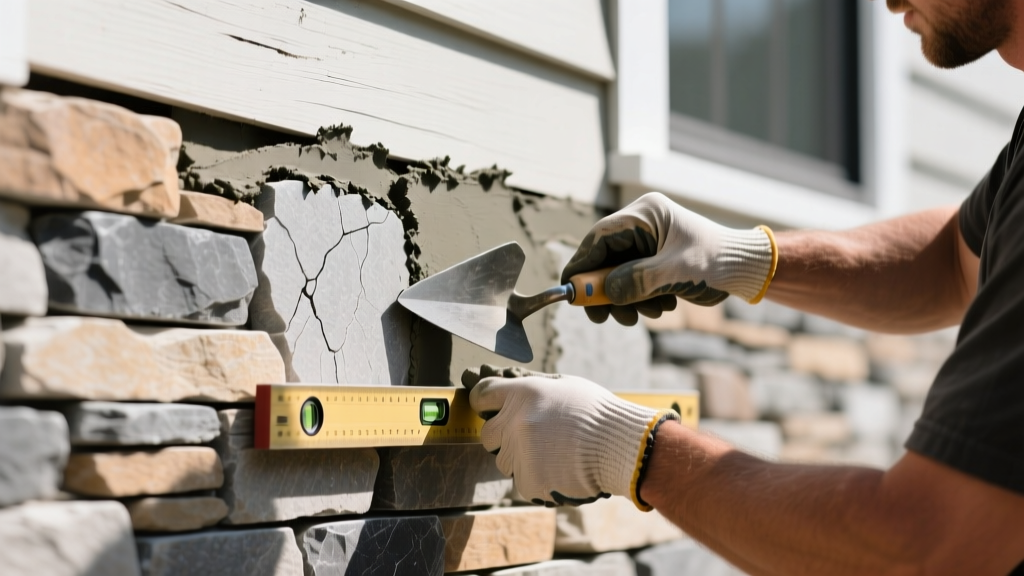
Because natural stone veneer is heavy, it cannot be adhered directly to drywall or painted surfaces. The wall must be prepped with a weather-resistive barrier (WRB), followed by 2.5 lb self-furring galvanized metal lath, and a 1/2-inch Portland cement scratch coat. Skipping the scratch coat is a primary cause of veneer delamination in freeze-thaw climates.
Mortar Selection: Type S vs. Type N
Masons must select the correct mortar for the specific application. Type S mortar (high compressive strength) is mandatory for exterior applications and below-grade foundations to resist water penetration and structural shifting. Type N mortar (medium strength) is preferred for interior accent walls and fireplaces, as it is easier to tool and less likely to crack on non-load-bearing interior partitions.
Waste Factor & Overage Calculations
When ordering Stoneyard stone veneer, you must account for cutting waste. The waste factor is dictated by the geometry of the chosen profile:
- Ledgestone (Linear): 5% to 8% waste. The rectangular shapes are easy to cut and fit with minimal offcuts.
- Colonial & Round (Smooth): 10% to 12% waste. Requires cutting to fit around outlets, windows, and rooflines.
- Mosaic & Antique (Irregular): 15% to 20% waste. The puzzle-like nature of these styles generates significant unusable offcuts when fitting into tight corners or around electrical boxes.
Stoneyard Veneer vs. Manufactured Stone: ROI Matrix
Is the premium for authentic Stoneyard natural stone justified over concrete-based manufactured stone (like Cultured Stone)? The following matrix breaks down the long-term value proposition based on industry standards outlined by The Masonry Society.
| Feature | Stoneyard Natural Stone | Manufactured Concrete Stone |
|---|---|---|
| Upfront Material Cost | $9.50 - $16.50 / sq. ft. | $6.00 - $10.00 / sq. ft. |
| UV & Color Stability | 100% UV Stable (Natural pigments) | Fades over 10-15 years (Iron oxide dyes) |
| Impact Resistance | Solid stone throughout (chips reveal same color) | Thin color coat (chips reveal gray concrete) |
| Weight (Structural Load) | 11 - 14 lbs / sq. ft. | 8 - 11 lbs / sq. ft. |
| Resale Value (ROI) | High (Appraisers note natural materials) | Moderate |
Expert Tips for Minimizing Your Final Invoice
- Consolidate Freight Shipments: LTL freight rates drop significantly per pound once you cross the 4,000 lb threshold. If you are doing both the exterior facade and an interior fireplace, order all Stoneyard stone in a single shipment to amortize the liftgate and residential delivery fees across a larger material base.
- Use Blended Mortar Colors: Instead of paying a mason to custom-tint mortar on-site (which adds $1.50+ per sq. ft. in labor), purchase pre-blended Type S mortar in a color that matches the stone's grout lines. This speeds up the installation and ensures consistent joint coloring.
- Dry-Lay Before Mortaring: For Mosaic and Antique styles, mandate that your masonry crew 'dry-lay' a 10-square-foot section on the ground before applying mortar. This allows them to map out the puzzle pieces, drastically reducing cutting time and material waste on the wall.
- Apply a Penetrating Sealer (Exterior Only): While natural stone does not require sealing for structural integrity, applying a silane/siloxane penetrating sealer ($0.45 per sq. ft.) prevents efflorescence (white salt deposits) and makes future power-washing safe without damaging the mortar joints.
Written by
Sarah WhitfieldSarah Whitfield is a chartered quantity surveyor (MRICS) and construction cost analyst with 15 years of experience in material pricing, procurement strategy, and project budgeting. She earned her degree in Construction Management from the University of Reading (UK) and has worked on projects ranging from $2M custom homes to $180M mixed-use developments across North America and Europe. Sarah currently leads cost estimating for BuildMat Insight, maintaining a proprietary database of 4,000+ material price points updated quarterly. She is a frequent contributor to RSMeans cost data panels and has presented at the International Cost Engineering Council (ICEC) congress. Based in Denver, CO, Sarah is an avid trail runner and volunteer mentor for Women in Construction.
More from Sarah Whitfield
View all
Wood & Lumber
What Are the Different Types of Wood? A Builder's Guide
Compare structural softwoods, finish hardwoods, and engineered lumber. Analyze Janka ratings, MOE values, and 2026 pricing for construction.
Aug 4, 2026

Walls & Panels
Steel Framing vs Wood Framing: Corrosion and Moisture Defense
Compare steel framing vs wood framing for moisture resistance. Learn about galvanized coatings, condensation risks, and corrosion protection strategies.
Jul 21, 2026

Stone & Masonry
How to Cut Stone Veneer: Wet Saw vs Grinder Comparison
Compare the best tools for cutting stone veneer. We review wet saws, angle grinders, and chop saws to help you achieve clean, chip-free cuts.
Jul 21, 2026