Natural Stone Veneer Limestone: The Complete Material Guide
Master natural stone veneer limestone selection, installation, and costs. Explore ASTM grades, mortar types, and failure mitigation for modern projects.
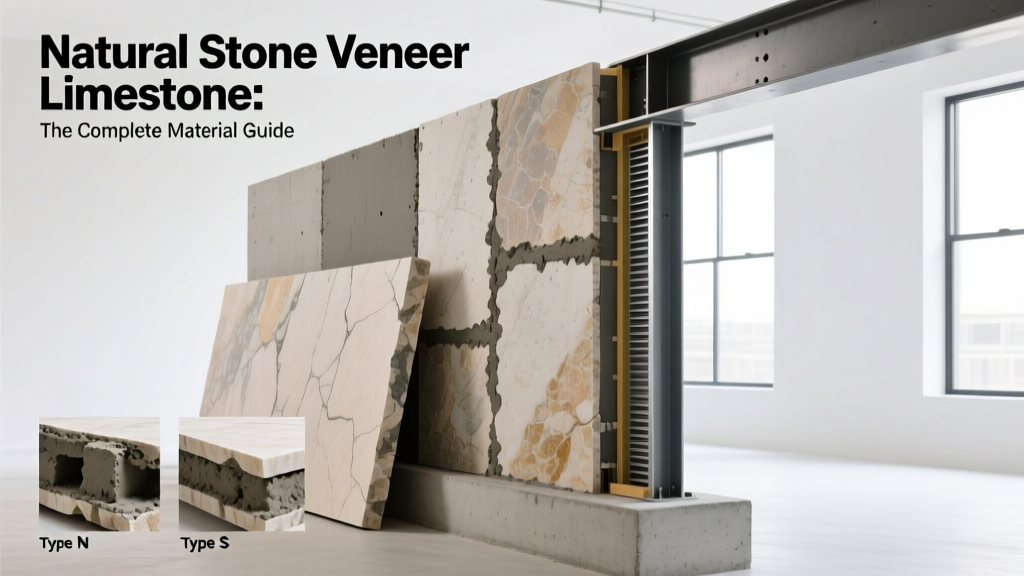
Geological Composition and Veneer Performance
Limestone is a sedimentary rock composed primarily of calcium carbonate (CaCO3), formed over millennia through the accumulation of organic marine debris and chemical precipitation. When milled into stone veneer limestone, it provides the thermal mass, acoustic dampening, and aesthetic gravitas of full-bed masonry while reducing structural dead loads by up to 75%. Unlike manufactured concrete veneers, natural limestone offers distinct geological variations that directly dictate its weathering characteristics, compressive strength, and appropriate installation methodologies.
The porosity of limestone is its defining vulnerability. Because it is highly susceptible to water ingress and subsequent freeze-thaw damage, specifying the correct geological classification and pairing it with a breathable mortar matrix is non-negotiable for long-term facade performance.
ASTM C568 Classifications: Selecting the Right Profile
Not all limestone veneer performs equally in exterior environments. The ASTM C568 Standard Specification for Limestone Dimension Stone categorizes the material into three distinct density classes. Specifying the correct class based on your regional climate is the first critical decision in the procurement process.
| ASTM Class | Common Name | Density & Absorption | Compressive Strength | Best Application |
|---|---|---|---|---|
| Class I | Low Density (Oolitic) | High absorption (>12%) | 1,200 - 4,000 psi | Interior feature walls, covered porticos, mild climates |
| Class II | Medium Density | Moderate (3% - 12%) | 4,000 - 8,000 psi | Exterior veneer in moderate freeze-thaw zones |
| Class III | High Density (Dolomitic) | Low absorption (<3%) | 8,000 - 18,000+ psi | Exterior cladding in severe freeze-thaw and coastal environments |
Expert Note: For exterior applications in northern climates, mandate Class III dolomitic limestone. The presence of magnesium carbonate increases the stone's density and drastically reduces capillary water absorption, mitigating spalling during winter cycles.
Dimensional Specifications and Structural Load
Stone veneer limestone is milled into two primary profiles, each requiring different structural support and anchoring systems:
Thin Veneer (Adhered)
- Thickness: 0.75 to 1.5 inches
- Weight: 10 to 15 lbs per square foot
- Structural Requirement: Can be adhered directly to properly prepared wood or steel stud framing using metal lath and mortar. Does not require a masonry ledge or foundation shelf.
Full-Bed Veneer (Anchored)
- Thickness: 3 to 4 inches
- Weight: 35 to 45 lbs per square foot
- Structural Requirement: Requires a continuous concrete or masonry shelf angle at the foundation. Must be mechanically anchored to the backup wall using stainless steel corrugated ties spaced at a maximum of 16 inches on center.
Real-World Cost Breakdown
Pricing for limestone veneer fluctuates based on quarry origin, milling precision, and profile complexity. The following data reflects current market averages for material and specialized masonry labor.
| Cost Component | Thin Veneer (Adhered) | Full-Bed (Anchored) |
|---|---|---|
| Material (Class II/III) | $11.00 - $18.50 / sq ft | $16.00 - $28.00 / sq ft |
| Mortar, Lath & Accessories | $2.50 - $4.00 / sq ft | $4.50 - $7.00 / sq ft |
| Masonry Labor | $14.00 - $22.00 / sq ft | $28.00 - $45.00 / sq ft |
| Total Installed Cost | $27.50 - $44.50 / sq ft | $48.50 - $80.00 / sq ft |
Limestone is highly alkaline. If moisture penetrates the veneer and migrates through the mortar, it will leach calcium hydroxide to the surface, creating stubborn white efflorescence deposits. Always install a continuous weep screed at the base of the veneer and ensure a minimum 1-inch air cavity behind full-bed installations to facilitate drainage.
Substrate Preparation and Mortar Selection
The most common cause of limestone veneer failure is the use of incompatible mortar. According to guidelines published by the Natural Stone Institute, the mortar must always be softer and more permeable than the stone it binds.
The Type N Mortar Mandate
Never use Type S or Type M mortar for limestone veneer. These high-Portland cement mixes possess compressive strengths exceeding 1,800 to 2,500 psi. When the limestone expands and contracts during thermal cycling, the rigid mortar will not yield, causing the face of the stone to spall or delaminate.
Specify Type N Mortar:
- Mix Ratio: 1 part Portland cement, 1 part hydrated lime, 6 parts masonry sand.
- Compressive Strength: ~750 psi (ideal for Class I and II limestone).
- Advantage: The high lime content provides autogenous healing, where free lime dissolves in entering moisture and recrystallizes to seal micro-cracks in the joint.
Weather-Resistant Barrier (WRB) and Lath
For adhered thin veneer over wood framing, apply two layers of Grade D building paper or a fluid-applied membrane over the OSB sheathing. Follow this with 2.5 lb galvanized expanded metal lath, fastened with corrosion-resistant nails penetrating the studs at 6-inch intervals. The lath must be self-furring to allow the scratch coat to fully encapsulate the metal wires.
Common Failure Modes and Mitigation Strategies
Understanding how stone veneer limestone fails in the field allows for proactive specification and detailing.
- Iron Oxidation Staining: Many limestone deposits contain pyrite (iron sulfide) nodules. When exposed to oxygen and water, these nodules oxidize, creating unsightly rust streaks on the facade. Mitigation: Specify 'Select' grade limestone from the quarry, which requires visual inspection to reject stones with visible metallic inclusions.
- Thermal Spalling: Occurs when trapped moisture freezes and expands. Mitigation: Ensure the stone's absorption rate is below 3% (Class III) for exterior use, and maintain a strict 1/2-inch mortar joint to allow for thermal expansion.
- Delamination at the Scratch Coat: Caused by improper curing of the base mortar layer or applying the setting bed to a dry, dusty scratch coat. Mitigation: Mist the scratch coat with water immediately before applying the setting mortar to prevent rapid moisture extraction from the fresh mix.
Sealing Protocols and Long-Term Maintenance
Applying a surface sealer to exterior limestone veneer is highly debated. Film-forming sealers (acrylics or urethanes) trap moisture inside the stone, accelerating freeze-thaw destruction from the inside out.
If sealing is required to prevent staining in high-splash zones (such as near grade or behind landscaping), specify a silane or siloxane penetrating sealer. These reactive sealers do not clog the stone's pores; instead, they line the capillary walls, creating a hydrophobic barrier while maintaining a Water Vapor Transmission Rate (WVTR) of over 85%. Reapplication is typically required every 5 to 7 years, depending on UV exposure and driving rain frequency.
For routine maintenance, avoid acid-based cleaners (like muriatic acid) which will aggressively etch the calcium carbonate surface. Use only neutral-pH masonry detergents and a low-pressure (under 400 psi) wash with a wide-angle fan tip to remove biological growth and atmospheric soiling.
Written by
Priya KapoorPriya Kapoor is a real estate market analyst and construction economics researcher with expertise in housing affordability, development feasibility, and infrastructure investment. She holds a Master of Regional Planning from Cornell University and previously worked as a senior analyst at CBRE's Investment Properties group, where she modeled returns for $4B in mixed-use development pipelines. Priya now runs an independent research practice advising developers, municipalities, and REITs on construction cost forecasting and market timing. She publishes the quarterly "BuildMat Market Pulse" report tracking material price indices across 12 commodity categories. Based in Austin, TX, Priya serves on the board of Habitat for Humanity Austin and is a marathon runner.
More from Priya Kapoor
View all
Construction Cost
Cost to Build a 1600 Sq Ft Home in 2026: Full Breakdown
Accurate 2026 cost to build a 1600 sq ft home—material, labor, and regional pricing breakdowns included. Plan your budget with real-time estimates.
Aug 11, 2026

Wood & Lumber
Name the Types of Wood for Pressure Treatment and Preservation
Learn how to name the types of wood best suited for pressure treatment. Compare species treatability, chemical retention levels, and 2026 preservation costs.
Aug 4, 2026

Stone & Masonry
Stone Veneer Suppliers Lindenhurst: 2026 Cost Analysis
Analyze 2026 stone veneer costs in Lindenhurst, NY. Compare local supplier pricing, delivery fees, and Suffolk County installation labor rates.
Aug 4, 2026