Realistic Stone Veneer Cost Guide: 2026 Pricing & ROI
Analyze 2026 realistic stone veneer costs, comparing manufactured masonry and polyurethane panels. Includes labor, hidden fees, and ROI data.

The 2026 Pricing Landscape for Realistic Stone Veneer
When evaluating realistic stone veneer for exterior cladding or interior accents, the initial sticker price of the material is only a fraction of the total financial commitment. In 2026, the market is dominated by two distinct product categories: Cementitious Manufactured Stone Veneer (MSV) and High-Density Polyurethane (HDPU) faux stone panels. While both deliver exceptional visual fidelity to natural quarried stone, their installation requirements, structural loads, and long-term maintenance profiles create vastly different cost structures.
Quick Cost Snapshot (Per Square Foot)
- Manufactured Stone Veneer (MSV): $22.00 – $38.00 installed
- Polyurethane Faux Stone (HDPU): $14.00 – $24.00 installed
- Natural Quarried Stone: $45.00 – $85.00+ installed
Note: Prices reflect 2026 national averages for residential applications. Regional labor variances and substrate remediation can shift these baselines by ±15%.
Material & Labor Cost Matrix
To accurately budget a project, you must decouple material costs from labor and substrate preparation. The following matrix breaks down the financial anatomy of the three primary stone cladding options available to contractors and homeowners.
| Material Type | Material Cost / Sq.Ft. | Labor Cost / Sq.Ft. | Total Installed | Weight / Sq.Ft. |
|---|---|---|---|---|
| Cementitious MSV | $6.50 – $12.50 | $22.00 – $38.00 | 10 – 14 lbs | |
| HDPU Faux Panels | $9.00 – $16.00 | $4.00 – $9.00 | $14.00 – $24.00 | 1.0 – 1.5 lbs |
| Natural Stone Veneer | $18.00 – $35.00 | $25.00 – $50.00 | $45.00 – $85.00 | 15 – 25 lbs |
Brand-Specific Pricing & Model Breakdown
Not all realistic stone veneer is priced equally. Premium manufacturers invest heavily in mold-making from actual quarried stone and use integral iron-oxide pigments that prevent fading. In 2026, the top-tier brands command a premium but offer superior UV stability and texture depth.
- Eldorado Stone (Rustic Ledge / Fieldstone): Averaging $8.50 – $10.50 per sq.ft. for materials. Known for deep shadow lines and high color variation.
- Cultured Stone (Pro-Fit / Country Rubble): Averaging $7.00 – $9.50 per sq.ft. The Pro-Fit modular system reduces mason layout time, indirectly lowering labor costs.
- GenStone (Stacked Stone HDPU Panels): Averaging $10.50 – $13.00 per sq.ft. These 2-foot by 4-foot interlocking polyurethane panels eliminate the need for mortar, lath, and scratch coats.
Hidden Costs: Substrate Preparation and Moisture Management
The most common budgeting error with cementitious MSV is ignoring the substrate preparation. MSV is a reservoir cladding, meaning it absorbs and holds moisture. If installed directly against a weather-resistive barrier (WRB) without a drainage plane, it will trap water against the wood sheathing, leading to catastrophic rot.
According to the Masonry Veneer Manufacturers Association (MVMA), proper installation requires a multi-layered moisture management system. Failing to budget for these components will result in failed inspections and voided warranties.
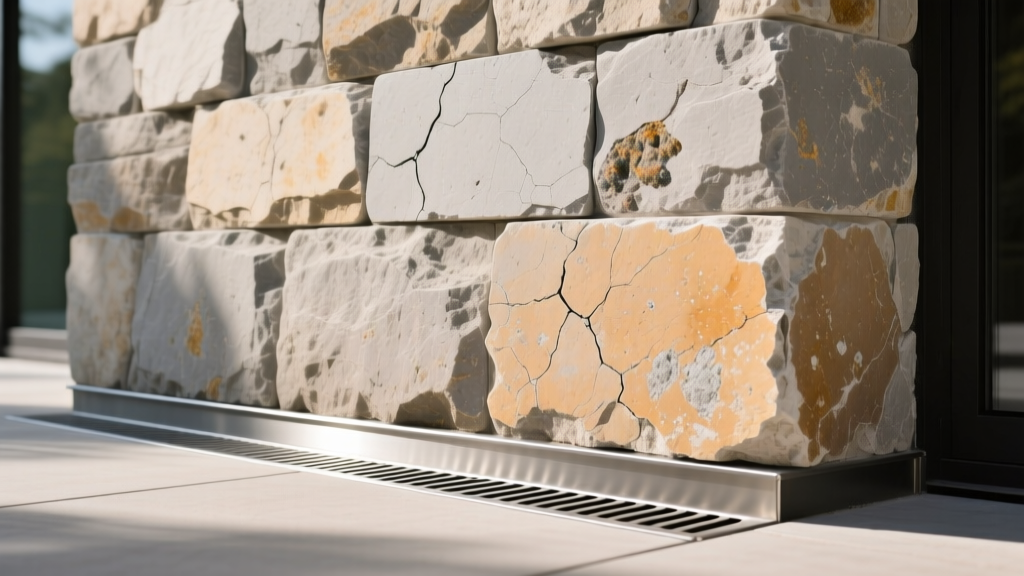
Critical Warning: Never install MSV below grade or allow it to rest directly on a concrete slab without a weep screed. Ground moisture wicking into the porous cement matrix will cause severe efflorescence (white salt deposits) and freeze-thaw spalling in northern climates. Budget an additional $3.50 to $5.00 per linear foot for corrosion-resistant weep screeds and flashing.
The True Cost of the MSV Substrate Stack
When calculating your MSV budget, you must add the following hidden material costs to your baseline square footage:
- Weather-Resistive Barrier (WRB): Two layers of Grade D felt paper or a specialized rainscreen mat (e.g., Keene DriWall) costs $0.75 – $2.50 per sq.ft.
- Metal Lath: 2.5 lb self-furring galvanized steel lath is mandatory. Cost: $1.20 – $1.80 per sq.ft.
- Scratch Coat & Mortar: Type S or Type N mortar for the scratch coat and setting bed. Cost: $1.50 – $2.50 per sq.ft.
- Structural Reinforcement: Because MSV adds 10-14 lbs per sq.ft., cantilevered soffits or second-story overhangs may require additional structural blocking or engineering stamps, adding $500 – $1,500 to project soft costs.
Polyurethane vs. Cementitious: The Labor Differential
While HDPU faux stone panels have a higher upfront material cost than basic MSV, the labor differential is where HDPU achieves massive cost efficiency. Cementitious veneer requires certified masons capable of mixing mortar, managing lath, and executing proper jointing techniques. In 2026, skilled masonry labor rates range from $85 to $140 per hour depending on the region.
Conversely, HDPU panels are installed using standard carpentry tools. They are fastened directly to OSB, plywood, or existing siding using exterior-rated construction adhesive (e.g., Loctite PL Premium) and corrosion-resistant trim screws. A general carpenter or experienced DIYer can install HDPU at a rate of 15-20 square feet per hour, compared to a mason's rate of 4-8 square feet per hour. For interior applications like fireplace surrounds or basement accent walls, HDPU eliminates the need for heavy mortar cleanup and structural floor reinforcement.
ROI and Resale Value Analysis
From an investment perspective, realistic stone veneer consistently outperforms almost all other exterior cladding upgrades. Data from the National Association of Home Builders (NAHB) and annual remodeling cost-versus-value analyses indicate that adding manufactured stone veneer to a home's exterior yields a return on investment (ROI) between 92% and 102% at the time of resale.
Real estate appraisers categorize MSV as a premium masonry finish, elevating the perceived value of the property far beyond the actual cost of installation. A $12,000 investment in an MSV wainscoting skirt around the base of a vinyl-sided home can increase the appraised value by $11,500 to $13,000, while drastically improving curb appeal and reducing the time the property spends on the market.
Decision Framework: Selecting the Right Veneer
Choosing between MSV and HDPU should not be based on material cost alone. Use this scenario-based framework to specify the correct product for your 2026 construction or remodeling project.
Scenario A: Full Exterior Cladding in Wet Climates
Recommendation: Cementitious MSV over a ventilated rainscreen mat.
Rationale: MSV provides superior impact resistance and handles UV exposure indefinitely without degrading. The rainscreen gap ensures bulk water drains freely. Reference Building Science Corporation guidelines for reservoir claddings in high-humidity zones.
Scenario B: Interior Fireplace or Accent Wall
Recommendation: HDPU Faux Stone Panels (Class A Fire-Rated).
Rationale: Zero structural reinforcement required. HDPU panels can be cut with a standard miter saw and installed in a single afternoon. Ensure the specific SKU carries an ASTM E84 Class A fire rating for use within 36 inches of a firebox.
Scenario C: Foundation Skirting & Mobile Homes
Recommendation: HDPU Faux Stone Panels.
Rationale: Ground-level moisture and soil acidity will cause efflorescence and spalling in cementitious MSV. HDPU is entirely impervious to ground moisture wicking and can be easily removed for foundation inspections or termite treatments.
Common Installation Failures to Avoid
Protect your investment by auditing your contractor's installation plan for these frequent failure modes:
- Thermal Expansion Buckling (HDPU): Polyurethane expands and contracts with temperature swings. Installers must leave a 1/8-inch gap between panels and at corners, filling with color-matched exterior polyurethane sealant. Screwing panels too tightly without expansion gaps will cause the faces to bow outward in peak summer heat.
- Mortar Smearing on MSV Faces: Inexperienced masons often use a 'smear joint' technique incorrectly, leaving Portland cement residue on the stone face. Once cured, this requires harsh muriatic acid washes that can strip the integral pigments from lower-quality manufactured stones.
- Missing Control Joints: For MSV installations spanning more than 18 feet horizontally, ASTM C1063 requires control joints to prevent stair-step cracking in the mortar bed as the wood framing shrinks and settles over the first two years.
Written by
Marcus ChenMarcus Chen is a licensed structural engineer (PE) and building materials analyst with over 12 years of experience across residential, commercial, and industrial construction. He holds a Master of Science in Civil Engineering from UC Berkeley and spent six years at Thornton Tomasetti before transitioning to independent consulting and technical writing. Marcus specializes in material selection for seismic-prone regions, concrete reinforcement strategies, and lifecycle cost analysis. His work has been cited by the American Concrete Institute (ACI) and the Structural Engineers Association of California (SEAOC). When he is not on a job site or at his desk, you will find him hiking the Sierra Nevada or restoring a 1920s craftsman bungalow in Oakland, CA.
More from Marcus Chen
View all
Construction Cost
How Much Did the Eiffel Tower Cost to Build?
How much did the Eiffel Tower cost to build in 1889? We adjust for inflation and compare its budget to modern skyscraper construction.
Aug 4, 2026

Fire Resistance
What Is a Fire Resistant Material? Testing & Certification Guide
Discover what is a fire resistant material through ASTM and UL testing. Learn how fire ratings, certifications, and assemblies work in construction.
Aug 4, 2026

Construction Cost
How Much Did the Burj Khalifa Cost to Build?
How much did the Burj Khalifa cost to build? We break down the $1.5B project and extract 5 money-saving strategies for your next build.
Jul 30, 2026