How to Calculate Mortarless Stone Wall Costs and Materials
Learn how to accurately estimate mortarless stone wall costs. Our calculator guide covers material quantities, waste factors, and hidden expenses.
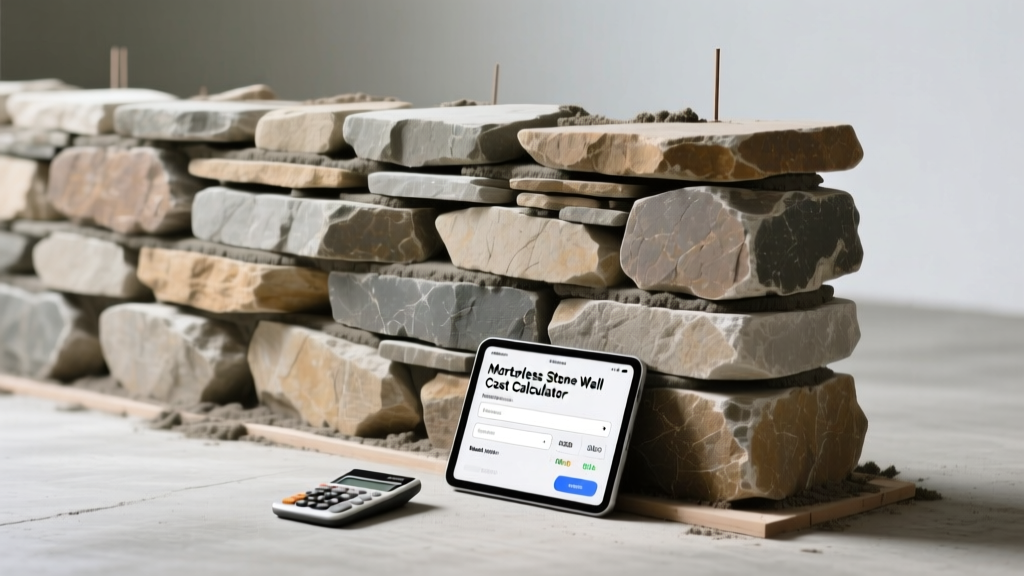
Building a mortarless stone wall offers a dramatic aesthetic upgrade without the messy, time-consuming process of mixing and applying traditional masonry mortar. Whether you are installing interlocking manufactured stone veneer panels on a home exterior or constructing a natural dry-stack retaining wall in your landscape, precise cost estimation and quantity calculation are critical. Miscalculating linear feet for corners or underestimating the waste factor can blow your budget by 20% or more. This guide provides the exact mathematical frameworks, current 2026 pricing baselines, and material specifications needed to accurately scope your project.
Material Cost Baselines: Interlocking Veneer vs. Natural Dry-Stack
The term "mortarless stone wall" generally refers to two distinct construction methods. Understanding which system you are using is the first step in accurate cost estimation, as the material and substrate requirements differ vastly.
| Feature | Interlocking Manufactured Veneer (e.g., GenStone, NextStone) | Natural Dry-Stack Stone (e.g., Fieldstone, Limestone) |
|---|---|---|
| Primary Use | Aesthetic cladding over existing wood/masonry substrates | Structural retaining walls, freestanding garden walls, privacy screens |
| Material Cost (per sq. ft.) | $9.50 – $16.00 | $18.00 – $38.00 |
| Weight | 1 – 2 lbs per sq. ft. (Polyurethane/High-Density Foam) | 80 – 130 lbs per sq. ft. (Solid Natural Stone) |
| Substrate Requirement | OSB, Plywood, or existing flat masonry | Compacted angular gravel base, geotextile fabric, drainage pipe |
The Quantity Calculator Protocol: Step-by-Step Measurement
To order the correct amount of material, you must separate your measurements into flat square footage and linear corner footage. Mortarless veneer systems sell flat panels and corner pieces as separate SKUs.
Step 1: Calculate Gross and Net Square Footage
Measure the total height and width of the wall surface. Multiply these figures to get the gross square footage. Next, measure any windows, doors, or vents that will not be covered, calculate their square footage, and subtract them from the gross total to find your net flat square footage.
Step 2: Calculate Linear Feet for Corners
Measure the vertical height of every outside and inside corner that will be wrapped in stone. Add these heights together. For example, if you have two outside corners on an 8-foot-tall wall, you have 16 linear feet of corners. Most interlocking corner pieces cover exactly 2 linear feet. In this scenario, you would need 8 corner pieces.
Step 3: Apply the Waste and Cut Factor
Never order exact net measurements. Mortarless panels must be cut to fit around windows, electrical outlets, and rooflines. Use the matrix below to determine your waste factor based on the complexity of your wall.
| Wall Complexity | Description | Recommended Waste Factor |
|---|---|---|
| Simple / Unbroken | Long, continuous walls with few windows or obstructions. | 5% – 7% |
| Moderate | Standard home exteriors with multiple windows, doors, and eaves. | 10% – 12% |
| Complex | Walls with numerous outlets, vents, tight corners, and irregular rooflines. | 15% – 18% |
Fastener, Adhesive, and Substrate Math
A common estimation error is forgetting the consumables required to secure interlocking mortarless veneer. While the panels lock into one another, they must be mechanically fastened and chemically bonded to the substrate to prevent wind uplift and water intrusion.
- Adhesive Coverage: One standard 28 oz tube of polyurethane construction adhesive yields approximately 30 linear feet of 3/8-inch bead. You will need to apply a bead along the interlocking seams and the perimeter of every panel. Estimate 1 tube per 40 square feet of wall coverage.
- Mechanical Fasteners: Use 1.5-inch to 2-inch #8 or #9 exterior-grade star-drive (Torx) wood screws. If installing over masonry, use 1.75-inch Tapcon concrete screws. Plan for 6 to 8 screws per 24"x48" panel. A 100 sq. ft. wall requires roughly 80 screws.
- Substrate Prep: If your exterior is covered in vinyl siding or uneven stucco, you must first install a flat substrate. 7/16-inch OSB or exterior-grade plywood costs approximately $45 to $65 per 4x8 sheet (32 sq. ft.) in current markets.
Site Prep Costs for Natural Dry-Stack Retaining Walls
If your project involves natural mortarless stone rather than veneer, the material cost of the stone itself is only half the equation. A dry-stack wall relies entirely on gravity, friction, and a perfectly level base. If the base shifts, the wall collapses.
For a standard 3-foot-high retaining wall, budget for the following hidden site-prep materials:
- Excavation & Base Gravel: You must excavate a trench twice as wide as the base stone and 8 inches deep. Fill this with 3/4-inch crushed angular gravel (never use round pea gravel, which rolls). Compacted gravel costs roughly $40 to $60 per ton.
- Geotextile Fabric: A non-woven filter fabric must line the trench to prevent soil from migrating into the gravel base. Budget $0.50 to $0.80 per square foot of fabric.
- Drainage: A 4-inch perforated PVC drain pipe must run behind the base course, surrounded by washed drainage rock. PVC pipe and fittings will add roughly $3.50 per linear foot to your estimate.
Labor Metrics and Time Estimation
Whether you are calculating your own weekend time or reviewing a contractor's bid, understanding standard installation rates prevents you from overpaying. Data compiled by Forbes Home Improvement indicates that professional masonry labor rates vary wildly by region, but the square-footage time metrics remain relatively constant.
| Installation Type | DIY Installation Rate | Professional Installation Rate | Average Pro Labor Cost (per sq. ft.) |
|---|---|---|---|
| Interlocking Veneer Panels | 10 – 15 sq. ft. / hour | 25 – 40 sq. ft. / hour | $4.00 – $8.50 |
| Natural Dry-Stack (Flat) | Not Recommended for DIY | 3 – 6 sq. ft. / hour | $25.00 – $45.00 |
Frequently Asked Questions
Do I need a vapor barrier behind mortarless stone veneer?
Yes, if you are installing interlocking veneer over a wood-framed substrate (like OSB or plywood), you must install a weather-resistive barrier (WRB) such as Tyvek house wrap before attaching the panels. The panels themselves are water-resistant, but the seams can allow wind-driven rain to reach the substrate.
Can mortarless stone panels be installed directly over painted brick?
It is not recommended. Paint creates a non-porous, slick surface that prevents polyurethane construction adhesive from achieving a proper mechanical bond. You should either strip the paint, score the brick deeply with a masonry grinder, or install a layer of plywood furring strips over the brick to screw the panels into.
How do I calculate capstone requirements for a freestanding dry-stack wall?
Capstones are sold by the linear foot or by individual piece dimensions. Measure the total linear length of the top of your wall. If your wall is 20 feet long and you are using 24-inch (2-foot) capstones, you need exactly 10 pieces. Always add 1 extra capstone to your order to account for chipping or breakage during final trimming.