How to Calculate the True Cost to Build a Flagstone Patio: DIY vs Pro
Discover the true cost to build a flagstone patio. Compare DIY vs professional installation prices, material choices, and hidden base preparation expenses.

The Real Cost to Build a Flagstone Patio: Beyond the Stone
Calculating the accurate cost to build a flagstone patio requires looking past the surface material. While the stone itself represents roughly 30% to 40% of the total budget, the remaining expenses are tied to site preparation, base materials, jointing compounds, and specialized tool rentals. A poorly calculated base will lead to frost heave, settling, and polymeric sand washout, turning a weekend DIY project into a costly repair nightmare.
This guide breaks down the exact material costs, labor rates, and installation phases required to build a durable, code-compliant flagstone patio, providing the data needed to decide between a DIY approach and hiring a professional mason.
Flagstone Material Cost Matrix
The Natural Stone Institute classifies flagstone into several distinct geological categories, each with varying price points, porosity, and structural integrity. Irregular (uncut) stone is generally cheaper per square foot but requires more time to fit, while thermal (rectangular) stone costs more upfront but installs significantly faster.
| Stone Type | Cost per Sq. Ft. (Material) | Durability & Porosity | Best Jointing Method |
|---|---|---|---|
| Pennsylvania Bluestone | $7.00 - $14.00 | High density, low porosity, excellent freeze-thaw resistance | Polymeric sand or mortar |
| Arizona Sandstone | $4.00 - $9.00 | Moderate density, higher porosity, prone to flaking if sealed poorly | Decomposed granite or gravel |
| Idaho Quartzite | $9.00 - $16.00 | Extremely hard, non-slip surface, highly weather-resistant | Polymeric sand or tight mortar |
| Oklahoma Limestone | $5.00 - $10.00 | Softer, susceptible to acid etching and moss growth in damp climates | Wide gravel joints or moss planting |
Step-by-Step Installation & Cost at Each Phase
Phase 1: Excavation and Base Preparation (The Hidden Cost Driver)
The most common failure point in flagstone patios is an inadequate base. According to guidelines published by the University of Minnesota Extension, a proper hardscape base in freeze-thaw climates requires a minimum of 4 to 6 inches of compacted 3/4-inch crushed aggregate over a geotextile fabric.
- Excavation Depth: Dig 7 to 9 inches below the final desired patio height to accommodate the base, bedding, and stone thickness.
- Geotextile Fabric: Lay a non-woven landscape fabric ($0.40 per sq. ft.) to prevent the aggregate base from migrating into the native soil.
- Aggregate Base: Use 3/4-inch crushed limestone or granite ($45 to $65 per ton). Calculation formula: (Length_ft × Width_ft × Depth_ft) / 27 = Cubic Yards. Multiply Cubic Yards by 1.4 to determine the required tons.
- Compaction: Rent a vibratory plate compactor ($85 to $120 per day). Compact the base in 2-inch lifts (layers) until it reaches 95% Proctor density.
Phase 2: Laying the Bedding Layer
Unlike uniform concrete pavers, irregular flagstone requires a forgiving bedding layer that allows for height adjustments. Do not use fine masonry sand for irregular stone; it washes out and fails to support uneven thicknesses.
- Decomposed Granite (DG) or Stone Dust: Spread a 1 to 1.5-inch layer of DG ($35 to $50 per ton). This material locks together when dampened, providing a stable yet adjustable bed for stones of varying thickness.
- Screeding: Use a notched 2x4 to screed the DG, leaving exactly the thickness of your average flagstone piece below the final grade line.
Phase 3: Stone Placement and Jointing
Jointing material dictates both the aesthetic and the maintenance cycle of the patio. Gaps between irregular flagstones typically range from 1 to 3 inches.
- Standard Masonry Sand ($0.10 / sq. ft.): Cheap and traditional, but requires annual topping off as it washes away during heavy rain.
- Decomposed Granite / Crushed Gravel ($0.40 / sq. ft.): Excellent drainage and a natural look. Ideal for rustic designs and permeable patio requirements.
- Polymeric Sand (e.g., Alliance Gator Maxx) ($1.20 - $1.80 / sq. ft.): Contains water-activated polymers that harden like concrete. Best for joints under 1 inch wide. Warning: Using polymeric sand in joints wider than 1.5 inches often leads to cracking and washout.
If you choose polymeric sand, you must use a leaf blower to remove every trace of dust from the stone surface before misting it with water. Failure to do so will result in a permanent, hazy polymer film on the face of the flagstone that requires professional chemical stripping to remove.
DIY vs. Professional Labor Costs: The Breakdown
Deciding whether to self-perform the work or hire a masonry contractor depends heavily on your access to tools, physical capability, and the complexity of the stone layout.
| Cost Category | DIY Installation (per sq. ft.) | Professional Installation (per sq. ft.) |
|---|---|---|
| Flagstone Material | $6.00 - $12.00 | $7.00 - $15.00 (Contractor markup) |
| Base & Bedding Materials | $1.50 - $2.50 | $2.00 - $3.50 |
| Jointing Material | $0.20 - $1.50 | $0.50 - $2.00 |
| Equipment Rental & Tools | $1.00 - $2.00 | Included in labor |
| Labor | $0.00 (Sweat equity) | $12.00 - $25.00 |
| Total Estimated Cost | $8.70 - $18.00 | $22.00 - $47.50 |
Professional masons charge a premium not just for physical labor, but for their ability to 'read' the stone. An experienced mason can visually match the undulating edges of irregular flagstone, minimizing cutting time and reducing material waste by up to 15% compared to a novice.
Sourcing and Tool Rental Checklist
If you opt for the DIY route, securing the right equipment is non-negotiable. Attempting to hand-tamp a 400-square-foot patio base will result in uneven settling within the first year.
- Vibratory Plate Compactor (Minimum 5,000 lbs of centrifugal force): $85 - $120/day.
- Wet Masonry Saw with 10-inch Diamond Blade: $100 - $150/day. Essential for cutting thick quartzite or bluestone without shattering the edges.
- Rotary Laser Level and Grade Rod: $45/day. Crucial for maintaining a strict 1/8-inch per foot slope away from the home's foundation to ensure positive drainage.
- Heavy-Duty Stone Carrying Tongs: $40 (purchase). Flagstone pieces routinely weigh between 80 and 150 lbs; tongs prevent severe lower back strain and finger crush injuries.
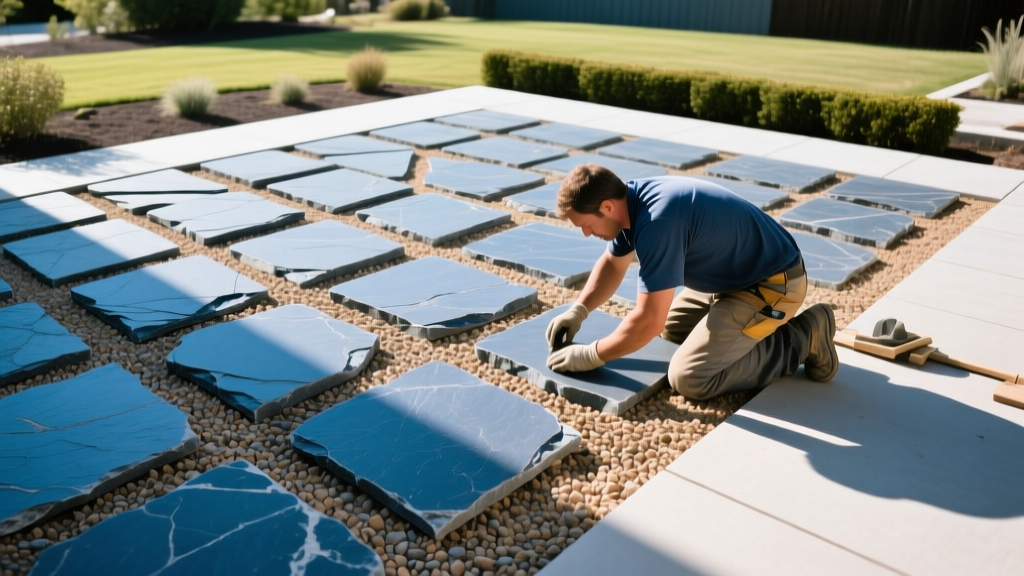
When Flagstone Patios Fail: Avoiding Costly Mistakes
Understanding failure modes allows you to allocate your budget toward preventative measures rather than future repairs.
Frost Heave and Base Migration
In northern climates, water trapped beneath the patio freezes and expands, pushing stones upward. This occurs when builders skip the geotextile fabric or fail to slope the subgrade (the native dirt beneath the gravel) before laying the aggregate. Always slope the native soil at a 2% grade before adding fabric and gravel.
Tree Root Intrusion
Building a flagstone patio within the drip line of mature oak or maple trees guarantees structural failure within 3 to 5 years as roots expand. If you must build near trees, utilize a permeable gravel jointing system rather than mortar or polymeric sand, allowing you to lift and re-level individual stones as roots shift the ground beneath them.
Written by
Priya KapoorPriya Kapoor is a real estate market analyst and construction economics researcher with expertise in housing affordability, development feasibility, and infrastructure investment. She holds a Master of Regional Planning from Cornell University and previously worked as a senior analyst at CBRE's Investment Properties group, where she modeled returns for $4B in mixed-use development pipelines. Priya now runs an independent research practice advising developers, municipalities, and REITs on construction cost forecasting and market timing. She publishes the quarterly "BuildMat Market Pulse" report tracking material price indices across 12 commodity categories. Based in Austin, TX, Priya serves on the board of Habitat for Humanity Austin and is a marathon runner.
More from Priya Kapoor
View all
Construction Cost
Cost to Build a 1600 Sq Ft Home in 2026: Full Breakdown
Accurate 2026 cost to build a 1600 sq ft home—material, labor, and regional pricing breakdowns included. Plan your budget with real-time estimates.
Aug 11, 2026

Wood & Lumber
Name the Types of Wood for Pressure Treatment and Preservation
Learn how to name the types of wood best suited for pressure treatment. Compare species treatability, chemical retention levels, and 2026 preservation costs.
Aug 4, 2026

Stone & Masonry
Stone Veneer Suppliers Lindenhurst: 2026 Cost Analysis
Analyze 2026 stone veneer costs in Lindenhurst, NY. Compare local supplier pricing, delivery fees, and Suffolk County installation labor rates.
Aug 4, 2026