Slate Roof Material Selection Guide: Grades, Costs & Lifespan
Compare natural slate roof material grades, costs, and lifespans. This buyer's guide helps you choose the best stone shingles for your home's exterior.

Decoding ASTM C406: The S-1, S-2, and S-3 Grading System
Selecting a natural slate roof material requires looking past aesthetic variations and focusing on geological durability. The benchmark for quality in the United States is the ASTM C406 Standard Specification for Roofing Slate. This standard categorizes slate into three distinct grades based on modulus of rupture (flexural strength), water absorption, and weather resistance. Understanding these grades is the first critical step in preventing premature roof failure.
- Grade S-1 (75+ Years): The premier standard for residential and commercial roofing. S-1 slate has a modulus of rupture exceeding 9,000 psi and water absorption of less than 0.25%. It is virtually impervious to freeze-thaw cycling.
- Grade S-2 (40 to 75 Years): Suitable for moderate climates with fewer freeze-thaw cycles. Water absorption ranges from 0.26% to 0.45%. While durable, it may exhibit edge spalling after 40 years in harsh northern winters.
- Grade S-3 (20 to 40 Years): Highly porous (up to 0.60% absorption) and structurally weaker. Often sold at a steep discount, S-3 slate is generally not recommended for primary residences unless used on vertical wall cladding or temporary structures.
Hard vs. Soft Slate: Regional Quarry Comparison
The terms "hard" and "soft" in the slate industry do not refer to how the stone feels to the touch, but rather to its resistance to weathering and chemical breakdown. Hard slate is typically sourced from metamorphic deposits that underwent intense tectonic pressure, resulting in dense, non-porous stone. Soft slate often contains higher levels of calcite or iron sulfide, which can lead to fading, rust weeping, and eventual delamination.
| Quarry Region / Brand | Classification | Color Profile | ASTM Grade | Estimated Lifespan |
|---|---|---|---|---|
| Buckingham (Virginia) | Hard | True Black / Charcoal | S-1 | 100 - 150+ Years |
| Vermont Structural | Hard | Unfading Green, Mottled, Red | S-1 | 100 - 125 Years |
| Peach Bottom (PA/MD) | Hard | Deep Blue-Black | S-1 | 125+ Years |
| Pennsylvania "Ribbon" | Soft / Semi-Soft | Gray with brown/black ribbons | S-2 / S-3 | 40 - 60 Years |
| Imported Chinese / Indian | Variable (Often Soft) | Variegated, Rustic, Oxidized | S-2 / S-3 | 30 - 50 Years |
For buyers prioritizing a century-long lifespan, the National Slate Association strongly recommends sticking to established North American hard slate quarries. While imported slate can cost 40% less upfront, the high calcite content in many overseas shipments leads to rapid weathering and "gypsum blooming" (a white, powdery surface efflorescence) within the first ten years.
Thickness, Exposure, and Headlap Specifications
Slate is sold by the "square" (100 square feet of coverage). When ordering, you must specify both thickness and length. Standard architectural slate is 3/16-inch thick. However, for high-wind zones or steep pitches exceeding 12:12, upgrading to 1/4-inch or 3/8-inch thickness provides necessary mass to resist wind uplift.
Equally critical is the headlap—the portion of the slate that overlaps the course two rows below it. The universal minimum for standard pitches (4:12 to 8:12) is a 3-inch headlap. If your roof pitch drops below 4:12, slate is generally not recommended, but if local codes permit it, a 4-inch headlap is mandatory to prevent capillary water action.
2026 Cost Matrix: Material, Framing, and Installation
Budgeting for a slate roof requires separating the raw material cost from the specialized labor and structural reinforcement required. Prices below reflect Q1 2026 market rates for S-1 grade natural stone.
| Cost Component | Standard 3/16" S-1 | Heavy 1/4" S-1 | Textured / Graduated |
|---|---|---|---|
| Material (Per Square) | $900 - $1,400 | $1,300 - $1,800 | $1,600 - $2,500 |
| Specialized Labor (Per Sq) | $800 - $1,200 | $1,000 - $1,500 | $1,500 - $2,200 |
| Underlayment & Flashing | $150 - $250 | $150 - $250 | $200 - $350 |
| Total Installed (Per Sq) | $1,850 - $2,850 | $2,450 - $3,550 | $3,300 - $5,050 |
Note: A typical 2,500 sq. ft. home requires roughly 35 to 40 squares of material, accounting for waste, valleys, and starter courses. Total project costs generally range from $65,000 to over $150,000 depending on architectural complexity.
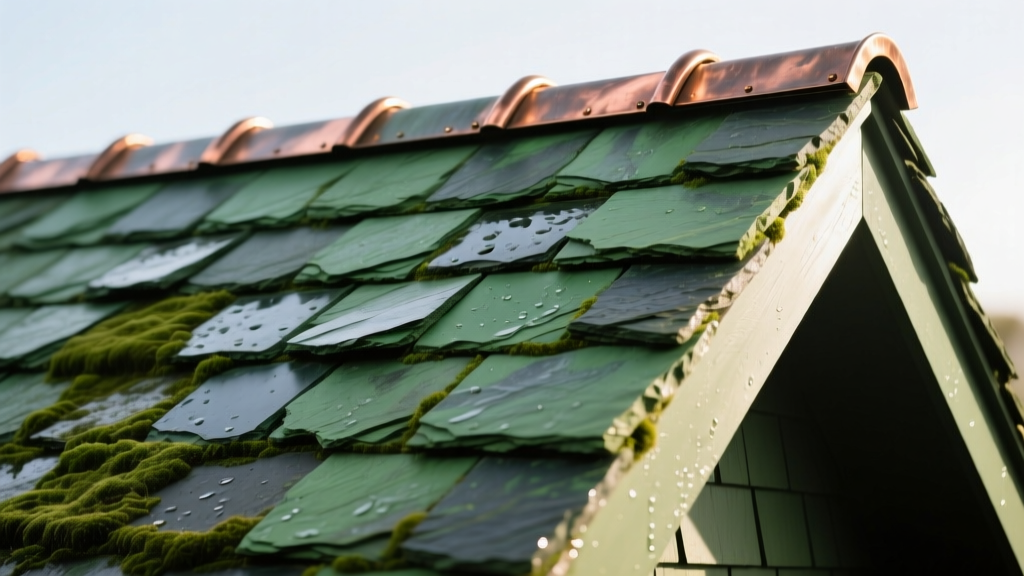
Structural Load Prerequisites: The 1,000-Pound Reality
The most frequently overlooked aspect of buying slate roof material is the dead load it places on the building's framing. Asphalt shingles weigh approximately 250 pounds per square. Standard 3/16-inch slate weighs between 800 and 900 pounds per square. If you opt for 1/4-inch or graduated textural slate, the weight can exceed 1,300 pounds per square.
If your framing requires reinforcement, expect to add $4,000 to $12,000 to your project budget for sistering joists, adding collar ties, or installing supplemental load-bearing beams.
Fasteners and Flashing: Preventing Galvanic Corrosion
A slate shingle will easily outlast a century, but the roof system will fail in 30 years if the wrong fasteners are used. The slate industry has a strict hierarchy for metal compatibility.
The Fastener Hierarchy
- Copper Nails (16 oz): The gold standard. Copper nails will outlast the slate itself and develop a patina that prevents galvanic corrosion when in contact with copper flashing.
- Stainless Steel (Type 304 or 316): An excellent, slightly more affordable alternative to copper. Type 316 is mandatory for coastal homes due to its superior resistance to salt spray.
- Hot-Dipped Galvanized (HDG): Avoid entirely. While building codes in some rural areas still permit HDG nails, the zinc coating will inevitably wear away in 20 to 30 years. The nail will rust, snap, and the perfectly intact slate will slide off the roof.
Flashing and Valleys
Never use aluminum or galvanized steel flashing with a natural slate roof. The runoff from slate is slightly acidic and will corrode aluminum within a decade. All valleys, chimneys, and step flashing must be fabricated from a minimum of 16 oz cold-rolled copper or lead-coated copper. For open valleys, a minimum width of 18 inches (9 inches on each side of the center line) is required to handle high-volume water runoff without capillary draw.
Final Quarry-Direct Purchasing Checklist
When buying direct from a quarry or a master distributor, use this checklist to ensure you receive architectural-grade material rather than commercial flooring offcuts:
- Punch Hole Verification: Ensure the nail holes are punched from the back (split side) to the face. This creates a slight countersink on the face, preventing the nail head from sitting proud and cracking the overlapping shingle.
- Squareness Tolerance: Check a random sample of 20 shingles. The diagonal measurements should be within 1/8-inch of each other. Excessive out-of-square material will cause wavy courses and compromised headlaps.
- Pyrite Inspection: Look for small, metallic gold flecks on the surface. This is pyrite (iron sulfide). While aesthetically pleasing to some, pyrite oxidizes when exposed to moisture, leaving permanent rust streaks down the roof face.
- Sound Test: Hold a piece of S-1 slate by the corner and tap it with your knuckles or a metal tool. It should produce a clear, high-pitched metallic "ring." A dull thud indicates internal micro-fractures or high porosity, signaling an inferior S-2 or S-3 grade.
Written by
Priya KapoorPriya Kapoor is a real estate market analyst and construction economics researcher with expertise in housing affordability, development feasibility, and infrastructure investment. She holds a Master of Regional Planning from Cornell University and previously worked as a senior analyst at CBRE's Investment Properties group, where she modeled returns for $4B in mixed-use development pipelines. Priya now runs an independent research practice advising developers, municipalities, and REITs on construction cost forecasting and market timing. She publishes the quarterly "BuildMat Market Pulse" report tracking material price indices across 12 commodity categories. Based in Austin, TX, Priya serves on the board of Habitat for Humanity Austin and is a marathon runner.
More from Priya Kapoor
View all
Construction Cost
Cost to Build a 1600 Sq Ft Home in 2026: Full Breakdown
Accurate 2026 cost to build a 1600 sq ft home—material, labor, and regional pricing breakdowns included. Plan your budget with real-time estimates.
Aug 11, 2026

Wood & Lumber
Name the Types of Wood for Pressure Treatment and Preservation
Learn how to name the types of wood best suited for pressure treatment. Compare species treatability, chemical retention levels, and 2026 preservation costs.
Aug 4, 2026

Stone & Masonry
Stone Veneer Suppliers Lindenhurst: 2026 Cost Analysis
Analyze 2026 stone veneer costs in Lindenhurst, NY. Compare local supplier pricing, delivery fees, and Suffolk County installation labor rates.
Aug 4, 2026