Outside Stone Veneer vs. Real Stone: 2026 Exterior Comparison
Compare outside stone veneer and natural stone for 2026 exteriors. Analyze costs, ASTM durability standards, moisture management, and installation.

The Core Dilemma: Manufactured Veneer vs. Full-Bed Natural Stone
When specifying exterior cladding for residential and commercial builds, architects and homeowners frequently debate the merits of outside stone veneer (manufactured stone veneer, or MSV) versus full-bed natural stone. While both deliver the coveted masonry aesthetic, their structural requirements, moisture dynamics, and long-term aging profiles differ drastically. In 2026, advancements in polyurethane molds and iron-oxide pigment stabilization have narrowed the visual gap, but the physics of how these materials interact with the building envelope remain fundamentally distinct.
Quick Comparison Snapshot
- Outside Stone Veneer (MSV): 10–12 lbs/sq ft. Adhered directly to lath and scratch coat. No structural footing required.
- Natural Thin Veneer: 12–15 lbs/sq ft. Sliced natural stone. Adhered similarly to MSV but requires diamond-blade cutting.
- Full-Bed Natural Stone: 35–50+ lbs/sq ft. Requires an enlarged, continuous concrete footing and structural masonry ties.
Structural Load and Footing Requirements
The most immediate differentiator between outside stone veneer and real stone is dead load. Full-bed natural stone, such as limestone or fieldstone, weighs between 35 and 50 pounds per square foot. According to structural engineering standards, this mass cannot be supported by standard wood framing or a basic 4-inch concrete slab. It necessitates a continuous, enlarged concrete footing that extends below the local frost line, often adding $15 to $30 per linear foot to the foundation budget before a single stone is laid.
Conversely, manufactured outside stone veneer is engineered from expanded shale, clay, and Portland cement, resulting in a density of roughly 10 to 12 pounds per square foot. Because it is an adhered cladding rather than a structural or self-supporting masonry wythe, MSV can be installed directly over standard wood or steel stud framing, provided the wall is sheathed and properly prepared with a weather-resistive barrier (WRB) and metal lath. This makes MSV the default choice for retrofitting existing exteriors or building on expansive soils where minimizing foundation loads is critical.
2026 Installed Cost Breakdown
Labor and material costs have shifted in 2026, with masonry labor shortages driving up the price of full-bed installations. The following matrix reflects current national averages for exterior cladding installations.
| Cost Factor | Outside Stone Veneer (MSV) | Natural Thin Veneer | Full-Bed Natural Stone |
|---|---|---|---|
| Material Cost (per sq ft) | $5.50 – $9.00 | $8.00 – $14.00 | $12.00 – $25.00+ |
| Prep & Lath (per sq ft) | $2.50 – $4.00 | $2.50 – $4.00 | $1.00 – $2.00 (Ties) |
| Masonry Labor (per sq ft) | $14.00 – $22.00 | $18.00 – $28.00 | $35.00 – $60.00 |
| Structural Footing Req. | None | None | $15 – $30 / linear ft |
| Total Installed Estimate | $22.00 – $35.00 | $28.50 – $46.00 | $48.00 – $87.00+ |
While premium manufactured brands like Eldorado Stone or Cultured Stone push the upper limits of MSV material costs, the labor savings and elimination of footing requirements consistently make outside stone veneer 40% to 60% less expensive than full-bed natural stone.
Moisture Dynamics: The Reservoir Cladding Effect
The most common cause of exterior stone failure is not material degradation, but moisture mismanagement. Both natural stone and MSV are classified as 'reservoir claddings.' They are highly porous and absorb significant amounts of rainwater. When the sun emerges after a storm, solar radiation heats the stone, creating a vapor drive that pushes moisture inward toward the sheathing.
Critical Warning: The OSB Rot Trap
If outside stone veneer is installed directly over a standard housewrap without a drainage mat, the trapped hydrostatic pressure will force moisture through the WRB, leading to catastrophic rot in OSB sheathing and wood studs within 3 to 5 years. Always consult the U.S. Department of Energy's building envelope guidelines regarding reservoir claddings and vapor permeability.
Mandatory Drainage Plane Specifications
To mitigate the reservoir effect, modern building codes and best practices dictate the use of a continuous drainage plane. For outside stone veneer, this means installing a dimpled drainage mat (such as Mortairvent or MortarNet) over the WRB before applying the metal lath. This creates a 1/4-inch to 3/8-inch air gap that allows water to drain down to a weep screed at the base of the wall. Full-bed natural stone naturally creates a larger cavity if backed by a CMU wythe, but when adhered directly to framing, it requires the exact same drainage mat specifications as MSV.
Aesthetic Aging: Iron Oxide Pigments vs. Petrology
Visual authenticity is the primary reason buyers choose stone. High-end MSV manufacturers use polyurethane molds taken directly from natural stone to capture microscopic fissures and tooling marks. However, the coloration relies on iron-oxide pigments suspended in the concrete mix. Over 15 to 20 years, intense UV exposure in southern or high-altitude climates can cause subtle fading in lower-tier manufactured stones, shifting browns toward gray.
Natural stone, governed by its petrological composition (as detailed by the Building Stone Institute), derives its color from mineral deposits—iron, quartz, and calcite. These colors are UV-stable and will not fade. However, natural limestone (ASTM C568) and sandstone (ASTM C616) are susceptible to biological growth, efflorescence, and acid rain etching. In freeze-thaw climates, natural stones with high absorption rates can spall and delaminate if not properly sealed, whereas MSV (governed by ASTM C1670) is engineered with specific density and absorption limits to resist freeze-thaw scaling.
Installation Edge Cases: Mortar Mixes and Cutting Techniques
The physical act of installing these materials requires different skill sets and tools. Outside stone veneer is designed to be cut and shaped using a masonry hatchet or wide nippers. Installers can easily 'snip' the edges of MSV to fit around electrical fixtures or window casings, and the uniform color throughout the stone hides the cut mark. Corner pieces are pre-molded to wrap seamlessly, though inexperienced masons often fail to stagger the return lengths, resulting in a visible, repetitive 'zipper' effect on outside corners.
Natural stone, particularly hard varieties like granite or dense quartzite, requires a continuous-rim diamond blade on a wet saw to make precise cuts. Chipping the edges to create a natural 'pitched' look on corners requires a skilled mason with a carbide-tipped chisel and pitching tool. Furthermore, while MSV is typically installed using a standard Type S or Type N mortar, natural thin veneer often requires a polymer-modified mortar or a specialized non-sag adhesive to prevent the heavier, denser stones from sliding down the wall before the mortar cures.
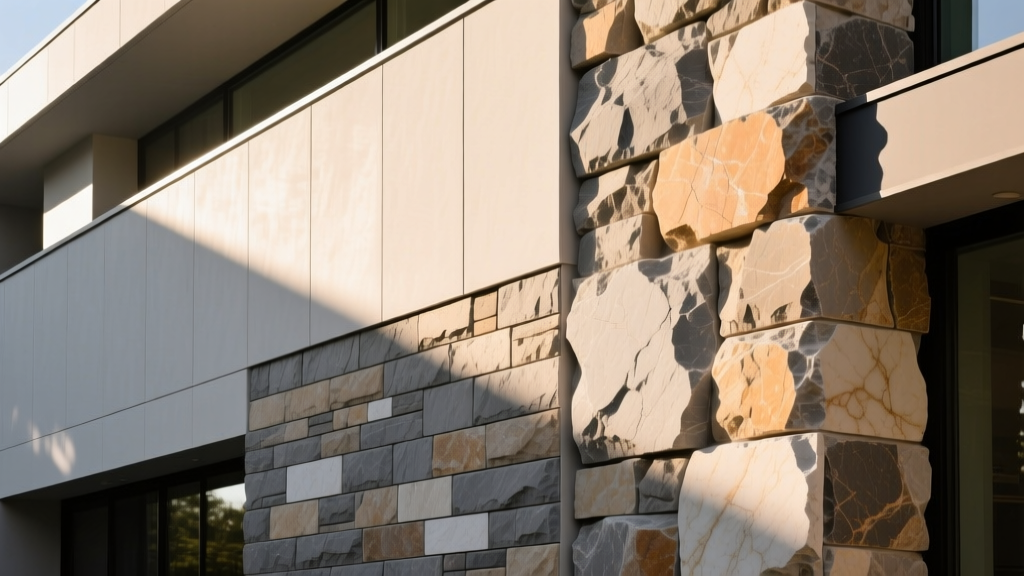
Decision Matrix: Which Cladding Fits Your Build?
Selecting between outside stone veneer and real stone requires aligning the material's physical properties with your project's structural and aesthetic constraints.
| Project Scenario | Recommended Material | Technical Rationale |
|---|---|---|
| Retrofitting an existing wood-framed home | Outside Stone Veneer (MSV) | Existing foundations cannot support the 40+ lbs/sq ft dead load of full-bed stone. |
| High-end custom build with masonry foundation | Full-Bed Natural Stone | Budget allows for structural footings; provides unmatched petrological authenticity and permanence. |
| Commercial facade requiring rapid installation | Mortarless MSV Systems | Mechanical track systems eliminate curing times and reduce specialized masonry labor requirements. |
| Coastal or high-salt environment | Natural Thin Veneer (Granite/Slate) | Low-absorption natural stones resist salt crystallization and spalling better than Portland-based MSV. |
Ultimately, outside stone veneer offers a highly engineered, cost-effective solution that respects modern framing and moisture-management science, while natural stone remains the benchmark for structural permanence and geological authenticity. Base your decision not just on the initial material cost, but on the structural readiness of your foundation and the long-term moisture dynamics of your specific climate zone.
Written by
James ThorntonJames Thornton is a construction industry veteran with 25 years of hands-on experience in wood framing, lumber grading, and residential building codes. He started as a framing carpenter in rural Oregon, earned his ICC Residential Building Inspector certification, and eventually became a senior plan reviewer for the City of Portland Bureau of Development Services. James holds a B.S. in Wood Science & Technology from Oregon State University and is a certified lumber grader through the West Coast Lumber Inspection Bureau (WCLIB). He has inspected over 3,000 residential construction sites and authored the city's internal guide on advanced framing techniques (2x6 at 24" O.C.). James lives in Bend, OR, where he builds custom timber-frame cabins and competes in lumberjack sports.
More from James Thornton
View all
Insulation
Best Home Insulation Materials: Complete 2026 Guide
Compare top home insulation materials for 2026. Find R-values, installed costs per square foot, and best uses for fiberglass, spray foam, and mineral wool.
Aug 4, 2026

Sustainable Building
Certify Your Green Building Material for LEED and WELL
Step-by-step guide to certifying a green building material for LEED v5 and WELL v2. Master EPDs, HPDs, and VOC limits for 2026 project specifications.
Aug 4, 2026

Stone & Masonry
Veneer Stacked Stone Panels: Interior Design & Style Showcase
Discover how veneer stacked stone panels transform interiors. Explore modern design profiles, material pairings, and technical installation specs.
Aug 4, 2026