How Much Does It Cost to Build a Stone Wall? Maintenance Costs
Discover how much it costs to build a stone wall and the hidden long-term maintenance expenses. Expert care tips for mortar, sealing, and efflorescence.

The True Cost of Ownership: Beyond the Initial Build
When homeowners and contractors ask, how much does it cost to build a stone wall, the conversation almost exclusively focuses on initial material and labor expenses. In 2026, constructing a natural stone wall typically ranges from $30 to $55 per square foot, while manufactured stone veneer sits between $18 and $32 per square foot. However, evaluating the financial commitment of masonry requires a lifecycle perspective. A stone wall is not a static structure; it is a dynamic, breathable assembly that interacts with moisture, thermal expansion, and biological elements.
Failing to budget for long-term maintenance and care transforms a premium architectural feature into a structural liability. This guide breaks down the hidden maintenance costs, specific failure modes, and actionable care protocols required to protect your masonry investment over a 50-year lifespan.
Initial Build Costs vs. Lifetime Maintenance Matrix
Understanding the relationship between your initial stone selection and its ongoing maintenance requirements is critical for accurate budgeting. Softer, more porous stones require higher maintenance than dense, low-absorption materials.
| Material Type | Initial Build Cost (per sq. ft.) | Absorption Rate | 50-Year Maintenance Cost (per sq. ft.) | Primary Maintenance Driver |
|---|---|---|---|---|
| Granite (Natural) | $45 - $65 | 0.1% - 0.5% | $4 - $8 | Joint repointing |
| Limestone (Natural) | $35 - $50 | 5% - 12% | $18 - $28 | Efflorescence, spalling, biological growth |
| Sandstone (Natural) | $30 - $45 | 8% - 15% | $22 - $35 | Erosion, freeze-thaw fracturing |
| Manufactured Veneer | $18 - $32 | 10% - 18% | $12 - $20 | Sealer reapplication, color fading |
| Dry Stack (No Mortar) | $40 - $60 | N/A (Drains freely) | $5 - $10 | Settling, stone replacement |
Mortar Repointing: The Most Common Failure Point
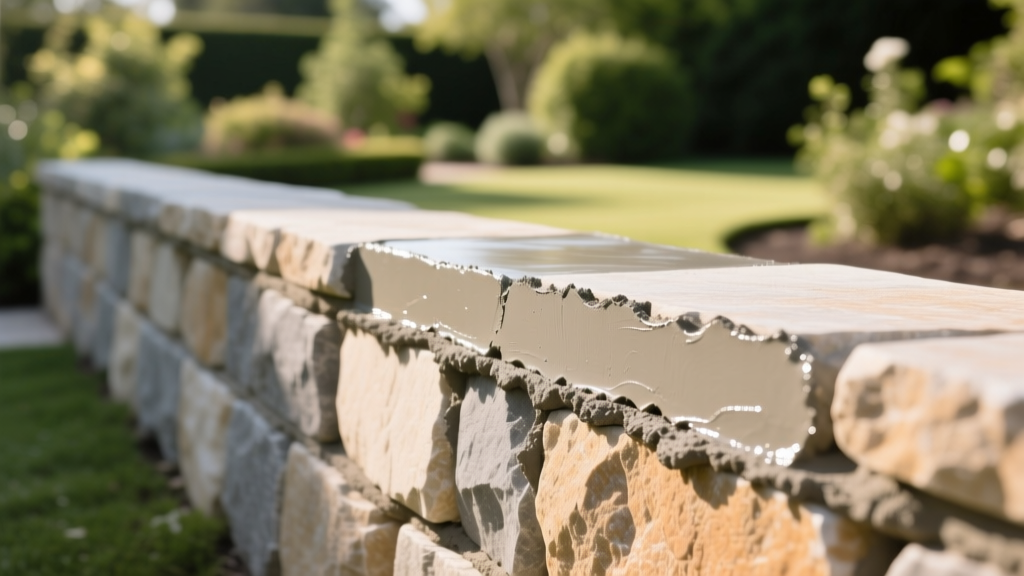
The mortar joints in a stone wall are designed to be the sacrificial element of the assembly. Because mortar is softer and more permeable than the stone itself, it absorbs the brunt of thermal movement and moisture intrusion. When mortar degrades, water penetrates the wall cavity, leading to catastrophic freeze-thaw damage.
Selecting the Correct Mortar for Historic and Soft Stone
A critical mistake in stone wall maintenance is using modern, high-strength Portland cement mortar (Type S or Type M) to repair older or softer stone walls. According to the National Park Service Preservation Brief 22, using mortar that is harder than the surrounding masonry forces moisture to evaporate through the stone face rather than the joint. This causes the stone face to spall, crack, and delaminate.
- Type N Mortar (750 PSI): Suitable for most modern, hard-stone exterior walls and general repointing. Contains 1 part Portland, 1 part lime, and 6 parts sand.
- Type O Mortar (350 PSI): Mandatory for soft, porous stones like historic limestone and sandstone. Contains 1 part Portland, 2 parts lime, and 9 parts sand. Allows for high flexibility and vapor transmission.
When removing deteriorated mortar, never use an angle grinder with a diamond blade on historic or soft stone walls. The risk of scoring the stone arris is exceptionally high. Use hand tools, such as a mortar rake and a pointing trowel, to remove mortar to a depth of 2 to 2.5 times the joint width before applying new material.
Efflorescence and Biological Growth Protocols
Efflorescence—the white, powdery salt deposits on stone surfaces—is a symptom of moisture moving through the masonry and evaporating, leaving behind water-soluble salts. While primarily a cosmetic issue, severe efflorescence can crystallize beneath the stone surface (subflorescence), generating immense internal pressure that shatters the stone face.
Step-by-Step Efflorescence Removal
- Dry Brushing: Always begin with a stiff, non-metallic bristle brush. Water applied to dry salts can drive them deeper into the stone pores.
- Low-Pressure Water Wash: If dry brushing fails, use a garden hose with a spray nozzle. Do not exceed 500 PSI if using a pressure washer, and maintain a 12-inch standoff distance.
- Chemical Treatment: For stubborn deposits, apply a specialized masonry cleaner like PROSOCO SureKlean Vana Trol or an equivalent buffered acidic cleaner. Never use muriatic acid on limestone, marble, or sandstone, as it will instantly etch and dissolve the calcium carbonate matrix.
Managing Algae, Moss, and Lichen
North-facing stone walls in humid climates are highly susceptible to biological growth. Lichen anchors itself into the microscopic pores of the stone, and attempting to scrape it off dry will tear the stone face. Apply a quaternary ammonium-based masonry biocide, allow a 15-minute dwell time, and gently agitate with a nylon brush. For long-term prevention, ensure landscaping is trimmed back at least 18 inches from the wall to promote UV exposure and airflow.
Sealing and Waterproofing: Breathability is Non-Negotiable
The decision to seal a stone wall dictates its long-term survival. The Masonry Society emphasizes that exterior masonry must be allowed to breathe. Trapping moisture inside a stone wall with the wrong sealer guarantees accelerated degradation in freeze-thaw climates.
Film-Forming vs. Penetrating Sealers
| Sealer Type | Chemistry | Vapor Permeability | Best Application | Cost per Sq. Ft. |
|---|---|---|---|---|
| Acrylic (Film-Forming) | Water/Solvent-based acrylic polymers | Very Low (Traps moisture) | Interior stone only, or non-freeze-thaw exterior | $0.50 - $1.20 |
| Silane/Siloxane (Penetrating) | Alkylalkoxy-silanes | High (Allows vapor out, blocks liquid water in) | All exterior natural stone and veneer | $1.50 - $3.00 |
| Fluoropolymer | Fluorinated siloxanes | High (Superior oil and water resistance) | High-traffic commercial stone, graffiti-prone areas | $4.00 - $7.50 |
For 90% of exterior residential stone walls, a silane/siloxane penetrating sealer is the only appropriate choice. These sealers do not form a surface film; instead, they react chemically with the silica in the stone to create a hydrophobic barrier within the pore structure. This allows internal water vapor to escape while preventing wind-driven rain from entering. Reapplication is typically required every 5 to 7 years, depending on UV exposure and weathering.
To determine if your existing stone wall needs resealing, sprinkle a few drops of water on the surface in various locations. If the water beads up and remains on the surface for 3 to 5 minutes, the sealer is intact. If the water immediately darkens the stone and absorbs, the hydrophobic barrier has failed, and resealing is urgently required before the next freeze-thaw cycle.
Drainage and Weep Hole Maintenance
A stone retaining wall or veneer wall without proper drainage will fail, regardless of the stone's quality or the sealer applied. Hydrostatic pressure buildup behind a retaining wall can exert thousands of pounds of lateral force, causing the wall to bulge or collapse.
- Weep Hole Clearance: Inspect weep holes (typically 1/2-inch to 3/4-inch PVC pipes or open head joints) every spring. Flush them with a low-pressure water stream to clear soil, insect nests, and debris.
- Backfill Integrity: If a wall begins to weep muddy water, the geotextile fabric separating the clean drainage gravel from the native soil has likely failed or was omitted during construction. This requires excavating the top 12 inches of backfill, installing a new layer of non-woven geotextile fabric, and replacing the clean 3/4-inch washed gravel.
50-Year Lifecycle Cost Projection
To fully answer how much it costs to build and maintain a stone wall, consider this projected 50-year lifecycle model for a 500-square-foot natural limestone retaining wall in a moderate freeze-thaw climate.
| Maintenance Milestone | Frequency | Estimated Cost (per occurrence) | 50-Year Total |
|---|---|---|---|
| Initial Construction | Year 0 | $20,000 ($40/sq ft) | $20,000 |
| Siloxane Sealer Application | Every 6 Years | $1,000 ($2/sq ft) | $8,000 |
| Biological/Chemical Cleaning | Every 4 Years | $400 | $5,200 |
| Partial Mortar Repointing | Years 25 & 45 | $2,500 (20% of wall) | $5,000 |
| Total 50-Year Investment | $38,200 |
By shifting the focus from the initial construction quote to the total lifecycle cost, property owners can make informed decisions about material selection, detailing, and proactive maintenance. Investing in proper flashing, breathable sealers, and historically appropriate mortar mixes during the build and early maintenance phases drastically reduces the compounding repair costs in decades three through five.
Written by
Priya KapoorPriya Kapoor is a real estate market analyst and construction economics researcher with expertise in housing affordability, development feasibility, and infrastructure investment. She holds a Master of Regional Planning from Cornell University and previously worked as a senior analyst at CBRE's Investment Properties group, where she modeled returns for $4B in mixed-use development pipelines. Priya now runs an independent research practice advising developers, municipalities, and REITs on construction cost forecasting and market timing. She publishes the quarterly "BuildMat Market Pulse" report tracking material price indices across 12 commodity categories. Based in Austin, TX, Priya serves on the board of Habitat for Humanity Austin and is a marathon runner.
More from Priya Kapoor
View all
Construction Cost
Cost to Build a 1600 Sq Ft Home in 2026: Full Breakdown
Accurate 2026 cost to build a 1600 sq ft home—material, labor, and regional pricing breakdowns included. Plan your budget with real-time estimates.
Aug 11, 2026

Wood & Lumber
Name the Types of Wood for Pressure Treatment and Preservation
Learn how to name the types of wood best suited for pressure treatment. Compare species treatability, chemical retention levels, and 2026 preservation costs.
Aug 4, 2026

Stone & Masonry
Stone Veneer Suppliers Lindenhurst: 2026 Cost Analysis
Analyze 2026 stone veneer costs in Lindenhurst, NY. Compare local supplier pricing, delivery fees, and Suffolk County installation labor rates.
Aug 4, 2026