Technical Specs and Substrate Rules for Peel Stick Stone Veneer
Explore the technical specifications, adhesive chemistry, and substrate requirements of peel stick stone veneer for flawless interior installations.

Core Material Composition and Adhesive Chemistry
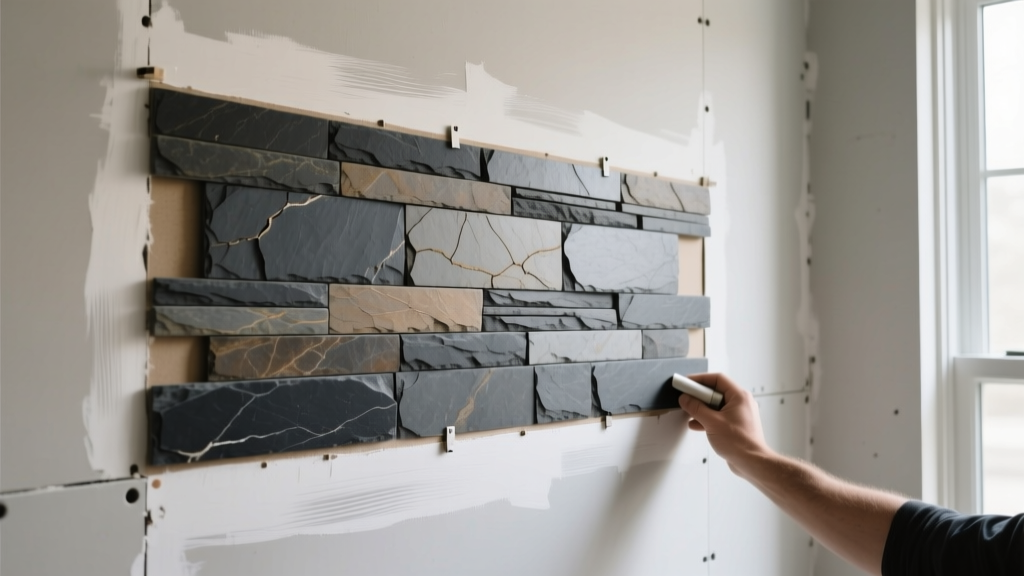
Peel stick stone veneer systems bypass traditional mortar beds and mechanical lath, relying entirely on pre-applied pressure-sensitive adhesives (PSA) or structural acrylic foam tapes. While installation is rapid, the structural integrity of the assembly depends strictly on adherence to manufacturer-defined substrate flatness, porosity, and dead-load shear limits. As of 2026, the market is dominated by two distinct adhesive chemistries, each with specific technical thresholds.
Entry-level and faux-stone (polyurethane) panels typically utilize hot-melt rubber-based PSA. These adhesives offer high initial tack but suffer from plasticizer migration and thermal degradation above 140°F (60°C). Premium natural stone veneers—such as thin-cut slate, quartzite, or marble backed with fiberglass mesh—require structural acrylic foam tapes (like 3M VHB) or high-performance nano-acrylic PSAs. Acrylic systems maintain bond integrity up to 180°F (82°C) and resist UV degradation, making them suitable for interior applications near heat sources or sun-drenched feature walls.
Dimensional Tolerances and Weight Load Metrics
The dead load of natural stone peel stick veneer dictates the required adhesive coverage and substrate reinforcement. A standard 1/2-inch natural quartzite veneer weighs approximately 4.5 lbs per square foot. To meet a standard safety factor of 4.0 for vertical sheer applications, the adhesive must provide a minimum sustained shear strength of 18 lbs per square foot. This typically requires 60% to 80% adhesive coverage on the back of the panel.
| Material Type | Nominal Thickness | Weight (lbs/sq ft) | Required Adhesive Type | Max Panel Size |
|---|---|---|---|---|
| Polyurethane Faux Stone | 3/4" - 1.5" | 0.8 - 1.2 | Rubber-based PSA | 24" x 48" |
| Thin-Cut Slate / Sandstone | 1/4" - 3/8" | 2.5 - 3.5 | Acrylic PSA | 12" x 24" |
| Quartzite / Granite Mesh-Backed | 1/2" - 3/4" | 4.0 - 6.5 | Structural Acrylic Foam | 6" x 24" (Modular) |
Dimensional tolerances for premium natural stone peel stick modules are generally held to ±1/16 inch in length and width. However, thickness can vary by up to 1/8 inch due to the natural cleft of the stone. Installers must account for this Z-axis variation by utilizing a soft foam backing or ensuring the acrylic tape has sufficient compressibility to absorb the thickness variance without creating localized high-stress points that could lead to adhesive fatigue.
Substrate Preparation and Flatness Standards
The most common cause of peel stick stone veneer failure is not adhesive defect, but substrate failure. Unprimed drywall paper has a low tensile strength. When the adhesive bond exceeds the tensile strength of the drywall paper face, a cohesive substrate failure occurs: the paper tears away from the gypsum core, leaving the adhesive fully bonded to a flimsy layer of paper while the heavy stone falls to the floor.
According to the Gypsum Association, walls must be finished to a minimum Level 4 standard before applying any heavy wallcovering or veneer. For peel stick stone, the following substrate protocol is mandatory:
- Flatness Verification: The wall must not deviate more than 1/8 inch over a 48-inch span. High spots must be sanded flush; low spots must be filled with setting-type joint compound.
- Cleaning: Wipe the surface with a Trisodium Phosphate (TSP) solution to remove drywall dust, grease, and silicone residues. Allow to dry completely.
- Priming (Critical): Apply a high-build, oil-based or shellac-based primer (such as Zinsser B-I-N or Kilz Original). This penetrates and consolidates the drywall paper fibers, increasing the tensile pull-off strength of the substrate by up to 300%. Do not use standard water-based PVA drywall primers, as they do not sufficiently harden the paper face.
- Cure Time: Allow the primer to cure for a minimum of 48 hours before applying the veneer to ensure all solvents have off-gassed and the surface has reached maximum hardness.
ASTM D4541 Pull-Off Strength Requirements
Before full installation, conduct an ASTM D4541 pull-off test using a dummy panel. The substrate should demonstrate a minimum pull-off strength of 15 psi. If the failure occurs at the primer-to-paper interface, the drywall must be sanded down to the gypsum core and replaced or reinforced with a 1/4-inch cement backer board.
Thermal Expansion and Environmental Limits
Natural stone and acrylic adhesives exhibit vastly different coefficients of thermal expansion (CTE). Natural stone expands at approximately 0.000005 in/in/°F, while acrylic foam tapes can expand at 0.00015 in/in/°F—a differential of nearly 30 times. When installed in environments with high temperature fluctuations, such as a wall adjacent to a wood stove or a sunroom, this mismatch creates significant shear stress at the bond line.
Engineering Note: To accommodate CTE mismatch, premium peel stick stone veneers utilize viscoelastic acrylic foam tapes rather than rigid PSAs. The foam core of the tape acts as a shock absorber, allowing for elongation of up to 150% without losing adhesion. Never substitute manufacturer-applied structural foam tape with rigid construction adhesives or liquid nails, as this will result in immediate edge lifting under thermal cycling.
Moisture limits are equally strict. While the stone itself is impervious, the adhesive bond line is vulnerable to hydrolysis. Peel stick stone veneer should only be installed in environments where ambient relative humidity remains below 85%. It is strictly prohibited for use in wet areas such as shower surrounds, steam rooms, or the splash zones of kitchen sinks unless the specific adhesive system is certified for continuous submersion.
Fire Performance and Safety Certifications
When specifying peel stick stone veneer for commercial builds or multi-family residential projects, fire ratings are a primary compliance hurdle. Natural stone is inherently non-combustible, but the fiberglass mesh backing and the acrylic adhesive layer are organic compounds that can contribute to flame spread.
High-quality systems are tested to ASTM E84 (Standard Test Method for Surface Burning Characteristics of Building Materials). To achieve a Class A rating, the assembly must demonstrate a Flame Spread Index (FSI) of 25 or less and a Smoke Developed Index (SDI) of 450 or less. According to technical bulletins from the Natural Stone Institute, the thickness of the stone and the specific chemical makeup of the adhesive backing dictate the final rating. Always request the manufacturer's specific ASTM E84 test report for the exact SKU being installed, as substituting a different adhesive primer on-site can void the fire rating.
Common Failure Modes and Edge-Case Troubleshooting
Even with perfect substrate preparation, improper handling and cutting of the veneer modules can introduce mechanical failures. Below are the most frequent technical failure modes and their engineered solutions.
- Edge Lifting and Micro-Fractures: Cutting natural stone peel stick panels with a standard carbide-tipped wood blade creates severe vibration, resulting in micro-fractures along the cut edge. These fractures break the fiberglass mesh backing, eliminating the structural tension holding the stone together and causing the edges to curl and lift. Fix: Always cut natural stone modules using a continuous-rim diamond blade on a wet saw, or score-and-snap with a specialized stone guillotine.
- Adhesive Starvation at Joints: When panels are forced tightly together during installation, the adhesive can squeeze out from the edges, creating a visible residue and starving the perimeter of the panel of bonding agent. Fix: Maintain a 1/16-inch expansion gap between modular panels. Use a non-sanded, color-matched silicone caulk to fill the joints, which allows for lateral movement without compromising the bond line.
- Plasticizer Bleed on Faux Stone: Polyurethane faux stone panels contain internal plasticizers to maintain flexibility. Over time, these plasticizers can migrate into rubber-based PSAs, turning the adhesive into a viscous liquid and causing the panels to slide down the wall. Fix: If using faux stone, ensure the panels have been factory-sealed with a polyurethane barrier coat on the back, or apply a compatible barrier primer to the back of the panels 24 hours before installation.
For further technical data on structural bonding in architectural applications, consult the 3M VHB Technical Data Sheets, which provide exact shear-strength calculations and surface-energy matching charts required for specifying peel stick veneer systems on non-standard substrates like powder-coated metals or high-pressure laminates.
Written by
Priya KapoorPriya Kapoor is a real estate market analyst and construction economics researcher with expertise in housing affordability, development feasibility, and infrastructure investment. She holds a Master of Regional Planning from Cornell University and previously worked as a senior analyst at CBRE's Investment Properties group, where she modeled returns for $4B in mixed-use development pipelines. Priya now runs an independent research practice advising developers, municipalities, and REITs on construction cost forecasting and market timing. She publishes the quarterly "BuildMat Market Pulse" report tracking material price indices across 12 commodity categories. Based in Austin, TX, Priya serves on the board of Habitat for Humanity Austin and is a marathon runner.
More from Priya Kapoor
View all
Construction Cost
Cost to Build a 1600 Sq Ft Home in 2026: Full Breakdown
Accurate 2026 cost to build a 1600 sq ft home—material, labor, and regional pricing breakdowns included. Plan your budget with real-time estimates.
Aug 11, 2026

Wood & Lumber
Name the Types of Wood for Pressure Treatment and Preservation
Learn how to name the types of wood best suited for pressure treatment. Compare species treatability, chemical retention levels, and 2026 preservation costs.
Aug 4, 2026

Stone & Masonry
Stone Veneer Suppliers Lindenhurst: 2026 Cost Analysis
Analyze 2026 stone veneer costs in Lindenhurst, NY. Compare local supplier pricing, delivery fees, and Suffolk County installation labor rates.
Aug 4, 2026