Best Mortar for Stone Veneer: Type S vs. Polymer-Modified Mixes Compared
Compare the best mortar for stone veneer projects. We review Type S, polymer-modified mixes, and thinset for interior and exterior installations.
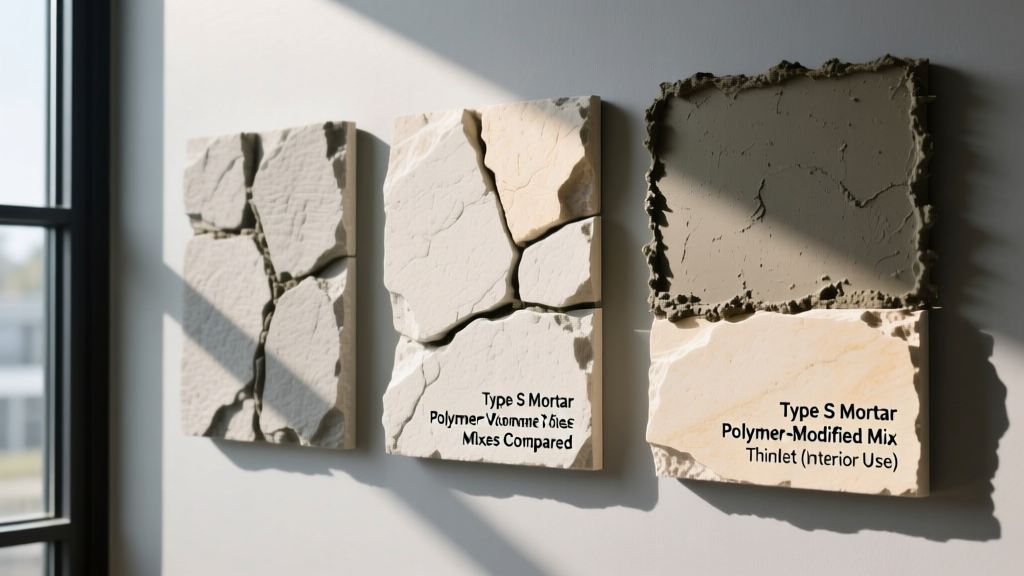
The Mortar Matrix: Polymer vs. Type S vs. Thinset
Selecting the correct adhesive matrix is the single most critical variable in stone veneer longevity. Delamination, efflorescence, and freeze-thaw spalling are rarely caused by the stone itself; they are almost universally the result of mortar failure, improper substrate preparation, or using a product outside its engineered performance envelope. While traditional masonry cements have dominated the industry for decades, the introduction of redispersible polymer powders has fundamentally shifted the standard for manufactured and lightweight natural stone installations.
To determine the best mortar for stone veneer applications in 2026, we must evaluate the three primary categories: Polymer-Modified Veneer Mortars, Type S Masonry Mortar, and ANSI A118.4 Modified Thinset. Each serves a distinct structural and environmental purpose.
| Mortar Category | Best Application | Avg. Cost (2026) | Governing Standard | Non-Sag Performance |
|---|---|---|---|---|
| Polymer-Modified Veneer | Exterior/Interior manufactured & natural stone | $19 - $26 / 50lb bag | Proprietary / ASTM C1714 | Excellent (High Tack) |
| Type S Masonry Mortar | Heavy natural stone, scratch coats, thick-set | $9 - $14 / 80lb bag | ASTM C270 | Poor (Requires support) |
| Modified Thinset | Interior mesh-backed veneers over cement board | $22 - $38 / 50lb bag | ANSI A118.4 | Very Good |
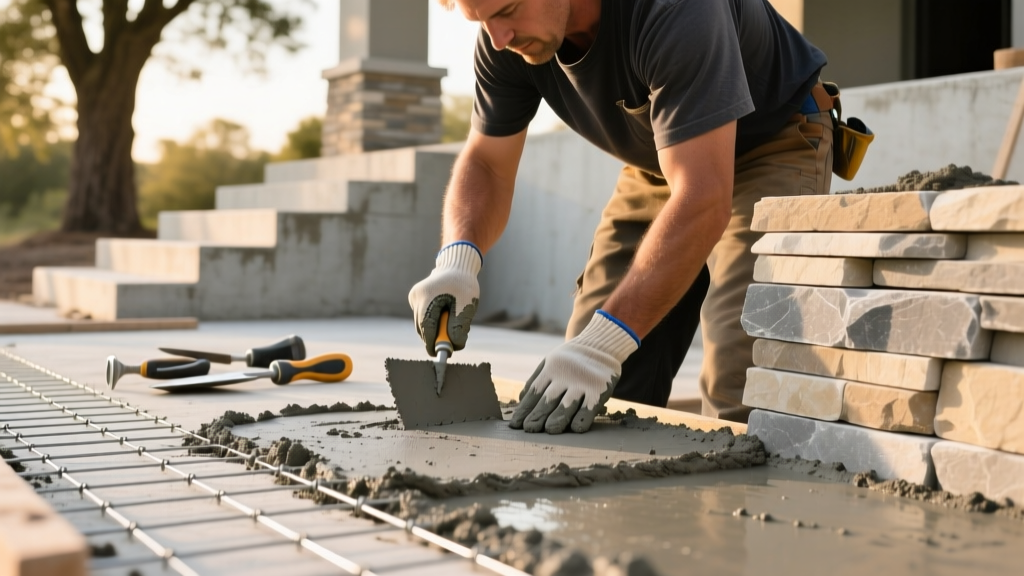
Polymer-Modified Veneer Mortars: The Modern Standard
For 90% of residential and commercial stone veneer projects—particularly those utilizing manufactured concrete stone or lightweight natural profiles—polymer-modified veneer mortar is the undisputed best mortar for stone veneer. These pre-blended, factory-engineered mixes contain Portland cement, graded masonry sand, and proprietary redispersible polymer powders (typically Vinyl Acetate Ethylene or acrylics).
Why Polymers Change the Chemistry
When mixed with water, the polymer powder re-emulsifies, creating a microscopic plastic network throughout the cement matrix as it cures. This network provides three distinct advantages over traditional cementitious bonds:
- Flexural Strength: Traditional mortar is rigid and brittle. Polymer-modified mortar can absorb the thermal expansion and contraction of exterior walls without micro-fracturing, drastically reducing freeze-thaw spalling.
- High-Tack Non-Sag Properties: Manufactured stone veneer can weigh 10 to 15 lbs per square foot. Polymer mortars exhibit extreme initial grab (tack), holding heavy stones in place on vertical surfaces without the need for mechanical fasteners or temporary shoring while the bed joint cures.
- Water Retention: Polymers reduce the porosity of the mortar bed, limiting the migration of water-soluble salts to the surface, which is the primary mechanism behind efflorescence.
Top Product Specifications
Leading formulations in the current market include SAKRETE Veneer Stone Mortar and ProSpec Veneer Stone Mortar. Both are engineered specifically for the unique absorption rates of manufactured stone. When mixing these products, strict adherence to water ratios is mandatory; adding excess water to improve workability will dilute the polymer emulsion, destroying the non-sag properties and reducing bond strength by up to 40%.
Type S Masonry Mortar: The Heavy-Duty Workhorse
Defined by ASTM C270 standards, Type S mortar is characterized by its high compressive strength (minimum 1,800 psi) and high tensile bond strength. It is formulated using two parts Portland cement, one part hydrated lime, and nine parts sand (or pre-blended masonry cement equivalents). While it lacks the chemical tack of polymer-modified blends, Type S remains the mandatory choice for specific heavy-duty scenarios.
When Type S Outperforms Polymers
If your project involves full-thickness, heavy natural stone (such as 3-inch to 4-inch thick limestone, granite, or heavy fieldstone), polymer veneer mortars are insufficient. The sheer mass of these stones exceeds the shear strength of a thin polymer bed. Type S mortar, applied in a thick-set method (1/2-inch to 1-inch bed joints), provides the necessary compressive load-bearing capacity.
Furthermore, Type S is the required material for the scratch coat. When applying stone over open framing, a weather-resistive barrier, and metal lath, the scratch coat must be highly breathable, rigid, and capable of deeply penetrating the lath dimples to create a mechanical lock. A standard Type S mix, applied at 3/8-inch and scored horizontally, creates the ideal structural substrate for the subsequent stone installation.
Modified Thinset: The Interior Mesh-Backed Specialist
Modified thinset mortars, governed by ANSI A118.4 standards, are designed for ceramic and porcelain tile, but they have found a niche in the stone veneer market. However, their use is strictly limited to interior applications featuring lightweight, mesh-backed stone panels installed over drywall or cement backer board.
Thinset offers unparalleled bond strength to non-porous substrates like painted drywall or fiberglass-faced gypsum boards, where traditional masonry mortars will fail to adhere. The high polymer content in premium thinsets (such as LATICRETE 254 Platinum or Custom Building Products MegaLite) allows for a razor-thin 1/8-inch application, preserving interior floor space and reducing overall wall weight. However, thinset must never be used on exterior facades or over metal lath. Its lack of vapor permeability and inability to bridge the dimensional gaps of wire lath make it a catastrophic failure risk in exterior environments.
The 2026 Decision Framework: Matching Mortar to Substrate
Eliminate guesswork on the job site by applying this material-to-substrate decision matrix:
Scenario A: Exterior Manufactured Stone over Wood Framing
- Substrate Prep: WRB + 2.5lb galvanized metal lath.
- Scratch Coat: Type S Masonry Mortar (3/8-inch thick, horizontally scored).
- Setting Bed: Polymer-Modified Veneer Mortar (1/2-inch thick, back-buttered).
Scenario B: Exterior Heavy Natural Stone (Full Thickness)
- Substrate Prep: CMU block wall or reinforced concrete foundation.
- Scratch Coat: Not required if applying directly to clean, open-pore CMU.
- Setting Bed: Type S Masonry Mortar (1/2-inch to 1-inch thick-set, with mechanical wall ties if exceeding 12 inches in thickness).
Scenario C: Interior Mesh-Backed Panels over Drywall
- Substrate Prep: Level 4 finished drywall or cement board.
- Scratch Coat: None required.
- Setting Bed: ANSI A118.4 Modified Thinset (1/8-inch to 1/4-inch notch trowel).
Critical Application Protocols to Prevent Delamination
Even the best mortar for stone veneer will fail if application protocols are ignored. The most common contractor errors in 2026 involve open-time mismanagement and inadequate mechanical bonding.
The 100% Back-Buttering Rule
Applying mortar to the wall (the setting bed) is only half the process. The back of every single stone must be 'back-buttered'—meaning a thin layer of mortar is burned into the stone's pores using the flat edge of a trowel before pressing it into the setting bed. Manufactured stones often have release agents (dust or oils from the molds) on their backs. Failing to back-butter results in the mortar bonding to the dust, not the stone, leading to hollow spots and eventual delamination.
Pro Tip: In high-temperature environments (above 85°F), polymer-modified mortars will 'skin over' in as little as 10 to 15 minutes. Once a skin forms on the setting bed, the mechanical bond is compromised. Mix smaller batches and discard any mortar that has developed a surface skin; never attempt to re-temper (add water to) a polymer-modified mix that has begun its initial set.
Managing Efflorescence
Efflorescence—the white, powdery salt deposit on stone surfaces—is driven by moisture moving through the mortar bed. To mitigate this, ensure the mortar is mixed to the manufacturer's exact water specifications (a stiff, peanut-butter-like consistency is ideal). A wetter mix introduces excess free water that will migrate through the stone face during the curing process, carrying soluble alkalis to the surface. Additionally, ensure the building's roof overhangs, gutters, and ground grading are designed to keep bulk water away from the base of the veneer installation.
Written by
Priya KapoorPriya Kapoor is a real estate market analyst and construction economics researcher with expertise in housing affordability, development feasibility, and infrastructure investment. She holds a Master of Regional Planning from Cornell University and previously worked as a senior analyst at CBRE's Investment Properties group, where she modeled returns for $4B in mixed-use development pipelines. Priya now runs an independent research practice advising developers, municipalities, and REITs on construction cost forecasting and market timing. She publishes the quarterly "BuildMat Market Pulse" report tracking material price indices across 12 commodity categories. Based in Austin, TX, Priya serves on the board of Habitat for Humanity Austin and is a marathon runner.
More from Priya Kapoor
View all
Construction Cost
Cost to Build a 1600 Sq Ft Home in 2026: Full Breakdown
Accurate 2026 cost to build a 1600 sq ft home—material, labor, and regional pricing breakdowns included. Plan your budget with real-time estimates.
Aug 11, 2026

Wood & Lumber
Name the Types of Wood for Pressure Treatment and Preservation
Learn how to name the types of wood best suited for pressure treatment. Compare species treatability, chemical retention levels, and 2026 preservation costs.
Aug 4, 2026

Stone & Masonry
Stone Veneer Suppliers Lindenhurst: 2026 Cost Analysis
Analyze 2026 stone veneer costs in Lindenhurst, NY. Compare local supplier pricing, delivery fees, and Suffolk County installation labor rates.
Aug 4, 2026