Rough Cut Stone Veneer Maintenance: Cleaning, Sealing, and Repair
Master rough cut stone veneer maintenance. Learn specific cleaning protocols, efflorescence removal, penetrating sealers, and mortar repair techniques.

The Unique Maintenance Challenges of Rough Cut Profiles
Rough cut stone veneer—encompassing split-face, quarry-faced, and ashlar profiles with rugged, uneven textures—provides striking architectural depth. However, the very geometry that makes this material visually appealing creates distinct maintenance liabilities. Unlike tumbled or honed stone, rough cut profiles feature depth variations ranging from 1 to 3 inches. These deep crevices and pronounced shadow lines act as physical traps for wind-blown soil, organic debris, and moisture.
When water pools in the horizontal ledges of a split-face veneer, it accelerates freeze-thaw spalling in colder climates and creates an ideal microclimate for biological growth. Furthermore, the porous nature of the mortar joints used in veneer installations means that aggressive cleaning methods can easily erode the binding material, leading to structural failure behind the facade. Proper maintenance requires a highly specific approach that respects both the stone's mineral composition and the mortar's compressive strength.
Never use high-pressure nozzles (0-degree or 15-degree tips) on rough cut stone veneer. For manufactured stone veneer (MSV), limit pressure to 800 PSI maximum. For natural rough cut stone, do not exceed 1,200 PSI. Always use a 40-degree fan tip and maintain a minimum distance of 18 inches from the surface. High-pressure streams will instantly erode the Portland cement matrix in MSV and can fracture the natural bedding planes of sedimentary stones like sandstone and limestone.
Routine Cleaning Protocol for Deep-Creviced Stone
Standard household detergents and chlorine bleach are fundamentally incompatible with masonry. Chlorine bleach (sodium hypochlorite) leaves behind soluble salts that exacerbate efflorescence and destroys the beneficial lime content in mortar joints. Instead, utilize an oxygen-based cleaning protocol that lifts dirt from deep crevices without altering the stone's pH.
The Oxygen Bleach Agitation Method
- Pre-Wet the Surface: Saturate the stone and mortar joints with clean water using a garden hose. This prevents the cleaning solution from absorbing too deeply into the masonry substrate.
- Mix the Solution: Dissolve 1 cup of powdered oxygen bleach (sodium percarbonate, such as Stain Solver or OxiClean) per 1 gallon of warm water. Do not use liquid oxygen bleaches, as they often contain unnecessary surfactants that leave residue.
- Apply and Dwell: Apply the solution using a low-pressure pump sprayer. Allow a dwell time of 10 to 15 minutes. The solution must remain wet; mist it lightly with water if it begins to dry in direct sunlight.
- Mechanical Agitation: Scrub the deep crevices using a stiff nylon-bristle brush. Never use wire brushes, as steel bristles will shed microscopic metal particles that rust and stain the stone permanently.
- Rinse Thoroughly: Rinse from the top down with a low-pressure hose to flush the suspended dirt out of the crevices.
Tackling Efflorescence in Rough Textures
Efflorescence—the white, powdery salt deposit common on new masonry—is particularly stubborn in rough cut stone because it anchors deeply into the porous surface. According to the Brick Industry Association Technical Note 20, water should never be used to clean efflorescence, as it simply dissolves the salts and drives them back into the masonry pores.
First, remove the bulk of the deposits using a dry, stiff nylon brush and a vacuum with a brush attachment. For persistent, crystallized efflorescence trapped in the rough grooves, apply a diluted sulfamic acid or phosphoric acid masonry cleaner (such as Prosoco Sure Klean Restoration Cleaner). Always test the acid on an inconspicuous 2x2 foot area first, as acid etching can permanently lighten certain natural stones like bluestone or slate.
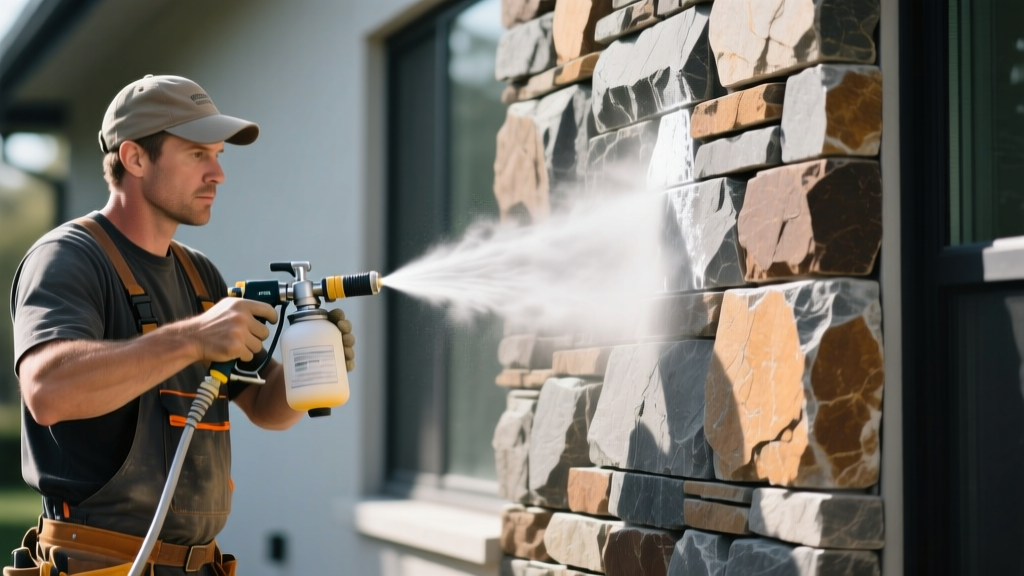
Sealing Rough Cut Veneer: Penetrating vs. Film-Forming
Applying the wrong sealer to rough cut stone veneer is a catastrophic and expensive mistake. Film-forming sealers (acrylics and urethanes) create a plastic-like shell over the stone. On rough textures, these sealers pool in the deep crevices, creating a milky, uneven appearance that is nearly impossible to remove. Furthermore, they trap moisture vapor inside the wall assembly, leading to hidden rot and stone spalling.
The Natural Stone Institute strongly recommends breathable, penetrating sealers for exterior masonry. Below is a decision matrix for selecting the correct chemical protection for your veneer.
| Sealer Type | Breathability | Appearance Change | Lifespan | 2026 Cost / Sq Ft |
|---|---|---|---|---|
| Silane/Siloxane Penetrating | Excellent (100% vapor permeable) | None (Invisible matte finish) | 5–10 Years | $0.75 – $1.25 |
| Acrylic Film-Forming | Poor (Traps moisture vapor) | High (Glossy/Satin, pools in crevices) | 1–3 Years | $0.40 – $0.80 |
| Unsealed (Natural) | Maximum | Natural weathering and patina | N/A | $0.00 |
Expert Recommendation: For rough cut exterior veneer, use a water-based silane/siloxane blend (e.g., Prosoco Weather Seal Siloxane PD or Foundation Armor SX5000). These molecules are small enough to penetrate the dense capillary structure of the stone and mortar, reacting chemically to form a hydrophobic resin matrix beneath the surface. Apply using a low-pressure sprayer, ensuring you saturate the deep crevices without letting the product run and dry on the surface.
Biological Growth Removal (Moss, Algae, and Lichen)
The horizontal ledges of rough cut stone are prime real estate for moss and lichen. While chlorine bleach will kill the growth, it damages the surrounding landscaping and degrades the mortar. According to Penn State Extension, potassium salts of fatty acids (insecticidal/algicidal soaps) or zinc sulfate solutions are highly effective, masonry-safe alternatives.
Apply a potassium salt solution directly to the biological growth. Allow it to sit for 24 to 48 hours. The organic matter will turn brown and detach from the stone's pores. Once dead, use a wooden scraper or a stiff nylon brush to dislodge the moss from the deep crevices. To prevent regrowth, install zinc or copper flashing strips above the veneer section; as rain washes over the metal, it deposits trace ions down the wall that naturally inhibit biological growth.
Mortar Joint Repair and Repointing
The mortar joints in stone veneer are designed to be sacrificial—they should be slightly softer than the stone itself so that any structural movement or freeze-thaw expansion cracks the mortar rather than the stone. When repointing damaged joints in rough cut veneer, matching the compressive strength and profile is critical.
Selecting the Correct Mortar
- Type N Mortar (750 PSI): The standard for most exterior stone veneers. It offers a balance of strength and flexibility, accommodating minor thermal expansion without cracking the stone.
- Type S Mortar (1,800 PSI): Generally too rigid for standard veneer applications. Use only if the veneer is installed on a retaining wall or below-grade foundation where high lateral soil loads are present.
- Historic/Lime Mortar (350-500 PSI): Required if the rough cut stone is a soft, historic sandstone or limestone. Modern Portland cement mortars will destroy soft natural stones over time.
Tooling the Joint for Water Shedding
When applying new mortar to rough cut stone, use a margin trowel to push the mix deeply into the cavity, eliminating air pockets. Once the mortar has thumb-print hardness (usually 45 to 90 minutes depending on humidity), tool the joint using a convex jointer or a weathered jointer. A convex profile compresses the mortar against the stone edges, creating a dense, water-shedding surface that directs runoff away from the rough stone lips, preventing water from pooling in the horizontal crevices.
Frequently Asked Questions
Can I use a muriatic acid wash to clean my rough cut stone veneer?
Muriatic (hydrochloric) acid should be avoided on rough cut veneers unless specifically prescribed by a masonry restoration specialist. It is highly aggressive and will instantly etch calcareous stones like limestone, marble, and travertine, permanently dissolving the surface texture. Even on siliceous stones like granite, it can strip the color from the mortar joints and leave iron deposits that rust over time.
How often does rough cut stone veneer need to be resealed?
If treated with a high-quality penetrating silane/siloxane sealer, rough cut stone veneer typically requires resealing every 5 to 10 years. You can test the sealer's efficacy by splashing water on the stone. If the water beads up and rolls off, the sealer is intact. If the water immediately darkens the stone and absorbs into the surface, it is time to clean and reseal the facade.
Why is my manufactured rough cut stone veneer flaking?
Flaking, or spalling, on manufactured stone veneer (MSV) is almost always caused by trapped moisture freezing and expanding. This occurs when a non-breathable film-forming sealer was applied, when the weep screed at the base of the wall is blocked by soil or mulch, or when the mortar joints were tooled before the mortar had sufficiently cured, trapping water inside the matrix. Ensure the bottom 6 inches of the veneer remain clear of soil and landscaping debris to allow the wall cavity to drain and dry.
Written by
David NakamuraDavid Nakamura is a licensed architect (AIA) and construction technology writer focused on sustainable building methods, mass timber engineering, and high-performance building envelopes. He holds a Master of Architecture from the University of Washington and is a certified Passive House Consultant (CPHC). David spent eight years at the Seattle firm Mithun, where he led the design of three LEED Platinum projects, before founding his own practice specializing in net-zero residential design. He serves on the editorial advisory board of GreenBuilder Magazine and has authored peer-reviewed papers on cross-laminated timber (CLT) connections for the Journal of Structural Engineering. In his spare time, David teaches woodworking at Pratt Fine Arts Center and kayaks the Puget Sound.
More from David Nakamura
View all
Construction Cost
Labor Cost to Build a Deck Per Sq Ft: 2026 Installation Guide
Discover the exact labor cost to build a deck per sq ft in 2026. This installation guide breaks down contractor rates, complexity factors, and hidden fees.
Aug 4, 2026

Construction Cost
How Much Does It Cost to Build a 3 Bedroom House? Financing Guide
Learn exactly how much it costs to build a 3 bedroom house and explore 2026 financing options, construction loan types, and budget frameworks for your build.
Aug 4, 2026

Construction Cost
Cost to Build a Tennis Court: 2026 Guide
How much does it cost to build a tennis court in 2026? Breakdowns for asphalt, concrete, and synthetic surfaces plus fencing and lighting.
Jul 30, 2026