Technical Specs: Choosing the Right Adhesive for Stone Veneer
Explore technical specifications for stone veneer adhesive, including ANSI standards, shear bond strength, and polymer-modified mortar selection.

ANSI A118 Standards: The Baseline for Stone Veneer Adhesives
Selecting an adhesive for stone veneer requires strict adherence to performance thresholds defined by the American National Standards Institute (ANSI). Unlike ceramic tile, natural stone veneer possesses variable porosity, higher dead loads, and extreme sensitivity to substrate deflection. Consequently, organic mastics (Type 1 organic adhesives) are strictly prohibited for stone veneer installations due to their inability to cure under low-permeability materials and their vulnerability to moisture re-emulsification.
Specifiers must rely on cementitious thin-set mortars, specifically those meeting ANSI A118.4 (Modified Dry-Set Cement Mortar) or ANSI A118.15 (Improved Modified Dry-Set Cement Mortar). The primary differentiator is the volume and type of redispersible polymer powder—typically Vinyl Acetate Ethylene (VAE) or pure acrylics—integrated into the dry mix.
- ANSI A118.4: Requires a minimum shear bond strength of 400 psi. Suitable for interior applications over rigid, non-deflecting substrates like concrete or cement backer board.
- ANSI A118.15: Demands a minimum shear bond strength of 500 psi and superior flexibility. This is the mandatory specification for exterior stone veneer, installations over framed walls, and heavy stacked stone profiles.
For projects requiring maximum chemical resistance or zero water absorption during the curing phase, ANSI A118.3 (Epoxy Adhesives) is specified, though it is rarely used in residential stone veneer due to high material costs and complex rheology.
Shear Bond Strength and Load-Bearing Capacities
Stone veneer panels and stacked stone profiles exert continuous gravitational shear force on the adhesive bond line. The following matrix compares the technical performance metrics across the three primary adhesive categories used in masonry and veneer applications.
| Metric | ANSI A118.4 (Standard Modified) | ANSI A118.15 (Improved Modified) | ANSI A118.3 (Epoxy) |
|---|---|---|---|
| Shear Bond Strength | ≥ 400 psi | ≥ 500 psi | ≥ 1000 psi |
| Tensile Strength | ≥ 200 psi | ≥ 250 psi | ≥ 500 psi |
| T-Slump (Anti-Sag) | Standard | High (Large Format/Heavy) | High |
| Deformation Class (ISO Equiv.) | S1 (Flexible) | S2 (Highly Deformable) | Rigid |
| Recommended Application | Interior, stable substrates | Exterior, framed walls, heavy stone | Commercial wet areas, pools |
Industry-leading products meeting the rigorous A118.15 standard include LATICRETE 254 Platinum and Custom Building Products ProLite. These formulations utilize high-molecular-weight polymers that provide exceptional non-sag (anti-slump) properties, preventing heavy stone veneer from sliding down vertical surfaces before the cementitious matrix hydrates.
Substrate Deflection and Crack Isolation Requirements
The most common cause of stone veneer delamination is not adhesive failure, but cohesive failure within the stone or substrate due to unmitigated deflection. Natural stone is brittle and lacks the tensile flexibility of porcelain. According to the Tile Council of North America (TCNA) Handbook, the maximum allowable deflection for natural stone installations is L/720 under total load, compared to L/360 for standard ceramic tile.
When installing stone veneer over wood or steel-framed walls, the substrate will inevitably experience wind loads, thermal expansion, and seismic movement. To protect the adhesive bond line from transferring these stresses into the stone, specifiers must incorporate crack isolation membranes meeting ANSI A118.12.
Application Specifications: Troweling and Coverage Thresholds
Proper adhesive selection is rendered useless if the application technique fails to achieve the required contact area. Stone veneer installation demands strict adherence to coverage thresholds to prevent void spaces where moisture can accumulate and freeze.
Mandatory Coverage Requirements
- Interior Dry Areas: Minimum 80% adhesive contact.
- Exterior and Wet Areas: Minimum 95% adhesive contact.
Trowel Notch Selection and Back-Buttering
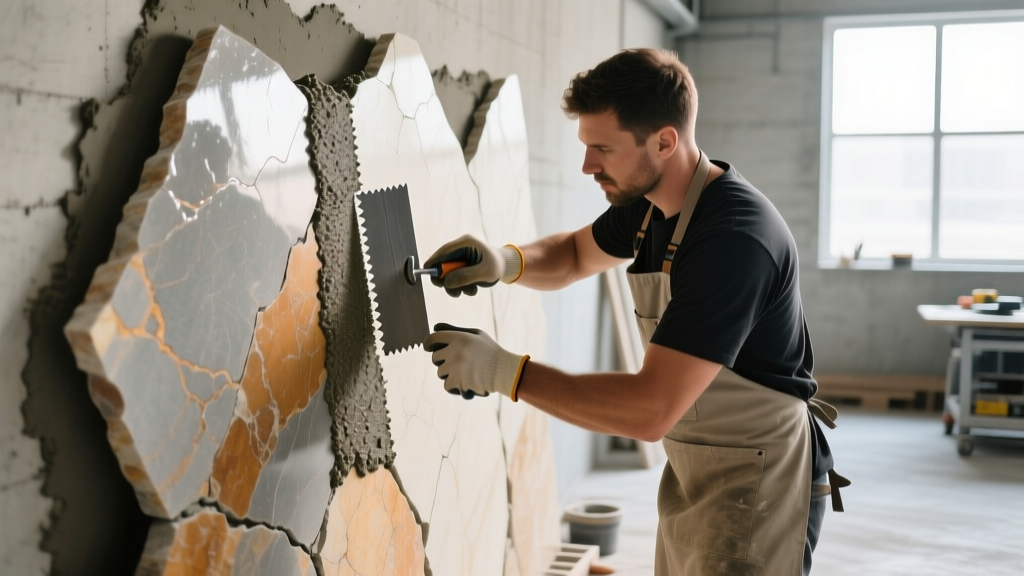
For stone veneer panels exceeding 12 inches in any direction, or any stacked stone profile with an uneven back, a 1/2-inch x 1/2-inch square-notch trowel is the minimum requirement. The installer must hold the trowel at a strict 45-degree angle to ensure full ridge height.
Furthermore, back-buttering (flat-troweling a thin layer of adhesive directly onto the back of the stone veneer) is mandatory for all exterior installations and any stone with a mesh backing or deep clefts. This technique fills the microscopic voids on the stone's surface, ensuring the mechanical bond is established between the adhesive and the stone substrate, rather than trapping air pockets that lead to freeze-thaw spalling.
Environmental Constraints: Open Time and Temperature Thresholds
The hydration process of polymer-modified thin-set mortars is highly sensitive to ambient environmental conditions. Specifiers must account for both pot life (the working time of the mixed adhesive in the bucket) and open time (the duration the troweled adhesive remains receptive to bonding after application to the wall).
- Temperature Limits: Ambient and substrate temperatures must remain between 40°F (4°C) and 100°F (38°C) during installation and for a minimum of 72 hours post-installation. Below 40°F, cement hydration stalls, and polymer coalescence fails, resulting in a chalky, weak bond line.
- Open Time Degradation: In high-heat or low-humidity environments, the open time of an A118.15 adhesive can drop from 20 minutes to under 10 minutes. If a skin forms on the trowel ridges, the adhesive will not transfer to the stone veneer. Installers must perform the 'finger touch' test; if the ridge does not stick to the finger, the adhesive must be scraped off and reapplied.
Troubleshooting Common Adhesive Failure Modes
When forensic analysis is performed on failed stone veneer installations, the root cause typically falls into one of three specific failure modes:
- Adhesive Starvation: Caused by using a trowel notch that is too small (e.g., 1/4-inch) or failing to collapse the ridges by pressing the stone firmly. The adhesive contacts only the peaks of the stone's back, resulting in less than 50% coverage and eventual shear failure.
- Efflorescence and Staining: Occurs when standard (non-rapid-set) cementitious adhesives are used with highly porous, light-colored stones like limestone or white marble. The prolonged moisture from the slow-curing adhesive migrates through the stone, depositing soluble salts on the face. For these materials, a rapid-setting, white-portland-cement-based adhesive is required.
- Substrate Contamination: Applying adhesive over painted drywall, dusty concrete, or waterproofing membranes that have exceeded their tack-free window. The adhesive bonds to the contaminant layer, which subsequently detaches from the structural substrate under the dead load of the stone.
Written by
Priya KapoorPriya Kapoor is a real estate market analyst and construction economics researcher with expertise in housing affordability, development feasibility, and infrastructure investment. She holds a Master of Regional Planning from Cornell University and previously worked as a senior analyst at CBRE's Investment Properties group, where she modeled returns for $4B in mixed-use development pipelines. Priya now runs an independent research practice advising developers, municipalities, and REITs on construction cost forecasting and market timing. She publishes the quarterly "BuildMat Market Pulse" report tracking material price indices across 12 commodity categories. Based in Austin, TX, Priya serves on the board of Habitat for Humanity Austin and is a marathon runner.
More from Priya Kapoor
View all
Construction Cost
Cost to Build a 1600 Sq Ft Home in 2026: Full Breakdown
Accurate 2026 cost to build a 1600 sq ft home—material, labor, and regional pricing breakdowns included. Plan your budget with real-time estimates.
Aug 11, 2026

Wood & Lumber
Name the Types of Wood for Pressure Treatment and Preservation
Learn how to name the types of wood best suited for pressure treatment. Compare species treatability, chemical retention levels, and 2026 preservation costs.
Aug 4, 2026

Stone & Masonry
Stone Veneer Suppliers Lindenhurst: 2026 Cost Analysis
Analyze 2026 stone veneer costs in Lindenhurst, NY. Compare local supplier pricing, delivery fees, and Suffolk County installation labor rates.
Aug 4, 2026