Essential Maintenance for Stone Veneer and Brick Siding Exteriors
Protect your exterior investment. Learn exact PSI limits, efflorescence treatments, and sealing protocols for stone veneer and brick siding maintenance.

The Hidden Vulnerabilities of Masonry Exteriors
Stone veneer and brick siding offer exceptional durability, frequently lasting 50 to 100 years when properly installed. However, their longevity relies entirely on moisture management and mortar integrity. Neglecting routine maintenance does not merely result in cosmetic degradation; it leads to structural spalling, substrate rot behind the weather-resistant barrier (WRB), and catastrophic freeze-thaw failure. While clay brick and natural stone are highly resilient, manufactured stone veneer (MSV) is essentially a lightweight concrete product that requires highly specific care protocols to prevent surface erosion and matrix breakdown.
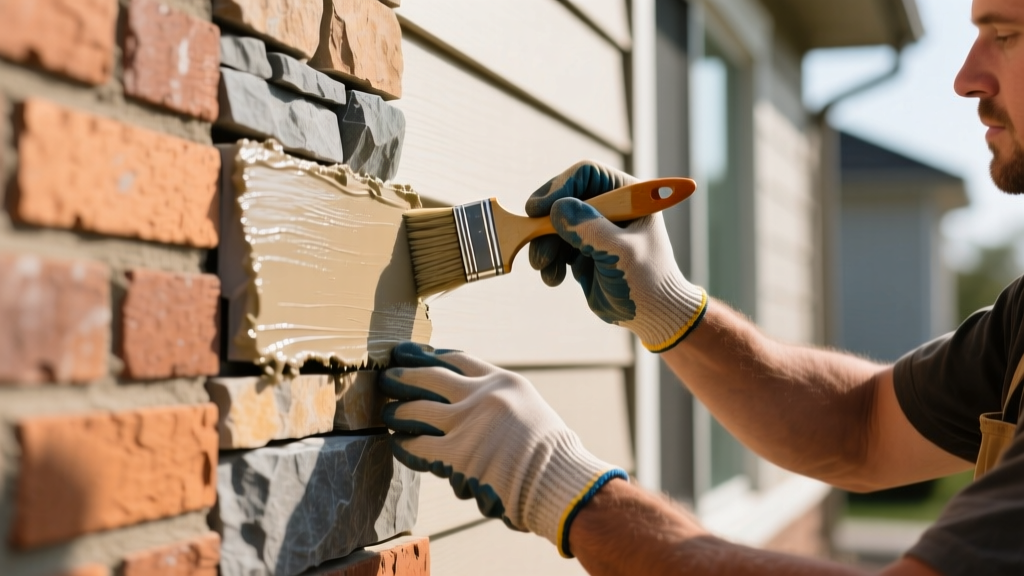
Precision Cleaning: PSI Limits and Chemical Protocols
The most common mistake homeowners and inexperienced contractors make is treating all masonry surfaces equally during power washing. The color layer on manufactured stone veneer is typically only 1/8 to 1/4 inch thick. Exceeding the recommended pressure will strip the pigmented face, exposing the gray aggregate beneath. Clay brick is far denser but can suffer from mortar erosion if subjected to concentrated high-pressure streams.
| Material Type | Max Pressure (PSI) | Nozzle Tip (Degree) | Recommended Cleaning Agent |
|---|---|---|---|
| Manufactured Stone Veneer | 400 - 600 PSI | 40° (White Fan) | Mild alkaline detergent or specialized MSV cleaner |
| Natural Stone (Limestone/Sandstone) | 800 - 1,000 PSI | 25° (Green Fan) | Neutral pH stone cleaner (non-acidic) |
| Clay Brick Siding | 1,200 - 1,500 PSI | 15° (Yellow Fan) or 25° | Masonry-specific alkaline cleaner for organic stains |
Never use raw muriatic acid or highly acidic brick cleaners on manufactured stone veneer. The acid reacts with the calcium hydroxide in the Portland cement binder, causing the surface to chalk, pit, and permanently lose its structural cohesion. Reserve acidic cleaners strictly for uncolored, traditional clay brick, and always pre-wet the masonry before application to prevent deep chemical penetration.
Eradicating Efflorescence Without Damaging the Matrix
Efflorescence is the white, powdery deposit of water-soluble salts that migrates to the surface of masonry as moisture evaporates. While it is primarily a cosmetic issue, persistent efflorescence indicates chronic moisture intrusion behind the veneer or within the mortar joints. According to the Brick Industry Association's Technical Notes, removing these salts requires a graduated approach to avoid driving the salts deeper into the pores.
- Dry Brushing (Step 1): Use a stiff, non-metallic bristle brush to aggressively remove loose surface salts. Do not use water at this stage, as it will simply dissolve the salts and pull them back into the masonry pores.
- Vinegar Solution (Step 2): For mild, stubborn deposits, apply a solution of 1 part distilled white vinegar to 3 parts water. Agitate with a nylon brush and rinse thoroughly with low-pressure water.
- Specialized Cleaners (Step 3): For severe cases on brick or natural stone, use a proprietary efflorescence remover like PROSOCO Sure Klean Light Duty Concrete Cleaner. These formulations contain buffered acids that dissolve salts without aggressively attacking the cementitious binder.
- Address the Source: If efflorescence returns within weeks of cleaning, inspect the weep screeds, flashing, and roof drainage. The moisture source must be eliminated, or the salts will continue to migrate.
Mortar Joint Triage: When to Tuckpoint
Mortar is designed to be the sacrificial element in a masonry wall; it should be softer and more permeable than the stone or brick it binds. Over time, freeze-thaw cycles and thermal expansion cause hairline cracking, allowing water to infiltrate the drainage plane. In 2026, professional tuckpointing costs range from $9 to $16 per square foot, depending on scaffold requirements and joint complexity.
- Type N Mortar (750 PSI): The standard for stone veneer and non-load-bearing brick siding. Mix ratio: 1 part Portland cement, 1 part hydrated lime, 6 parts masonry sand. Its high lime content provides superior flexibility and autogenous healing for micro-cracks.
- Type S Mortar (1,800 PSI): Reserved for structural brick walls or below-grade applications. Using Type S on veneer siding can cause the rigid mortar to crack the softer masonry units during thermal expansion.
When repairing joints, grind out the deteriorated mortar to a depth of at least 2 to 2.5 times the width of the joint. This ensures adequate mechanical keying for the new mortar. Always mist the joints with water before applying fresh mortar to prevent the dry, existing masonry from sucking the moisture out of the new mix too quickly, which leads to shrinkage cracking and poor adhesion.
The Sealing Debate: Breathable Penetrants vs. Film-Formers
The decision to seal stone veneer and brick siding is heavily debated in the masonry industry. The National Park Service Preservation Brief on Waterproof Coatings explicitly warns against the use of non-breathable sealers on historic and traditional masonry, a principle that applies equally to modern veneer systems.
Film-Forming Sealers (Acrylics, Urethanes, Epoxies)
These products create a continuous plastic-like film on the surface. While they provide an immediate, high-gloss 'wet look' that many homeowners find visually appealing, they act as a vapor barrier. When moisture inevitably enters the wall system from the interior (via humid air exfiltration) or through micro-cracks in the mortar, it becomes trapped behind the sealer. During winter, this trapped water freezes, expands, and causes the face of the stone or brick to spall off entirely.
Penetrating Sealers (Silanes and Siloxanes)
Silane/siloxane sealers are the only chemically appropriate choice for exterior masonry maintenance. Instead of forming a surface film, these molecules penetrate deeply into the capillary pores and chemically bond to the silica in the masonry. They create a hydrophobic lining that repels liquid water and wind-driven rain, while remaining completely vapor-permeable. This allows internal moisture to evaporate outward, preventing freeze-thaw damage. Look for products with a minimum 40% active siloxane content, such as PROSOCO Siloxane PD or Euclid Chemical EverClear, and reapply every 5 to 7 years depending on UV exposure and driving rain frequency.
Seasonal Inspection Matrix
Routine maintenance for stone veneer and brick siding should be integrated into a seasonal schedule to catch minor failures before they compromise the structural sheathing.
- Spring: Inspect the weep screed at the base of the veneer. Clear away accumulated mulch, soil, or debris that bridges the gap between the grade and the screed, which can cause capillary wicking into the wall cavity. Check for new efflorescence, which often blooms after winter snowmelt.
- Summer: Perform the annual wash using the PSI limits outlined above. Trim back any ivy, creeping fig, or shrubbery touching the masonry. Organic root systems can penetrate hairline mortar cracks and exert enough hydraulic pressure to fracture the joints as they grow.
- Fall: Clear gutters and downspouts. Overflowing water cascading directly onto brick or stone siding is the leading cause of localized saturation, efflorescence, and winter spalling. Verify that downspout extensions direct water at least 4 feet away from the masonry base.
- Winter: Never use chemical de-icers (like calcium chloride or rock salt) on masonry steps, walkways, or siding bases adjacent to the house. Salt-laden meltwater splashes onto the lower courses of brick and veneer, accelerating chemical degradation and causing severe scaling at the freeze line.
'The most critical component of a masonry veneer wall is not the stone itself, but the air cavity and drainage plane behind it. Surface maintenance is useless if the flashing and weep systems are compromised.' — Masonry Veneer Manufacturers Association (MVMA) Installation Guidelines
By adhering to strict pressure limits, utilizing vapor-permeable siloxane treatments, and maintaining the structural integrity of Type N mortar joints, property owners can ensure their stone veneer and brick siding remains structurally sound and visually striking for generations.
Written by
David NakamuraDavid Nakamura is a licensed architect (AIA) and construction technology writer focused on sustainable building methods, mass timber engineering, and high-performance building envelopes. He holds a Master of Architecture from the University of Washington and is a certified Passive House Consultant (CPHC). David spent eight years at the Seattle firm Mithun, where he led the design of three LEED Platinum projects, before founding his own practice specializing in net-zero residential design. He serves on the editorial advisory board of GreenBuilder Magazine and has authored peer-reviewed papers on cross-laminated timber (CLT) connections for the Journal of Structural Engineering. In his spare time, David teaches woodworking at Pratt Fine Arts Center and kayaks the Puget Sound.
More from David Nakamura
View all
Construction Cost
Labor Cost to Build a Deck Per Sq Ft: 2026 Installation Guide
Discover the exact labor cost to build a deck per sq ft in 2026. This installation guide breaks down contractor rates, complexity factors, and hidden fees.
Aug 4, 2026

Construction Cost
How Much Does It Cost to Build a 3 Bedroom House? Financing Guide
Learn exactly how much it costs to build a 3 bedroom house and explore 2026 financing options, construction loan types, and budget frameworks for your build.
Aug 4, 2026

Construction Cost
Cost to Build a Tennis Court: 2026 Guide
How much does it cost to build a tennis court in 2026? Breakdowns for asphalt, concrete, and synthetic surfaces plus fencing and lighting.
Jul 30, 2026