Elevating Design with Polymer Modified Stone Veneer Mortar
Discover how polymer modified stone veneer mortar enables daring architectural designs, from cantilevered hearths to seamless exterior cladding.

The Invisible Foundation of Modern Stone Design
Architectural stone design is fundamentally a battle against gravity and environmental stress. When designers specify dense, large-format natural stones—such as thick-cut quartzite, heavy slate, or oversized limestone ledgestone—the limiting factor is rarely the stone itself, but the adhesive binding it to the substrate. Standard Portland cement-based Type S mortars, while sufficient for traditional bricklaying and low-profile exterior veneers, frequently fail under the shear stress and dynamic movement inherent in modern interior feature walls and complex exterior cladding.
Enter polymer modified stone veneer mortar. By integrating redispersible polymer powders (typically acrylics or vinyl acetate-ethylene) into the cementitious matrix, manufacturers have created a bonding agent that fundamentally expands the boundaries of stone design. This advanced mortar category provides the flexural strength, non-sag characteristics, and tensile adhesion required to execute daring architectural visions without relying on visible mechanical anchors or restrictive design compromises.
Why Designers Specify Polymer Modified Formulations
The shift toward polymer-modified mortars in high-end residential and commercial projects is driven by three critical performance metrics that directly translate to design freedom:
- Tensile Adhesion Strength: Standard unmodified mortars typically achieve 50 to 100 psi of tensile adhesion. Polymer-modified variants meeting ANSI A118.4 and A118.15 standards routinely exceed 400 psi. This allows for the secure installation of heavier stone profiles on vertical surfaces and ceilings.
- Flexural and Impact Resistance: Buildings experience thermal expansion, wind load deflection, and seismic micro-movements. The polymer network within the cured mortar acts as a microscopic shock absorber, distributing stress and preventing the brittle micro-cracking that causes traditional mortar joints to fail and stone to delaminate.
- Non-Sag (Thixotropic) Properties: When designing with heavy, uneven stones like fieldstone or thick stacked ledger panels, standard mortars can slump before curing, leading to lippage and compromised joint lines. Polymer-modified mortars exhibit high thixotropy, meaning they hold heavy stones perfectly in place immediately upon application, ensuring crisp, intentional shadow lines.
Design Rule of Thumb: When to Upgrade
Specify standard unmodified mortar for exterior, ground-level, low-profile manufactured stone veneer (MSV) under 15 lbs/sq ft on rigid CMU substrates. Specify polymer modified stone veneer mortar whenever the design includes: interior drywall/cement board substrates, stones exceeding 15 lbs/sq ft, freeze-thaw exterior zones, cantilevered elements, or wet environments.
Showcasing Design Applications Enabled by Advanced Mortars
The Floating Hearth and Cantilevered Stone
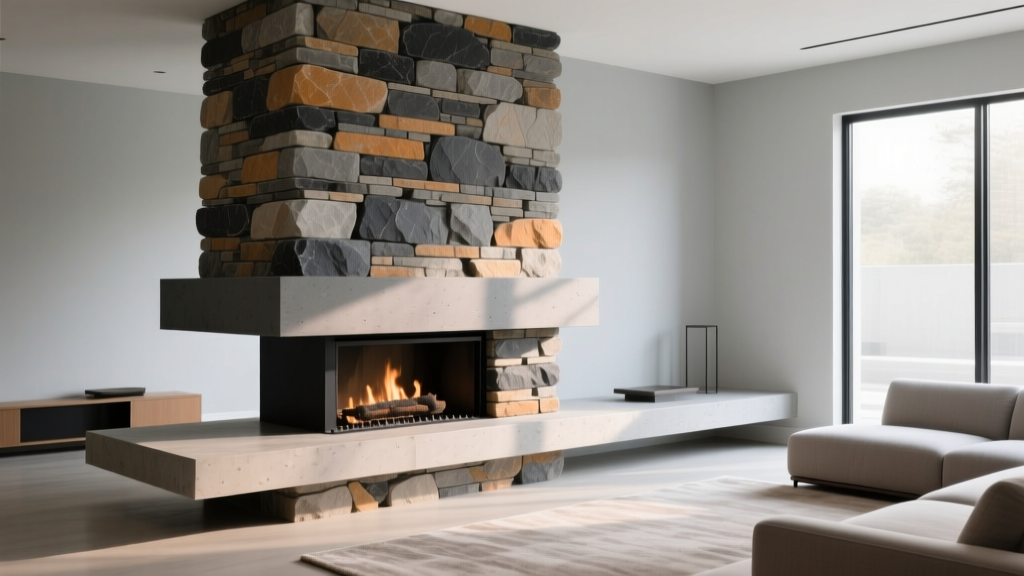
A hallmark of contemporary minimalist design is the floating hearth or cantilevered stone bench. Achieving this illusion requires bonding heavy stone directly to a framed substrate with zero visible support. Because polymer-modified mortars achieve rapid initial grab and immense long-term shear strength, installers can securely bond 3-inch thick granite or basalt hearths to reinforced cement board or steel stud framing. The mortar's non-sag properties eliminate the need for temporary shoring props during the 24-hour cure time, preserving the precise leveling required for seamless shadow gaps.
Seamless Indoor-Outdoor Feature Walls
Biophilic design often calls for a continuous stone feature wall that transitions from the interior living space through a glass facade to the exterior patio. This transition zone is subjected to extreme thermal differentials and moisture ingress. According to guidelines referenced by the Tile Council of North America (TCNA) Handbook, exterior and transition zones require mortars with high water retention and freeze-thaw stability. Polymer-modified mortars reduce water absorption rates and maintain bond integrity even when the substrate expands and contracts at different rates than the stone veneer, preventing the unsightly cracking that ruins continuous sightlines.
High-Moisture Spa and Wet Room Cladding
Designing luxury wet rooms or indoor spa enclosures with natural stacked stone requires mitigating constant hydrostatic pressure and steam penetration. Standard mortars are porous and can wick moisture to the stone face, causing efflorescence (white salt deposits) and biological growth. High-end polymer-modified mortars, when paired with a topical waterproofing membrane, create a denser, less permeable bond coat that restricts moisture migration, preserving the natural color and integrity of sensitive stones like sandstone and porous limestone.
Mortar Selection Matrix for Design Scenarios
Selecting the correct adhesive is a structural decision disguised as an aesthetic one. The following matrix compares standard options against polymer-modified formulations for common design scenarios.
| Mortar Type | Tensile Adhesion | Flexural Strength | Sag Resistance | Best Design Application |
|---|---|---|---|---|
| Type S (Standard) | 50 - 100 psi | Low | Poor | Exterior low-profile MSV on CMU |
| Polymer-Modified (ANSI A118.4) | 300 - 450 psi | High | Excellent | Interior feature walls, heavy natural stone |
| High-Performance Polymer (ANSI A118.15) | 450+ psi | Very High | Superior | Cantilevers, exteriors, wet areas, ceilings |
Real-World Product Specifications and Pricing
When budgeting a stone veneer project, material costs for the mortar represent a small fraction of the total install, making the upgrade to polymer-modified options an high-ROI decision. Below are current market specifications for leading professional-grade products:
- LATICRETE® Stone Veneer Mortar: A premium, polymer-fortified mortar designed specifically for natural and manufactured stone. It offers exceptional non-sag properties for large format stones and meets ANSI A118.4 standards. Expect to pay between $42 and $48 per 50 lb bag. Coverage is approximately 40-50 square feet per bag for standard ledger stone profiles. For detailed technical data sheets, refer to LATICRETE Stone and Brick Installation Systems.
- Custom Building Products (CBP) MegaLite® Stone Mortar: Known for its lightweight, high-bond formula that reduces installer fatigue while maintaining 400+ psi adhesion. Priced around $45 to $52 per 50 lb bag. Its extended open time (up to 45 minutes) is highly valued on complex, multi-angle fireplace surrounds.
- Sakrete Stone Veneer Mortar (Standard Baseline): A reliable, unmodified, pre-blended Type S mortar. While excellent for basic exterior scratch and brown coats or simple ground-level veneers, it lacks the polymer additives for high-shear interior applications. Priced at $16 to $20 per 50 lb bag.
Warning: Efflorescence and Moisture Trapping
While polymer-modified mortars are denser and more water-resistant, this very trait can trap moisture within the wall cavity if exterior weep holes and drainage planes are omitted. When designing exterior cavity walls with polymer mortars, you must strictly adhere to The Masonry Society guidelines for moisture management. Never use polymer-modified mortars as a substitute for proper flashing, weather-resistive barriers (WRB), and weep vents in exterior cladding systems.
Avoiding Aesthetic Failures: Installation Edge Cases
Even the most advanced polymer-modified mortar will fail if the designer ignores substrate deflection limits. Natural stone is unforgiving of movement. For interior framed walls (wood or steel studs), the substrate must be engineered to a deflection limit of L/600 (meaning the wall cannot bend more than 1/600th of its span under load). Standard residential framing often only meets L/360. If a designer specifies heavy slate veneer on a standard L/360 wall, the substrate will flex under wind or foot-traffic loads, eventually snapping the bond, regardless of the mortar's polymer content.
Furthermore, lippage—the uneven protrusion of adjacent stones—is a common aesthetic failure in stacked stone designs. Because polymer-modified mortars resist sagging, installers must use a flat trowel on the substrate and a notched trowel on the stone back (back-buttering) to ensure 100% coverage. Skimping on back-buttering with heavy stones leaves voids that invite impact damage and acoustic hollow-sounding walls.
Expert FAQ for Architects and Installers
Can polymer modified stone veneer mortar be used directly over painted drywall?
No. While the polymer provides immense adhesive strength, the bond is only as strong as the substrate surface. Painted drywall paper will delaminate under the sheer weight of stone veneer. Designers must specify a cement backer board (like Durock or HardieBacker) or a properly rated gypsum substrate (like DensGlass) mechanically fastened to the framing before mortar application.
Does the polymer additive change the color of the mortar joint?
Most high-quality polymer-modified stone veneer mortars are formulated with gray or white Portland cement bases and do not significantly alter the final cured color compared to standard mortars. However, if the design calls for a specific joint color (e.g., a bright white joint against dark basalt), it is best practice to use a polymer-modified mortar for the bond coat (scratch and set), and then point the joints with a specialized, color-consistent polymer-modified grout or pointing mortar to ensure aesthetic uniformity.
What is the required cure time before applying a stone sealer?
Polymer-modified mortars retain moisture differently than standard cementitious mixes due to their water-retention additives. While the stone may feel secure to the touch within 24 hours, the mortar requires a full 28 days to achieve complete hydration and polymer coalescence. Applying a topical stone sealer before this 28-day window will trap residual moisture inside the mortar bed, leading to vapor pressure buildup, hazing on the stone face, and potential bond degradation.
Written by
Marcus ChenMarcus Chen is a licensed structural engineer (PE) and building materials analyst with over 12 years of experience across residential, commercial, and industrial construction. He holds a Master of Science in Civil Engineering from UC Berkeley and spent six years at Thornton Tomasetti before transitioning to independent consulting and technical writing. Marcus specializes in material selection for seismic-prone regions, concrete reinforcement strategies, and lifecycle cost analysis. His work has been cited by the American Concrete Institute (ACI) and the Structural Engineers Association of California (SEAOC). When he is not on a job site or at his desk, you will find him hiking the Sierra Nevada or restoring a 1920s craftsman bungalow in Oakland, CA.
More from Marcus Chen
View all
Construction Cost
How Much Did the Eiffel Tower Cost to Build?
How much did the Eiffel Tower cost to build in 1889? We adjust for inflation and compare its budget to modern skyscraper construction.
Aug 4, 2026

Fire Resistance
What Is a Fire Resistant Material? Testing & Certification Guide
Discover what is a fire resistant material through ASTM and UL testing. Learn how fire ratings, certifications, and assemblies work in construction.
Aug 4, 2026

Construction Cost
How Much Did the Burj Khalifa Cost to Build?
How much did the Burj Khalifa cost to build? We break down the $1.5B project and extract 5 money-saving strategies for your next build.
Jul 30, 2026