How Much Does It Cost to Purchase Stone Veneer in 2026?
Learn the true costs to purchase stone veneer in 2026. Compare natural vs. manufactured prices, hidden installation fees, and expert buying tips.

The True Cost to Purchase Stone Veneer in 2026
When planning an exterior facade or interior accent wall, the decision to purchase stone veneer is often driven by the desire for high-end aesthetics at a fraction of the weight and cost of full-bed masonry. However, the final invoice rarely matches the simple "price per square foot" listed on a manufacturer's tag. In 2026, the national average to purchase manufactured stone veneer (MSV) materials ranges from $4.50 to $9.00 per square foot, while natural thin stone veneer commands $10.00 to $18.00 per square foot. According to industry data from HomeGuide, when you factor in mandatory substrate preparation, specialized mortars, and linear corner pieces, your actual material and labor spend will typically multiply the base square-footage price by a factor of 2.5 to 3.5.
This guide deconstructs the real costs of sourcing stone veneer, exposing the hidden pricing traps that inflate contractor bids and DIY budgets alike.
Material Price Matrix: Manufactured vs. Natural Thin Veneer
The market is dominated by two primary categories: Manufactured Stone Veneer (MSV), which is cast from Portland cement and iron oxide pigments, and Natural Thin Veneer (NTV), which is quarried and sliced to a 0.75-inch to 1.5-inch thickness. Leading brands like Cultured Stone by Westlake Royal and Coronado Stone dictate the premium MSV pricing tiers, while regional quarries supply NTV.
| Material Type & Brand Example | Material Cost (Per Sq. Ft.) | Weight (Per Sq. Ft.) | Best Application |
|---|---|---|---|
| MSV - Cultured Stone Cobblefield | $6.50 - $8.50 | 10 - 12 lbs | Exterior wainscoting, full facade |
| MSV - Coronado Stone Ledgerock | $4.50 - $6.00 | 8 - 10 lbs | Interior fireplaces, accent walls |
| NTV - Limestone (Sawn Thin) | $11.00 - $14.50 | 12 - 14 lbs | High-end residential exteriors |
| NTV - Fieldstone (Irregular) | $13.00 - $18.00+ | 13 - 16 lbs | Rustic chimneys, landscape walls |
The "Corner Piece" Trap: Where Budgets Fail
The most common mistake homeowners and junior estimators make when they purchase stone veneer is calculating total wall area and ordering that exact amount in flat stones. Stone veneer systems require pre-formed corner pieces to wrap around 90-degree exterior edges, window returns, and door jambs. Corner pieces are priced by the Linear Foot (LF), not the Square Foot (SF), and they represent a massive hidden cost.
Furthermore, corner pieces are disproportionately expensive. While flat MSV might cost $6.00 per SF, matching corner pieces often cost $10.00 to $16.00 per LF. For a standard two-story home exterior requiring 120 LF of corners, the corner pieces alone will add $1,200 to $1,920 to your material bill before a single flat stone is laid.
Where to Purchase Stone Veneer: Channel Analysis
Where you buy dictates your batch consistency, freight costs, and return policies. Stone veneer is exceptionally heavy (roughly 1,200 lbs per 100 SF pallet), making logistics a primary cost driver.
- Specialty Masonry Supply Yards (Recommended): The optimal channel for projects exceeding 300 SF. Yards offer "dye-lot matching," ensuring all your stone is manufactured in the same color run. They also provide LTL (Less Than Truckload) freight delivery with liftgate service, which is mandatory since pallets weigh over 1,000 lbs.
- Big Box Retailers (Home Depot / Lowe's): Suitable only for small interior projects (under 50 SF) like a single fireplace surround. The risk of batch variation between boxes is high, and they rarely stock sufficient linear feet of matching corner pieces for exterior projects.
- Direct-to-Consumer Online Retailers: While base prices may appear 15% lower, online retailers frequently obscure LTL freight surcharges. A $500 order of stone can easily incur $400 in freight fees if delivered to a residential address without a loading dock or forklift.
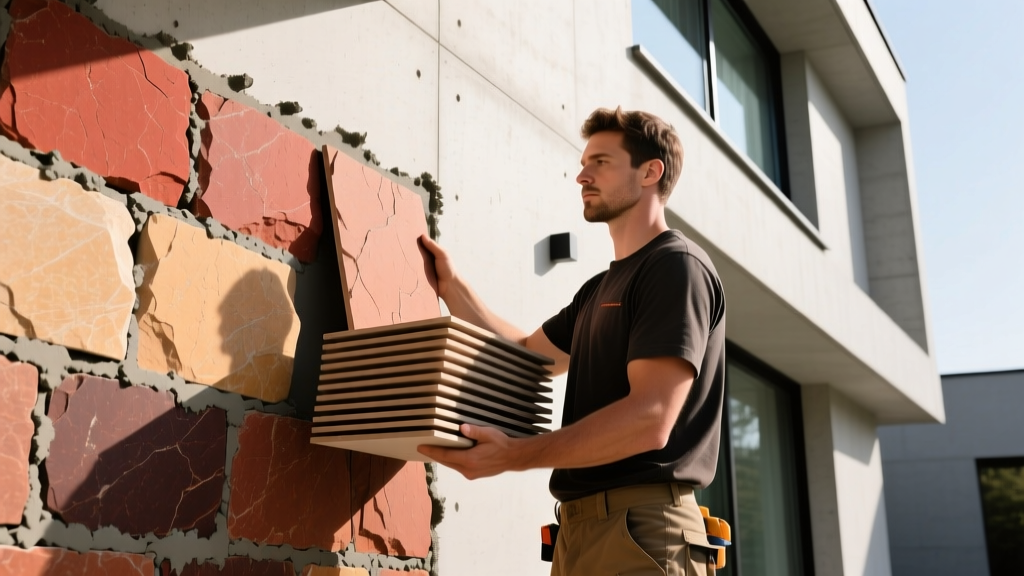
Substrate Prep and Mortar Requirements
You cannot adhere stone veneer directly to drywall, painted wood, or uninsulated sheathing. The hidden costs of substrate preparation often rival the cost of the stone itself. According to InterNACHI building standards, exterior applications require a weather-resistant barrier (WRB), corrosion-resistant metal lath, and a Portland cement scratch coat.
Essential Consumables Budget
When you purchase stone veneer, you must simultaneously budget for the following installation consumables:
- Corrosion-Resistant Metal Lath (2.5 lb grade): $1.20 - $1.80 per SF. Required for wood-frame construction to provide a mechanical key for the mortar.
- Type S Mortar or Polymer-Modified Mortar: $0.75 - $1.50 per SF. Type S provides the necessary compressive strength and flexibility for exterior freeze-thaw cycles. For interior applications over cement backer board, an ANSI A118.4 polymer-modified thin-set (like Custom Building Products VersaBond) is acceptable.
- Silane/Siloxane Penetrating Sealer: $0.50 - $0.90 per SF. Mandatory for exterior MSV to prevent efflorescence (white salt deposits) and water intrusion. Never use a film-forming acrylic sealer, which traps moisture and causes spalling.
The 5-Step Purchasing Formula
To ensure you order the exact materials required without catastrophic shortages or expensive overages, follow this strict procurement sequence:
- Calculate Gross Area: Measure the total height and width of all walls receiving veneer to get the gross square footage.
- Deduct Openings: Subtract the square footage of all windows, doors, and large vents that will not receive stone.
- Measure Linear Corners: Measure all 90-degree outside corners, window returns, and door jambs in linear feet (LF).
- Calculate Flat Stone Requirement: Multiply your total corner LF by 0.75. Subtract that number from your net square footage. Add a 10% waste factor to the remaining flat SF for cuts and breakage.
- Calculate Corner Requirement: Add a 5% waste factor to your total linear feet of corners (corners have less waste as they are pre-formed and require fewer cuts).
Expert Sourcing Tips for 2026
Supply chain stabilization in 2026 has improved lead times for MSV, but custom color blends and specific NTV profiles still require 4-to-8-week lead times from regional quarries. Always request a physical sample board before committing to a bulk purchase. Monitor color variation under both direct sunlight and shaded conditions, as iron oxide pigments in manufactured stone can shift dramatically depending on the ambient light temperature. Finally, ensure your contractor or mason verifies the structural load capacity of your wall framing; while veneer is "thin," the combined weight of the stone, metal lath, and mortar scratch coat frequently exceeds 15 lbs per square foot, requiring specialized structural headers over wide window spans.
Written by
David NakamuraDavid Nakamura is a licensed architect (AIA) and construction technology writer focused on sustainable building methods, mass timber engineering, and high-performance building envelopes. He holds a Master of Architecture from the University of Washington and is a certified Passive House Consultant (CPHC). David spent eight years at the Seattle firm Mithun, where he led the design of three LEED Platinum projects, before founding his own practice specializing in net-zero residential design. He serves on the editorial advisory board of GreenBuilder Magazine and has authored peer-reviewed papers on cross-laminated timber (CLT) connections for the Journal of Structural Engineering. In his spare time, David teaches woodworking at Pratt Fine Arts Center and kayaks the Puget Sound.
More from David Nakamura
View all
Construction Cost
Labor Cost to Build a Deck Per Sq Ft: 2026 Installation Guide
Discover the exact labor cost to build a deck per sq ft in 2026. This installation guide breaks down contractor rates, complexity factors, and hidden fees.
Aug 4, 2026

Construction Cost
How Much Does It Cost to Build a 3 Bedroom House? Financing Guide
Learn exactly how much it costs to build a 3 bedroom house and explore 2026 financing options, construction loan types, and budget frameworks for your build.
Aug 4, 2026

Construction Cost
Cost to Build a Tennis Court: 2026 Guide
How much does it cost to build a tennis court in 2026? Breakdowns for asphalt, concrete, and synthetic surfaces plus fencing and lighting.
Jul 30, 2026