How to Clean and Maintain Stone Veneer Porch Columns
Learn expert techniques to clean, seal, and repair stone veneer porch columns. Protect against efflorescence, salt spalling, and mortar degradation.

The Unique Microclimate of Porch Column Veneer
Stone veneer porch columns are architectural focal points, but they endure a punishing microclimate that interior walls and standard exterior facades do not. Unlike a flat wall, a porch column is exposed to 360-degree weathering, physical impact from landscaping equipment, and severe 'splashback' from the porch deck. Furthermore, the base of the column often sits just inches above soil or mulch beds, creating a capillary moisture trap that accelerates mortar degradation and stone spalling.
Maintaining stone veneer porch columns requires moving beyond generic masonry advice. You must address the specific failure modes of columnar installations, particularly the 'splash zone' (the bottom 18 to 24 inches of the column) where water, de-icing salts, and soil-borne acids concentrate. This guide provides a specialized, actionable maintenance framework for both natural and manufactured stone veneer columns.
Identifying Column-Specific Failure Modes
Before applying any cleaner or sealer, inspect your columns for these three common structural and cosmetic failures:
- Capillary Draw (Rising Damp): If your porch deck is unsealed concrete, water pools against the column base and wicks upward through the mortar scratch coat. This manifests as a dark, permanent-looking damp band at the bottom of the column and eventual mortar crumbling.
- Salt Spalling: Manufactured concrete veneer is highly porous. When winter de-icing salts (sodium chloride or calcium chloride) are tracked onto the porch and splash against the column base, the salts crystallize inside the stone pores during freeze-thaw cycles, popping the face off the veneer.
- UV and Thermal Shock: The south and west-facing sides of porch columns experience rapid temperature swings. This thermal expansion and contraction causes hairline fractures in rigid, high-strength mortar joints, allowing water infiltration behind the weather-resistant barrier (WRB).
Routine Cleaning Protocols by Stone Type
Never use a one-size-fits-all approach to cleaning. Natural stone and manufactured concrete veneer react differently to alkaline and acidic cleaners. According to the Natural Stone Institute, using the wrong pH cleaner can permanently etch calcareous stones like limestone and marble.
| Stone Type | Common Contaminant | Recommended Cleaner | Application Technique |
|---|---|---|---|
| Manufactured Concrete | Dirt, Algae, Mildew | Neutral pH Masonry Cleaner (e.g., Prosoco DailyKlean) | Low-pressure spray, agitate with natural bristle brush, rinse. |
| Natural Limestone / Marble | Organic Stains, Splashback | Stone-specific alkaline cleaner (pH 8-10) | Poultice application for deep stains; never use acid. |
| Natural Granite / Slate | Hard Water, Rust, Grime | Mild acidic cleaner (pH 4-5) or specialized rust remover | Pre-wet stone with water, apply cleaner, dwell 3-5 mins, rinse. |
| All Types (Mortar Joints) | Efflorescence (White Powder) | Dry brushing first; specialized efflorescence remover | Never use unbuffered muriatic acid; it degrades mortar. |
Never use a pressure washer exceeding 1,500 PSI on stone veneer porch columns. High-pressure water easily penetrates the mortar joints, bypassing the weather-resistant barrier and rotting the structural wood or steel post hidden inside the column. Always rely on chemical dwell time and soft-bristle agitation rather than brute water pressure.
Step-by-Step Efflorescence Eradication
Efflorescence—the white, powdery salt deposit on mortar joints and stone faces—is incredibly common on porch columns due to ground moisture wicking. As detailed by Penn State Extension, efflorescence requires three conditions: water-soluble salts, moisture to move them, and evaporation to deposit them on the surface.
- Dry Brush: Use a stiff, non-metallic brush to remove surface crystals. Do not use water at this stage, as it will simply dissolve the salts and drive them back into the pores.
- Identify the Moisture Source: If the efflorescence is concentrated at the column base, check the grading. Soil or mulch should be kept at least 4 inches below the weep screed or base flashing. If the porch deck slopes toward the column, apply a polyurethane concrete sealer to the deck to stop splashback.
- Chemical Treatment: For stubborn deposits, use a buffered, sulfamic acid-based cleaner specifically formulated for efflorescence. Dilute exactly to the manufacturer's specifications (typically 1 part cleaner to 10 parts water).
- Pre-Wet and Apply: Saturate the column with clean water before applying the chemical. This prevents the stone from absorbing the acidic solution too deeply, keeping the reaction on the surface where the salts reside.
- Neutralize and Rinse: After a 5-minute dwell time, rinse thoroughly with a garden hose. For natural stone, follow up with a baking soda and water rinse (1 cup per gallon) to neutralize any residual acid.
Sealing and Waterproofing: The Breathability Imperative
Sealing stone veneer porch columns is highly recommended, but using the wrong sealer will destroy the installation. Film-forming sealers (like acrylics or polyurethanes) create a plastic-like shell on the surface. When moisture inevitably gets behind the veneer through micro-cracks or the top cap flashing, it becomes trapped. During winter, this trapped moisture freezes, causing catastrophic spalling where the face of the stone pops off.
The Solution: Use a penetrating, breathable silane/siloxane water repellent (such as Siloxa-Tek 8500 or Prosoco Siloxane PD). These sealers line the microscopic pores of the stone and mortar, repelling liquid water while allowing water vapor to escape.
'The goal of a water-repellent treatment is not to make the masonry completely waterproof, but to reduce the amount of water absorbed into the masonry while allowing water vapor to transmit out.' — National Park Service Brief 22: Cleaning and Water-Repellent Treatments for Historic Masonry Surfaces.
Application Metrics for Column Sealing:
- Coverage Rate: Expect to use 1 gallon per 100-150 square feet for porous manufactured stone, and 1 gallon per 150-200 square feet for dense natural stone.
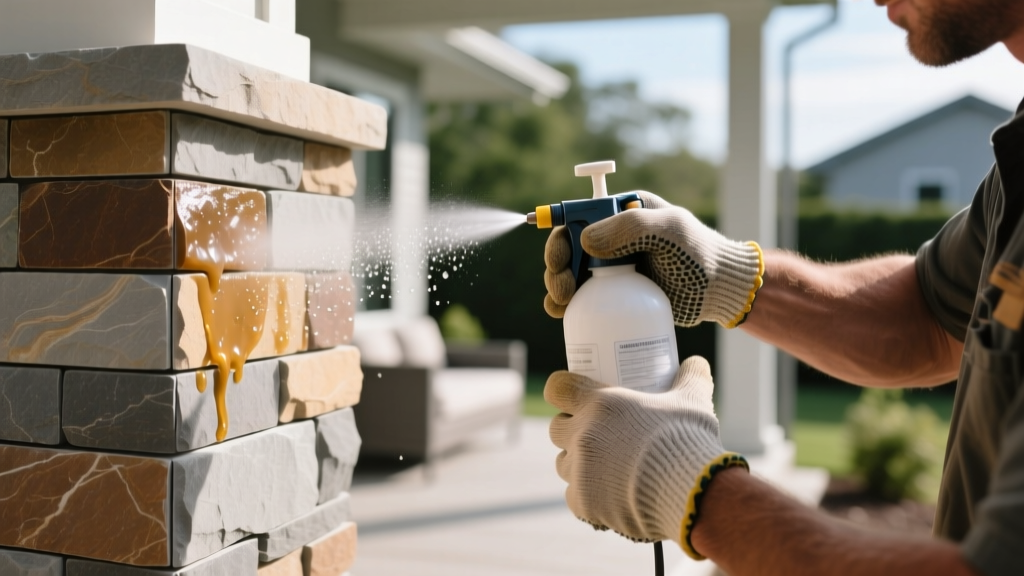
- Application Method: Apply using a low-pressure pump sprayer. Flood the surface from the bottom up to prevent streaking. Apply a second 'wet-on-wet' coat within 5 minutes of the first.
- The Splash Zone Override: For the bottom 24 inches of the column, consider a specialized hydrophobic impregnating sealer designed for below-grade or high-moisture environments, as this area faces constant splashback and capillary draw.
Mortar Joint Inspection and Repointing
The mortar joints on porch columns take the brunt of thermal expansion. Inspect the joints annually. If you find cracks wider than 1/16 inch, or mortar that crumbles when scratched with a screwdriver, repointing is required.
Do not use standard hardware store 'Type S' mortar mix for repairs unless the original installation specifically called for it. Type S mortar has a high compressive strength (1,800 PSI) and is very rigid. If your veneer stone is relatively soft, the rigid mortar will act as an anvil during freeze-thaw cycles, cracking the stone itself. Instead, use a Type N mortar mix (750 PSI), which offers superior flexibility and is the industry standard for exterior non-load-bearing veneer applications. Rake out the damaged joint to a depth of twice its width, dampen the cavity, and pack the new mortar tightly, tooling it to match the existing profile.
Seasonal Maintenance Checklist
Spring
- Inspect the top column cap flashing for gaps or failed caulking. Water entering from the top is the #1 cause of interior post rot.
- Wash the columns with a neutral pH cleaner to remove winter grime and salt residue.
Summer
- Ensure landscaping mulch, soil, and climbing vines are kept at least 4 to 6 inches away from the column base to promote airflow and prevent capillary wicking.
- Apply silane/siloxane sealer (ideal when temperatures are between 50°F and 90°F and no rain is forecast for 24 hours).
Fall
- Clear gutters and downspouts near the porch to prevent heavy water cascades from overwhelming the column splash zone.
- Rake out and repoint any mortar joints that degraded during summer heat waves.
Winter
- Avoid using calcium chloride or rock salt on the porch deck near the columns. Use sand or calcium magnesium acetate (CMA) based ice melters, which are significantly less corrosive to masonry and mortar.
- Do not pile shoveled snow against the base of the stone veneer columns.
Frequently Asked Questions
Can I paint my stone veneer porch columns?
While technically possible, painting stone veneer is strongly discouraged. Paint traps moisture inside the masonry assembly, leading to hidden rot and spalling. If you desire a color change, use a mineral-based masonry stain (like Nawkaw) which penetrates the pores and allows the stone to breathe.
How often should I reseal the columns?
High-quality silane/siloxane sealers typically last 5 to 7 years on vertical surfaces. Perform the 'splash test' annually: splash a cup of water on the column. If it beads up and rolls off, the sealer is intact. If it darkens the stone and absorbs within 30 seconds, it is time to reseal.
My column base is constantly damp. Can I fix this without tearing down the veneer?
If the dampness is caused by capillary draw from the porch floor, you can mitigate it by applying a high-solids, moisture-vapor-blocking epoxy sealer to the concrete porch deck immediately surrounding the column. This stops the water migration at the source, allowing the column base to eventually dry out from the top down.
Written by
Sarah WhitfieldSarah Whitfield is a chartered quantity surveyor (MRICS) and construction cost analyst with 15 years of experience in material pricing, procurement strategy, and project budgeting. She earned her degree in Construction Management from the University of Reading (UK) and has worked on projects ranging from $2M custom homes to $180M mixed-use developments across North America and Europe. Sarah currently leads cost estimating for BuildMat Insight, maintaining a proprietary database of 4,000+ material price points updated quarterly. She is a frequent contributor to RSMeans cost data panels and has presented at the International Cost Engineering Council (ICEC) congress. Based in Denver, CO, Sarah is an avid trail runner and volunteer mentor for Women in Construction.
More from Sarah Whitfield
View all
Wood & Lumber
What Are the Different Types of Wood? A Builder's Guide
Compare structural softwoods, finish hardwoods, and engineered lumber. Analyze Janka ratings, MOE values, and 2026 pricing for construction.
Aug 4, 2026

Walls & Panels
Steel Framing vs Wood Framing: Corrosion and Moisture Defense
Compare steel framing vs wood framing for moisture resistance. Learn about galvanized coatings, condensation risks, and corrosion protection strategies.
Jul 21, 2026

Stone & Masonry
How to Cut Stone Veneer: Wet Saw vs Grinder Comparison
Compare the best tools for cutting stone veneer. We review wet saws, angle grinders, and chop saws to help you achieve clean, chip-free cuts.
Jul 21, 2026