Best Adhesive for Stone Veneer: 2026 Cost & Performance Guide
Compare the best adhesive for stone veneer options in 2026. Analyze material costs, labor impacts, and polymer-modified vs. polyurethane performance.

The True Cost of Stone Veneer Adhesives: Beyond the Bucket Price
When budgeting a masonry project, contractors and homeowners often hyper-focus on the cost per square foot of the stone itself. However, the adhesive accounts for only 5% to 8% of the total material budget while dictating 100% of the installation's structural longevity. Selecting the best adhesive for stone veneer is not merely about finding the strongest bond; it is a complex cost-analysis equation involving material chemistry, labor application rates, substrate compatibility, and long-term failure mitigation.
In 2026, the market has shifted heavily toward advanced polymer-modified mortars and specialized polyurethanes, rendering older, non-modified Portland cement mixes obsolete for veneer applications. This guide dissects the real-world costs, labor multipliers, and technical specifications of modern stone veneer adhesives to help you maximize your installation ROI.
Categorizing Adhesives by Chemistry and Cost Profile
The term 'adhesive' in masonry encompasses three distinct chemical categories. Understanding their performance thresholds according to the Tile Council of North America (TCNA) ANSI standards is critical for accurate budgeting.
1. Polymer-Modified Thin-Set Mortars (ANSI A118.4 & A118.15)
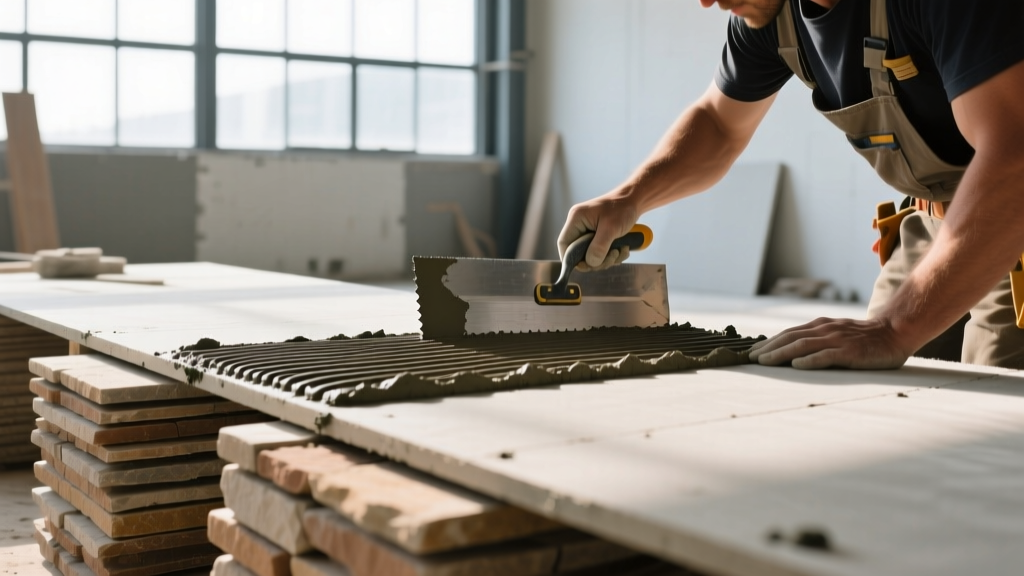
The industry standard for both natural and manufactured stone veneer. These are Portland cement-based powders fortified with liquid or dry polymers (like latex or acrylic) that provide high flexural strength and non-sag properties on vertical surfaces.
- Top Products: LATICRETE 254 Platinum, Custom Building Products MegaLite, Mapei Ultraflex LFT.
- Material Cost: $38 to $65 per 50 lb (22.6 kg) bag.
- Coverage: 45 to 65 sq. ft. per bag (using a 1/2' x 1/2' notched trowel).
- Best Application: Exterior facades, interior fireplaces, wet areas, and heavy natural stone (granite, limestone, slate).
2. Polyurethane Construction Adhesives
Moisture-curing, high-tack adhesives sold in caulking tubes. They offer immediate grab and eliminate the need for mixing, but their application speed on large surfaces is a major labor bottleneck.
- Top Products: Loctite PL Premium Polyurethane, OSI QUAD Max, Surebond SB-10.
- Material Cost: $8 to $14 per 10 oz (283 g) tube.
- Coverage: 12 to 20 sq. ft. per tube (dependent on bead pattern and stone weight).
- Best Application: Small interior DIY projects, lightweight manufactured veneer over drywall or painted masonry, and architectural trim.
3. Epoxy Mortars (ANSI A118.3)
Two-part resin systems offering chemical resistance and near-zero water absorption. They are rarely used for standard wall veneers but are mandatory for specific high-stress environments.
- Material Cost: $130 to $180 per gallon kit.
- Best Application: Commercial kitchens, exterior stone in areas exposed to de-icing salts or acid rain, and submerged water features.
2026 Cost Analysis: Material vs. Labor Multipliers
A common budgeting error is calculating adhesive costs based solely on material price per square foot. Labor application speed drastically alters the true cost. Below is a comparative analysis for a standard 100 sq. ft. exterior manufactured stone veneer installation over a scratch-coat CMU (Concrete Masonry Unit) wall.
| Adhesive Type | Material Cost (100 sq ft) | Est. Labor Time | Labor Cost (@ $75/hr) | Total Installed Cost |
|---|---|---|---|---|
| Polymer-Modified Thin-Set (50lb bags) | $95.00 (2 bags) | 3.5 Hours | $262.50 | $357.50 |
| Polyurethane Adhesive (10oz tubes) | $70.00 (7 tubes) | 6.0 Hours | $450.00 | $520.00 |
| Non-Modified Mortar (Not Recommended) | $45.00 (3 bags) | 4.0 Hours | $300.00 | $345.00* |
*Note: While non-modified mortar shows a slightly lower upfront installed cost, the risk of freeze-thaw delamination results in a 100% replacement cost liability within 3-5 years in northern climates. The Natural Stone Institute strictly advises against non-modified cements for vertical veneer applications due to high shrinkage rates.
Hidden Costs and Critical Failure Modes
Cutting corners on adhesive selection introduces severe secondary costs. When analyzing your budget, factor in the financial impact of these common failure modes:
Warning: The 'Gray Mortar' Staining Penalty
When installing porous natural stones (like limestone, travertine, or light-colored sandstone), using standard gray thin-set mortar will cause iron oxidation and alkali efflorescence, resulting in permanent dark stains on the stone face. The Fix: You must specify a white polymer-modified mortar. White mortars cost 15% to 22% more than gray equivalents. Failing to budget for this will result in a total tear-down and chemical cleaning cost that exceeds $40 per square foot.
- Vertical Sagging: Heavy stacked stone requires mortars with high 'non-sag' or 'medium-bed' properties (ANSI A118.15). If a standard thin-set is used, the mason must install temporary ledger boards and work in small 2-foot lifts, increasing scaffolding rental time and labor costs by up to 30%.
- Efflorescence Mitigation: High-alkali adhesives draw soluble salts to the surface of the stone when exposed to moisture. Using a low-alkali, polymer-fortified adhesive reduces post-installation acid washing and sealing costs.
- Cure Time Delays: Polyurethane adhesives require atmospheric moisture to cure and can take 24-48 hours to reach full structural strength, delaying grouting or pointing phases. Rapid-setting polymer mortars (which cost roughly $15 more per bag) allow for same-day pointing, saving a full day of crew labor.
Substrate-Specific Adhesive Selection Framework
Use this decision matrix to select the most cost-effective adhesive based on your specific wall assembly. Matching the adhesive to the substrate's coefficient of thermal expansion prevents catastrophic shear failures.
- Exterior CMU / Poured Concrete:
Selection: Standard Polymer-Modified Thin-Set (ANSI A118.4).
Rationale: Both the substrate and the mortar share similar rigidity and thermal expansion rates. Standard modified mortars provide the best cost-to-performance ratio here. - Exterior Wood Framing with Cement Backer Board:
Selection: High-Flexibility Improved Modified Mortar (ANSI A118.15).
Rationale: Wood framing expands, contracts, and deflects significantly with wind loads and humidity changes. An A118.15 mortar contains higher polymer content to absorb this shear stress without cracking the bond. - Interior Drywall (Lightweight Manufactured Veneer Only):
Selection: Polyurethane Construction Adhesive or Type-1 Organic Mastic.
Rationale: Drywall paper facings cannot support the sheer weight and moisture load of cementitious thin-sets. Polyurethane provides a secure mechanical bond to the paper/gypsum without degrading it. (Note: Never use this method for natural stone or exterior walls).
Expert Verdict: Maximizing ROI on Your Veneer Installation
The data clearly indicates that the best adhesive for stone veneer from a total-cost-of-ownership perspective is a high-quality, polymer-modified thin-set mortar (ANSI A118.4 or A118.15). While the upfront material cost is marginally higher than outdated non-modified cements, the labor savings from rapid trowel application, combined with the elimination of structural failure risks, yields the highest ROI.
For contractors and project managers estimating 2026 budgets, allocate $1.10 to $1.50 per square foot for premium thin-set materials, and always mandate white mortar formulations for any natural stone with a Mohs hardness below 5 or high porosity. By treating the adhesive as a structural insurance policy rather than a mere consumable, you protect the integrity of the masonry and the profitability of the project.
Written by
David NakamuraDavid Nakamura is a licensed architect (AIA) and construction technology writer focused on sustainable building methods, mass timber engineering, and high-performance building envelopes. He holds a Master of Architecture from the University of Washington and is a certified Passive House Consultant (CPHC). David spent eight years at the Seattle firm Mithun, where he led the design of three LEED Platinum projects, before founding his own practice specializing in net-zero residential design. He serves on the editorial advisory board of GreenBuilder Magazine and has authored peer-reviewed papers on cross-laminated timber (CLT) connections for the Journal of Structural Engineering. In his spare time, David teaches woodworking at Pratt Fine Arts Center and kayaks the Puget Sound.
More from David Nakamura
View all
Construction Cost
Labor Cost to Build a Deck Per Sq Ft: 2026 Installation Guide
Discover the exact labor cost to build a deck per sq ft in 2026. This installation guide breaks down contractor rates, complexity factors, and hidden fees.
Aug 4, 2026

Construction Cost
How Much Does It Cost to Build a 3 Bedroom House? Financing Guide
Learn exactly how much it costs to build a 3 bedroom house and explore 2026 financing options, construction loan types, and budget frameworks for your build.
Aug 4, 2026

Construction Cost
Cost to Build a Tennis Court: 2026 Guide
How much does it cost to build a tennis court in 2026? Breakdowns for asphalt, concrete, and synthetic surfaces plus fencing and lighting.
Jul 30, 2026