Best Stacked Stone Veneer for Pools: 2026 Material Comparison
Compare natural, manufactured, and faux stacked stone veneer for pools. Expert analysis on saltwater resistance, costs, and waterproofing protocols.

The Poolside Environment: Why Standard Veneer Fails
Installing stacked stone veneer around swimming pools introduces extreme environmental stressors that rapidly destroy standard exterior cladding. Poolside veneer must withstand continuous hydrostatic pressure, aggressive freeze-thaw cycling, and chemical bombardment from chlorine or saltwater generators (SWG). When contractors apply standard residential stone veneer techniques to pool waterfalls, coping, and perimeter bond beams, delamination and spalling typically occur within 18 to 24 months.
This comparison evaluates the three primary stacked stone veneer categories—natural stone, manufactured stone veneer (MSV), and high-density polyurethane faux stone—specifically through the lens of poolside durability, chemical resistance, and structural load limits. According to guidelines from the Pool & Hot Tub Alliance, material selection for water features must prioritize near-zero water absorption and resistance to chloride ion penetration.
Material Comparison Matrix: Natural vs. MSV vs. Polyurethane
The following matrix benchmarks the three dominant stacked stone materials against the specific demands of a 2026 pool construction environment.
| Material Category | Water Absorption Rate | Saltwater Tolerance | Weight (lbs/sq ft) | 2026 Installed Cost |
|---|---|---|---|---|
| Natural Stone (Quartzite/Slate) | < 0.5% | Excellent | 12 - 18 lbs | $24 - $42 per sq ft |
| Manufactured Stone Veneer (MSV) | 8% - 14% | Poor (High Spall Risk) | 10 - 14 lbs | $18 - $28 per sq ft |
| High-Density Polyurethane (Faux) | 0% (Impervious) | Excellent | 1 - 2 lbs | $14 - $22 per sq ft |
Deep Dive: Evaluating the Contenders
1. Natural Stacked Stone (The Premium Standard)
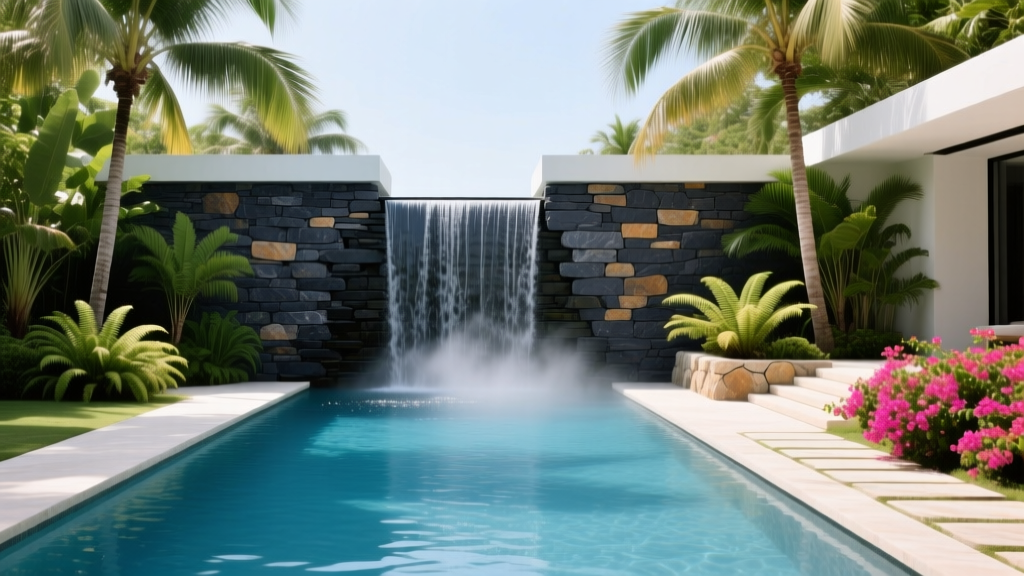
For high-end pool waterfalls and infinity edges, dense natural stones like Brazilian slate, quartzite, and certain granites remain the gold standard. The Natural Stone Institute classifies quartzite and slate as highly durable due to their low porosity and high compressive strength. Because these stones absorb virtually no water, they are immune to the freeze-thaw fracturing that plagues softer stones like limestone or sandstone.
The Catch: Natural stacked stone is heavy. A standard pool bond beam (the concrete cap at the top of the pool wall) is typically engineered to support the coping and a lightweight fence, not 15 pounds per square foot of vertical stone. Structural engineers must reinforce the bond beam with additional rebar if the stacked stone extends more than 24 inches above the waterline. Furthermore, natural stone requires an impregnating silane/siloxane sealer to prevent staining from pool oils and tannins; topical acrylic sealers must be avoided as they trap moisture and turn opaque (blush) under intense UV exposure.
2. Manufactured Stone Veneer (The Versatile but Vulnerable Contender)
Manufactured Stone Veneer (MSV), governed by ASTM C1670 standards, is a Portland cement-based product molded from natural stone casts. While MSV offers superior aesthetic consistency and easier cutting for complex pool curves, it is inherently porous. In traditional residential applications, this porosity is managed with building paper and weep screeds. In a pool environment, it is a critical liability.
The Saltwater Problem: If your pool uses a Saltwater Chlorine Generator (SWG), MSV is highly discouraged for splash zones. Saltwater splashes onto the MSV, and the water evaporates, leaving salt crystals inside the cementitious pores. As these crystals grow (subflorescence), they exert immense internal pressure, causing the face of the stone to pop off—a failure mode known as spalling. If MSV must be used, it should be restricted to dry perimeter walls at least 36 inches away from the water's edge and sealed annually with a high-quality siloxane water repellent.
3. High-Density Polyurethane Faux Stone (The Problem Solver)
Modern polyurethane stone panels (from manufacturers like GenStone or Texture Plus) have evolved significantly in aesthetic realism. For pool environments, they offer an unbeatable functional advantage: zero water absorption. Because they are essentially closed-cell rigid foam, they cannot wick pool water, chlorine, or salt.
The Structural Advantage: Weighing less than 2 pounds per square foot, polyurethane panels impose virtually no dead load on the pool's bond beam or surrounding retaining walls. They can be adhered directly to properly prepared concrete or exterior-grade cement board using a polymer-modified thinset or specialized polyurethane adhesive, bypassing the need for metal lath and scratch coats entirely.
⚠️ Critical Warning: Metal Lath Corrosion
Never use standard galvanized metal lath within 12 inches of a pool waterline or in any sub-grade pool vault. Chlorine gas and salt spray accelerate oxidation, causing the lath to rust and expand. This expansion blows the scratch coat and stone veneer completely off the wall. Always specify alkali-resistant (AR) fiberglass mesh or a polymer-based lath system for poolside masonry applications.
Substrate Preparation & Waterproofing Protocols
The most common cause of stacked stone failure around pools is not the stone itself, but the degradation of the substrate behind it. Pool shells are typically constructed of shotcrete or gunite, which are highly porous and prone to micro-cracking. Applying stone veneer directly to a pool shell guarantees water infiltration behind the veneer.
- Substrate Leveling: Grind down high spots on the shotcrete and fill voids with a polymer-modified patching compound to create a flat plane.
- Primary Waterproofing: Apply a liquid-applied elastomeric membrane (such as LATICRETE Hydro Ban) or a bonded sheet membrane (like Schluter-Kerdi). This creates a continuous, impenetrable barrier that prevents pool water from migrating behind the stone.
- Mortar Bed / Adhesive: For natural stone and MSV, use a high-performance, polymer-fortified thinset mortar rated for continuous water immersion (ANSI A118.15). For polyurethane panels, follow the manufacturer's specific adhesive requirements.
- Grouting and Pointing: Use a sanded, polymer-modified grout. Tool the joints to a slight concave profile to shed water away from the stone face.
Chemical Exposure: Efflorescence vs. Subflorescence
Understanding the difference between efflorescence and subflorescence is vital for poolside stone maintenance. Efflorescence is the white, powdery salt deposit that forms on the surface of the stone when water evaporates. It is primarily a cosmetic issue and can be brushed away or treated with a mild muriatic acid wash.
Subflorescence, however, occurs when the salt crystallizes inside the pores of the stone or the mortar joint before the water reaches the surface. The crystallization pressure can exceed 3,000 psi, which is stronger than the tensile strength of most cementitious mortars and manufactured stones. This results in catastrophic spalling. Natural quartzite and polyurethane are immune to subflorescence due to their lack of internal capillary networks; MSV and soft natural stones (like limestone) are highly susceptible.
'When designing water features and pool waterfalls, the assumption should always be that the stone will remain saturated with chemically treated water. Material selection must prioritize density and chemical inertness over mere aesthetic preference.' — Pool Engineering & Design Best Practices, 2026
2026 Cost Breakdown & Installation Variables
Budgeting for poolside stacked stone requires looking beyond the raw material cost per square foot. Labor, structural reinforcement, and waterproofing membranes significantly alter the final price.
- Material Waste Factor: Pool waterfalls and curved bond beams require extensive cutting. Add a 15% to 20% waste factor for natural stone and MSV, compared to just 5% to 8% for interlocking polyurethane panels.
- Waterproofing Costs: High-quality liquid membranes and AR fiberglass lath add approximately $3.50 to $5.00 per square foot to the substrate preparation phase.
- Labor Rates: Specialized masons who understand pool hydrology and immersion-rated thinsets charge a premium. Expect labor rates of $12 to $18 per square foot for natural stone, reflecting the precision required for dry-stacked or tight-joint pool profiles.
Final Decision Framework
Select the correct stacked stone veneer based on your specific pool chemistry and structural constraints:
- Choose Natural Quartzite/Slate if: You are building a premium infinity edge or waterfall, the pool bond beam has been structurally reinforced by an engineer, and you want a lifetime material with zero chemical degradation.
- Choose Polyurethane Faux Stone if: You are retrofitting stone onto an existing, non-reinforced pool wall, you have a saltwater pool with high splash zones, or you need to minimize structural dead load.
- Choose Manufactured Stone Veneer (MSV) ONLY if: The stone is being applied to a dry perimeter retaining wall well outside the splash zone, you are using a traditional liquid chlorine system (not saltwater), and you are committed to an annual siloxane sealing regimen.
Written by
David NakamuraDavid Nakamura is a licensed architect (AIA) and construction technology writer focused on sustainable building methods, mass timber engineering, and high-performance building envelopes. He holds a Master of Architecture from the University of Washington and is a certified Passive House Consultant (CPHC). David spent eight years at the Seattle firm Mithun, where he led the design of three LEED Platinum projects, before founding his own practice specializing in net-zero residential design. He serves on the editorial advisory board of GreenBuilder Magazine and has authored peer-reviewed papers on cross-laminated timber (CLT) connections for the Journal of Structural Engineering. In his spare time, David teaches woodworking at Pratt Fine Arts Center and kayaks the Puget Sound.
More from David Nakamura
View all
Construction Cost
Labor Cost to Build a Deck Per Sq Ft: 2026 Installation Guide
Discover the exact labor cost to build a deck per sq ft in 2026. This installation guide breaks down contractor rates, complexity factors, and hidden fees.
Aug 4, 2026

Construction Cost
How Much Does It Cost to Build a 3 Bedroom House? Financing Guide
Learn exactly how much it costs to build a 3 bedroom house and explore 2026 financing options, construction loan types, and budget frameworks for your build.
Aug 4, 2026

Construction Cost
Cost to Build a Tennis Court: 2026 Guide
How much does it cost to build a tennis court in 2026? Breakdowns for asphalt, concrete, and synthetic surfaces plus fencing and lighting.
Jul 30, 2026