Hiring a Stone Veneer Contractor Near Me: 2026 Costs
Analyze 2026 costs for hiring a stone veneer contractor near you. Break down labor rates, hidden fees, material quotes, and vetting local masonry experts.

The True Cost Breakdown: Materials vs. Contractor Labor
When you search for a stone veneer contractor near me, the estimates you receive will generally reflect a 35/65 or 40/60 split between materials and labor. Unlike siding or brick, adhered stone veneer requires meticulous substrate preparation that drastically inflates the labor component. In 2026, the national average for professional installation of manufactured stone veneer (MSV) ranges from $19 to $38 per square foot, while natural stone veneer installation pushes between $28 and $55 per square foot.
A professional bid must account for the entire wall assembly, not just the visible stone. The labor hours required to install a weather-resistant barrier (WRB), attach 2.5 lb self-furring galvanized metal lath, apply a 1/2-inch Portland cement scratch coat, and allow it to cure for 24 to 48 hours often exceed the time spent actually placing the stones. Contractors who quote suspiciously low labor rates are frequently skipping the scratch coat or using improper fasteners, leading to catastrophic delamination within three to five years.
Regional Labor Rate Variations for Stone Veneer Installation
Local market dynamics heavily influence the final quote. A stone veneer contractor near me in the Midwest will operate under a different labor and overhead structure than one in the Northeast or coastal California. Below is a breakdown of expected installed costs (materials plus labor) for a standard 500-square-foot exterior wainscoting project using mid-grade manufactured stone.
| Region | Avg. Labor Rate (per sq ft) | Total Installed Cost (500 sq ft) | Market Factors (2026) |
|---|---|---|---|
| Northeast | $22 - $32 | $16,500 - $23,000 | High union density, strict freeze-thaw code compliance |
| Southeast | $14 - $22 | $12,000 - $17,500 | Lower labor costs, high demand for moisture management |
| Midwest | $16 - $25 | $13,500 - $19,000 | Moderate rates, seasonal scheduling premiums |
| West / Pacific | $24 - $38 | $18,500 - $27,000 | High overhead, seismic anchoring requirements |
Hidden Costs Local Contractors Often Exclude from Initial Quotes
When evaluating bids from nearby masonry crews, scrutinize the exclusions. The lowest bid often omits critical preparatory and finishing steps that will later be presented as change orders.
- Corner Pieces and Linear Footage: Manufactured stone is sold by the square foot for flat surfaces, but corners are sold by the linear foot. A project with multiple window returns or external corners can add $12 to $25 per linear foot just for the corner pieces, plus premium labor for mitering and fitting.
- Weep Screed and Flashing Integration: Proper installation requires a corrosion-resistant weep screed at the base of the wall to allow moisture to escape. If your contractor is tying the veneer directly into an existing concrete slab without a weep screed or proper flashing integration, they are violating building codes and trapping water behind the wall.
- Scaffolding and Equipment Fees: For installations extending beyond the first story, scaffolding erection and teardown can add $800 to $2,500 to the project. Ensure this is explicitly stated in the bid.
- Substrate Remediation: If the contractor removes old siding and discovers rotted OSB or compromised sheathing, replacing the structural substrate is rarely included in the base veneer quote. Expect to pay $45 to $85 per sheet for plywood/OSB replacement.
Evaluating 'Stone Veneer Contractor Near Me' Search Results
Not all masons are qualified to install adhered veneer. Traditional bricklayers often struggle with the specific polymer-modified mortars and substrate preparations required for MSV. When vetting local contractors, use this decision matrix to filter out unqualified bids.
The Vetting Checklist
1. MVMA Certification: Does the contractor hold certification or documented training from the Masonry Veneer Manufacturers Association (MVMA)? This ensures they understand the critical differences between adhered veneer and structural masonry.
2. Mortar Selection: Ask what mortar they use. For MSV, they should specify a Type S mortar or a proprietary polymer-modified veneer mortar (such as SPEC MIX or Sakrete Veneer Stone Mortar). Standard Type N is often insufficient for high-wind or freeze-thaw regions.
3. WRB Overlap Details: A qualified contractor will explicitly state how they handle the weather-resistant barrier. According to guidelines published by the National Institute of Building Sciences (NIBS), the WRB must be integrated with the weep screed and feature proper shingle-lapping to direct water outward.
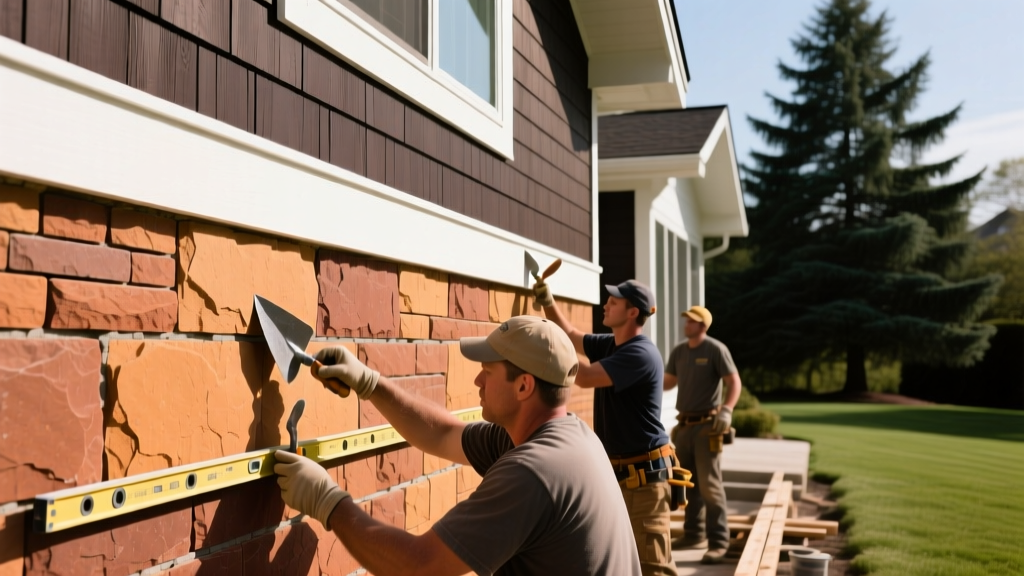
Material Selection Impact on Installation Labor
Manufactured Stone Veneer (MSV)
Brands like Cultured Stone (Boral) and Eldorado Stone dominate the MSV market. Because MSV is cast from molds and colored with iron oxide pigments, it weighs roughly 10 to 12 pounds per square foot. This lighter weight reduces the need for structural wall ties in most residential applications, speeding up installation. However, the uniform back surface requires the installer to butter the back of each stone completely to achieve a mechanical bond, preventing hollow spots that lead to freeze-thaw spalling.
Natural Stone Veneer
Natural options like thin-cut limestone, slate, or fieldstone weigh significantly more (15 to 25+ lbs per sq ft) and feature irregular back profiles. Installers must spend more time sorting, cutting, and fitting natural stones to maintain consistent joint widths. Consequently, labor costs for natural stone are typically 30% to 50% higher than MSV, and the project timeline extends by several days due to the increased cutting and layout time.
Red Flags in Contractor Bids
🚩 Critical Warning: If a contractor proposes applying mortar directly over painted brick, drywall, or existing smooth siding without installing metal lath and a scratch coat, terminate the bid immediately. Adhered veneer requires a mechanical key to the substrate; without it, the entire installation will shear off the wall under its own weight.
Another common red flag is the omission of a curing period. The scratch coat must cure for a minimum of 24 hours (and up to 48 hours in high humidity or cold temperatures) before the setting bed and stones are applied. Contractors who promise to complete a 500-square-foot exterior wall in a single day are skipping mandatory curing times, compromising the structural integrity of the bond.
Finally, verify that the bid includes a final cleaning and optional sealing phase. MSV is highly porous. If the contractor uses acid-based cleaners to remove mortar smears from the stone face, they risk etching the iron oxide pigments and permanently ruining the color. Professional bids should specify the use of a mild, non-acidic masonry cleaner and a soft-bristle brush, followed by the application of a breathable, silane/siloxane penetrating sealer to protect against efflorescence and water intrusion.
Written by
James ThorntonJames Thornton is a construction industry veteran with 25 years of hands-on experience in wood framing, lumber grading, and residential building codes. He started as a framing carpenter in rural Oregon, earned his ICC Residential Building Inspector certification, and eventually became a senior plan reviewer for the City of Portland Bureau of Development Services. James holds a B.S. in Wood Science & Technology from Oregon State University and is a certified lumber grader through the West Coast Lumber Inspection Bureau (WCLIB). He has inspected over 3,000 residential construction sites and authored the city's internal guide on advanced framing techniques (2x6 at 24" O.C.). James lives in Bend, OR, where he builds custom timber-frame cabins and competes in lumberjack sports.
More from James Thornton
View all
Insulation
Best Home Insulation Materials: Complete 2026 Guide
Compare top home insulation materials for 2026. Find R-values, installed costs per square foot, and best uses for fiberglass, spray foam, and mineral wool.
Aug 4, 2026

Sustainable Building
Certify Your Green Building Material for LEED and WELL
Step-by-step guide to certifying a green building material for LEED v5 and WELL v2. Master EPDs, HPDs, and VOC limits for 2026 project specifications.
Aug 4, 2026

Stone & Masonry
Veneer Stacked Stone Panels: Interior Design & Style Showcase
Discover how veneer stacked stone panels transform interiors. Explore modern design profiles, material pairings, and technical installation specs.
Aug 4, 2026