Technical Specifications for Black Veneer Stone Installation
Comprehensive technical specifications for black veneer stone, covering ASTM standards, substrate prep, mortar types, and efflorescence prevention.

Material Composition and ASTM Classifications
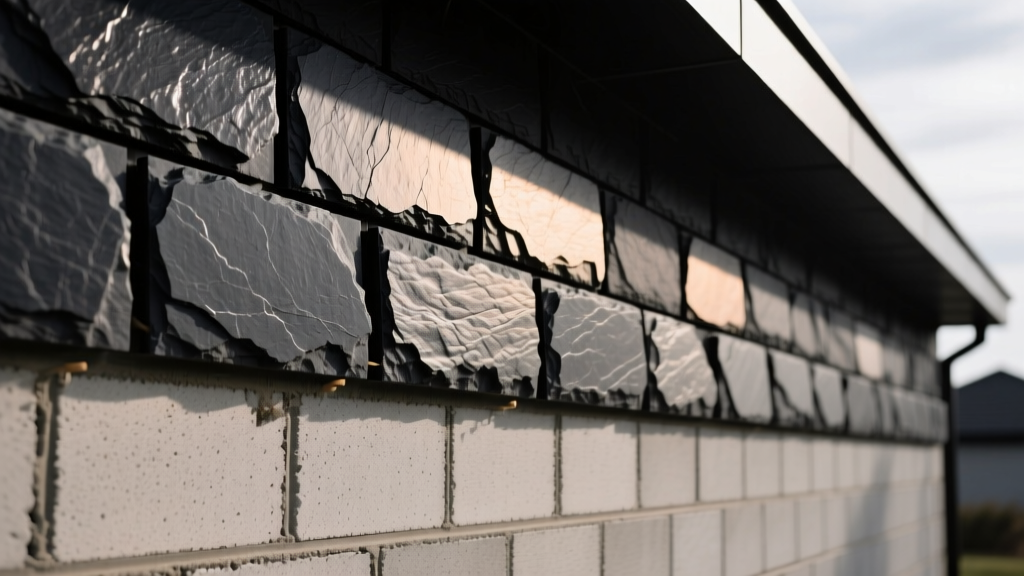
Black veneer stone is categorized into two distinct material classes, each governed by separate performance standards. Natural black veneer, typically quarried as basalt, slate, or dark limestone, must comply with The Masonry Society guidelines and ASTM C1242 (Standard Guide for Selection, Design, and Installation of Exterior Dimension Stone Anchors). Natural basalt veneer exhibits a high density of 160 to 180 lbs/cu ft, translating to an installed weight of 15 to 18 lbs per square foot.
Manufactured black veneer stone consists of Portland cement, lightweight aggregates (such as expanded shale or pumice), and iron oxide pigments. This material falls under ASTM C1670/C1670M (Standard Specification for Adhered Manufactured Stone Masonry Veneer). The engineered composition reduces the dead load to 10 to 12 lbs per square foot, a critical threshold that dictates the required structural backing and fastening schedules. When specifying manufactured black veneer, verify that the iron oxide pigments are UV-stable and constitute at least 3% of the cementitious matrix by weight to prevent fading under direct solar exposure.
Substrate Preparation and Moisture Management
Proper substrate preparation is the primary defense against catastrophic veneer failure. For wood-framed exterior assemblies, current building codes mandate a weather-resistive barrier (WRB) system capable of managing bulk water and vapor diffusion. The optimal specification requires two layers of Grade D building paper (ASTM D226) or a primary layer of woven housewrap overlaid with a secondary layer of building paper. This dual-layer approach creates a capillary break, preventing moisture from migrating from the stucco or mortar base into the structural sheathing.
At the base of the assembly, a corrosion-resistant weep screed (ASTM C847) is mandatory. The screed must feature a minimum 1-inch vertical flange and a 3/16-inch weep hole spacing to facilitate hydrostatic pressure release. The metal lath must be 2.5 lb/sq yd self-furring galvanized steel (ASTM C847), attached using corrosion-resistant staples or nails spaced no more than 6 inches on center vertically and 16 inches horizontally. Self-furring dimples are non-negotiable; they maintain a 1/4-inch standoff from the WRB, allowing the scratch coat mortar to fully encapsulate the lath and create a continuous mechanical lock.
Black veneer stone is notoriously unforgiving regarding efflorescence. White calcium carbonate deposits contrast severely against dark iron oxide pigments or natural basalt. To mitigate primary efflorescence, mandate low-alkali Portland cement (ASTM C150 Type I/II) in all mortar mixes. Never use acid washes to clean black stone, as hydrochloric acid will react with the iron oxides, causing permanent rust-colored staining and degrading the cementitious binder.
Mortar, Adhesive, and Anchoring Specifications
The selection of bonding material depends entirely on the application environment and veneer weight. For exterior installations subject to freeze-thaw cycling, Type S mortar is the absolute baseline specification. Type S provides a compressive strength of approximately 1,800 psi and high flexural bond strength, necessary to support the veneer's dead load without cracking under thermal deflection. The precise volumetric ratio for Type S mortar is 1 part Portland cement, 1/2 part hydrated lime, and 4.5 parts damp, loose masonry sand. The addition of hydrated lime is critical; it increases the mortar's workability, water retention, and autogenous healing properties, which are vital for sealing micro-cracks over time.
For interior applications or dry-stack manufactured black veneer systems, polymer-modified thin-set mortars meeting ANSI A118.4 (Improved Modified Dry-Set Cement Mortar) are specified. These adhesives offer superior non-sag characteristics, allowing installers to stack heavier basalt pieces without mechanical support during the curing phase. According to technical bulletins from the National Concrete Masonry Association (NCMA), when installing veneer exceeding 15 lbs per square foot on vertical surfaces, supplementary mechanical anchoring (such as stainless steel corrugated ties embedded into the substrate) must be integrated at a rate of one anchor per 2 square feet.
Technical Comparison: Natural vs. Manufactured Black Veneer
| Specification Metric | Natural Black Basalt/Slate | Manufactured Black Veneer |
|---|---|---|
| Installed Weight | 15 - 18 lbs / sq ft | 10 - 12 lbs / sq ft |
| Governing Standard | ASTM C1242 / ASTM C97 | ASTM C1670 / C1670M |
| Water Absorption | 0.2% - 1.5% (Highly Impermeable) | 12% - 18% (Porous) |
| Thickness Profile | 0.75" - 1.5" (Variable) | 0.5" - 1.0" (Uniform) |
| Efflorescence Risk | Low (Inherent salts minimal) | High (Cementitious matrix) |
Thermal Dynamics and Control Joint Placement
Thermal expansion and contraction dictate the placement of control joints in black veneer stone assemblies. Manufactured stone veneer possesses a coefficient of thermal expansion (CTE) of approximately 4.5 x 10^-6 in/in/°F, while natural basalt exhibits a lower CTE of roughly 3.0 x 10^-6 in/in/°F. In dark-colored veneers, solar radiation absorption is exceptionally high; surface temperatures on south-facing black stone walls can exceed ambient air temperatures by 40°F to 50°F, inducing significant thermal stress.
To prevent uncontrolled cracking, continuous control joints must be installed in the scratch coat and mortar bed. Horizontal control joints are required at maximum intervals of 20 feet, while vertical control joints must be spaced no further than 12 feet apart. These joints must align with the underlying structural control joints and be filled with a high-performance, non-staining elastomeric sealant meeting ASTM C920 (Type S, Grade NS, Class 25). Crucially, the sealant must be specifically formulated for masonry to prevent plasticizer migration, which can cause unsightly oil stains that are highly visible on black stone surfaces.
Sealing Protocols for Dark Pigmented Veneers
The application of topical sealers on black veneer stone requires strict chemical compatibility. Film-forming sealers, such as acrylics or polyurethanes, are strictly prohibited for exterior applications. These sealers create a vapor-impermeable membrane on the stone's face, trapping moisture within the masonry assembly. During freeze-thaw cycles, the trapped water expands, causing the face of the manufactured stone to spall or the natural slate to delaminate.
The correct specification is a penetrating silane or siloxane water repellent. These compounds react chemically with the silica in the cementitious matrix or natural stone to form a hydrophobic resin network within the pores, leaving the surface vapor-permeable. When applying to black veneer, the sealer must be rated as "non-enhancing" and "matte finish." Enhancing sealers contain solvents that artificially darken and gloss the stone; while this may look appealing initially, UV degradation causes the enhancers to break down unevenly, resulting in permanent, blotchy discoloration across the facade. Apply the silane/siloxane sealer at a coverage rate of 150 to 200 square feet per gallon, ensuring the substrate is entirely dry (below 15% moisture content by weight) prior to application.
Written by
Marcus ChenMarcus Chen is a licensed structural engineer (PE) and building materials analyst with over 12 years of experience across residential, commercial, and industrial construction. He holds a Master of Science in Civil Engineering from UC Berkeley and spent six years at Thornton Tomasetti before transitioning to independent consulting and technical writing. Marcus specializes in material selection for seismic-prone regions, concrete reinforcement strategies, and lifecycle cost analysis. His work has been cited by the American Concrete Institute (ACI) and the Structural Engineers Association of California (SEAOC). When he is not on a job site or at his desk, you will find him hiking the Sierra Nevada or restoring a 1920s craftsman bungalow in Oakland, CA.
More from Marcus Chen
View all
Construction Cost
How Much Did the Eiffel Tower Cost to Build?
How much did the Eiffel Tower cost to build in 1889? We adjust for inflation and compare its budget to modern skyscraper construction.
Aug 4, 2026

Fire Resistance
What Is a Fire Resistant Material? Testing & Certification Guide
Discover what is a fire resistant material through ASTM and UL testing. Learn how fire ratings, certifications, and assemblies work in construction.
Aug 4, 2026

Construction Cost
How Much Did the Burj Khalifa Cost to Build?
How much did the Burj Khalifa cost to build? We break down the $1.5B project and extract 5 money-saving strategies for your next build.
Jul 30, 2026