Stone Veneer Installation Cost Breakdown & Guide 2026
Detailed 2026 cost analysis for stone veneer installation. Break down material, labor, and prep expenses for manufactured and natural stone projects.

The True Cost of Stone Veneer Installation in 2026
Budgeting for stone veneer installation requires looking far beyond the per-square-foot price of the stones themselves. In 2026, the national average for a fully installed, code-compliant manufactured stone veneer (MSV) or natural thin stone veneer (NTSV) project ranges from $26 to $48 per square foot. For a standard 300-square-foot exterior facade or interior accent wall, homeowners should expect total project costs to land between $7,800 and $14,400. The variance in this range is dictated by substrate preparation requirements, regional masonry labor rates, and the specific architectural profile of the stone selected.
Quick Cost Summary (Per Square Foot)
- Materials (Stone): $8.00 – $22.00
- Prep & Substrate (WRB, Lath, Mortar): $4.50 – $7.50
- Masonry Labor: $13.50 – $24.00
- Total Installed Average: $26.00 – $48.00
Material Costs: Manufactured vs. Natural Stone Veneer
The choice between manufactured and natural stone is the primary driver of your material budget. Manufactured stone veneer (MSV) is cast from Portland cement, lightweight aggregates, and iron oxide pigments in molds taken from real stone. Natural thin stone veneer (NTSV) is quarried and sawn to a 0.75-inch to 1.5-inch thickness.
| Material Type | Popular Brand / Source | Cost Per Sq. Ft. (Materials Only) | Weight (Lbs / Sq. Ft.) |
|---|---|---|---|
| Manufactured Ledge Stone | Cultured Stone (Boral) | $9.50 – $13.00 | 10 – 12 lbs |
| Manufactured Fieldstone | Eldorado Stone | $10.00 – $14.50 | 11 – 13 lbs |
| Natural Thin Limestone | Quarry Direct (Regional) | $15.00 – $22.00 | 13 – 16 lbs |
| Natural Thin Granite | Quarry Direct (Regional) | $18.00 – $28.00+ | 15 – 18 lbs |
While natural stone offers unmatched geological authenticity and extreme durability, MSV provides significant cost advantages in both material pricing and structural support requirements. Because MSV is lighter, it rarely requires additional foundation footings or structural reinforcement when applied to standard wood-framed walls, keeping ancillary engineering costs at zero.
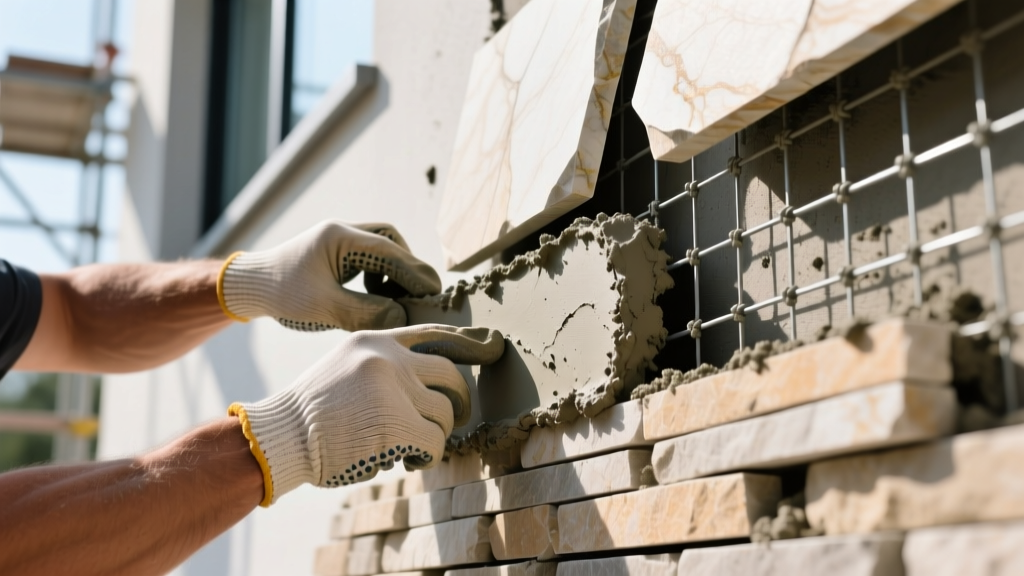
Labor and Preparation: The Hidden Cost Drivers
Amateur estimators often calculate stone veneer installation costs by simply multiplying the stone price by the wall area. This leads to severe budget shortfalls. Proper stone veneer installation is a multi-day masonry process governed by strict building codes and manufacturer specifications, such as those outlined by the Masonry Veneer Manufacturers Association (MVMA).
Substrate Preparation & Weatherproofing
Before a single stone is laid, the wall must be prepared to manage moisture. For exterior wood-framed walls, this requires:
- Water-Resistive Barrier (WRB): Two layers of Grade D building paper or a code-approved house wrap (like Tyvek CommercialWrap) applied in shingle fashion.
- Weep Screed: A corrosion-resistant weep screed (ASTM C2421) installed at the base of the wall, minimum 4 inches above grade or 2 inches above paved surfaces, to allow trapped water to escape.
- Metal Lath: Self-furring, galvanized wire lath (ASTM C847) weighing minimum 2.5 lbs per square yard, attached with corrosion-resistant fasteners penetrating the wall studs every 6 inches.
- Scratch Coat: A 3/8-inch to 1/2-inch layer of Portland cement plaster applied to the lath and horizontally scored to provide a mechanical grip for the setting bed.
This preparation phase adds $4.50 to $7.50 per square foot to the project and accounts for roughly 30% of the total labor time.
Mortar Selection and Application Labor
Masonry labor rates in 2026 average $85 to $135 per hour, translating to $13.50 to $24.00 per square foot for the setting and pointing phases. A critical, often overlooked cost factor is mortar selection. According to ASTM C270 standards, Type N mortar (approx. 750 PSI compressive strength) is the industry standard for MSV. It provides adequate bond strength while retaining enough flexibility to accommodate thermal expansion and minor structural settling. Using Type S mortar (1800+ PSI) is a common contractor error; its high rigidity and Portland cement density can trap moisture and cause the stone faces to spall or pop off during freeze-thaw cycles, leading to catastrophic warranty failures.
Edge Cases and Failure Modes That Inflate Budgets
When evaluating bids, be wary of contractors who undercut the market average. Budget stone veneer installation usually cuts corners on moisture management, leading to expensive remediation. Watch for these specific failure modes:
Warning: Costly Installation Red Flags
- Missing Kick-Out Flashing: Where a roofline intersects a stone-clad wall, a kick-out flashing is mandatory to divert rainwater into the gutter. Omitting this $150 flashing detail can cause thousands of dollars in hidden sheathing rot behind the stone.
- Mortar Bridging & Smearing: Inexperienced masons may smear mortar on the stone face during installation. Cleaning this requires specialized masonry cleaners or diluted muriatic acid, which can strip the iron oxide pigments from manufactured stone, ruining the aesthetic and requiring total replacement of the affected stones.
- Improper Sealing: Applying a non-breathable, film-forming acrylic sealer to exterior MSV traps moisture inside the masonry system. When the sun heats the wall, the trapped water turns to vapor, creating hydrostatic pressure that delaminates the stone from the scratch coat. MSV is designed to breathe; penetrating silane/siloxane sealers are the only acceptable (though often unnecessary) protective coatings.
Regional Cost Variations Across the US
Labor availability and local building code stringencies heavily influence the final invoice. Coastal regions and areas with strict seismic or hurricane building codes require enhanced mechanical fastening and engineering inspections, driving up costs.
| Region | Average Installed Cost (Per Sq. Ft.) | Primary Cost Driver |
|---|---|---|
| Northeast & Mid-Atlantic | $34.00 – $48.00 | High union labor rates; strict freeze-thaw code compliance. |
| West Coast (CA, OR, WA) | $32.00 – $45.00 | Seismic bracing requirements; high cost of living adjustments. |
| Midwest | $26.00 – $35.00 | Moderate labor rates; standard WRB and flashing requirements. |
| South & Southeast | $24.00 – $33.00 | Lower labor costs; focus on extreme humidity and rain management. |
ROI and Home Value Impact
From an investment perspective, stone veneer installation remains one of the highest-performing exterior upgrades in the residential real estate market. According to the annual Remodeling Magazine Cost vs. Value Report, adding manufactured stone veneer to a home's exterior consistently yields a national average return on investment (ROI) of 92% to 102% at the time of resale.
This exceptional ROI is driven by the dramatic boost in curb appeal and the perceived permanence of masonry. A 300-square-foot stone accent on a front facade or around a garage door typically costs around $10,500 but can increase the appraised value of the home by an equal or greater amount. When comparing this to vinyl siding replacement (which averages a 75% to 80% ROI) or fiber-cement siding, stone veneer offers superior financial recoupment alongside a 50-year+ material lifespan.
Expert Sourcing and Bidding Advice
When soliciting bids for your project, do not accept a simple lump-sum estimate. Require contractors to itemize their proposal to include the specific WRB brand (e.g., Tyvek, WrapMaster), the exact metal lath gauge, and the mortar type (ASTM C270 Type N). Furthermore, verify that the installer is certified by the manufacturer. Brands like Cultured Stone and Eldorado Stone maintain directories of certified installers who have passed rigorous testing on substrate prep, mortar mixing, and detailing around penetrations like windows and pipe sleeves.
"The longevity of a stone veneer system is dictated 10% by the stone itself and 90% by the quality of the water management system hidden behind it. Never compromise on the weep screed or flashing details to save a few dollars on the initial bid." — Industry Standard MVMA Installation Guideline
By focusing on the complete system—from the weather barrier to the mortar chemistry—rather than just the aesthetic face of the stone, homeowners can ensure their stone veneer installation remains structurally sound and visually flawless for decades, maximizing both their property value and their initial capital investment.
Written by
Marcus ChenMarcus Chen is a licensed structural engineer (PE) and building materials analyst with over 12 years of experience across residential, commercial, and industrial construction. He holds a Master of Science in Civil Engineering from UC Berkeley and spent six years at Thornton Tomasetti before transitioning to independent consulting and technical writing. Marcus specializes in material selection for seismic-prone regions, concrete reinforcement strategies, and lifecycle cost analysis. His work has been cited by the American Concrete Institute (ACI) and the Structural Engineers Association of California (SEAOC). When he is not on a job site or at his desk, you will find him hiking the Sierra Nevada or restoring a 1920s craftsman bungalow in Oakland, CA.
More from Marcus Chen
View all
Construction Cost
How Much Did the Eiffel Tower Cost to Build?
How much did the Eiffel Tower cost to build in 1889? We adjust for inflation and compare its budget to modern skyscraper construction.
Aug 4, 2026

Fire Resistance
What Is a Fire Resistant Material? Testing & Certification Guide
Discover what is a fire resistant material through ASTM and UL testing. Learn how fire ratings, certifications, and assemblies work in construction.
Aug 4, 2026

Construction Cost
How Much Did the Burj Khalifa Cost to Build?
How much did the Burj Khalifa cost to build? We break down the $1.5B project and extract 5 money-saving strategies for your next build.
Jul 30, 2026