Stone Veneer Over Brick Fireplace Cost Breakdown 2026
Detailed 2026 cost analysis for installing stone veneer over a brick fireplace. Includes material pricing, labor rates, prep work, and hidden expenses.

Executive Summary: The True Cost of the Upgrade
Upgrading a dated masonry hearth is one of the highest-impact interior renovations available to homeowners. When analyzing the cost to install stone veneer over a brick fireplace in 2026, the national average ranges from $1,450 to $3,800 for a standard 40-square-foot surround. However, this wide variance is driven by material selection, substrate preparation requirements, and regional labor rates. This cost analysis dissects the exact pricing tiers, hidden structural expenses, and material-specific labor multipliers you need to build an accurate budget.
Material Costs: Manufactured vs. Natural Stone Veneer
The most significant budget variable is the veneer itself. The market is split between Manufactured Stone Veneer (MSV), Natural Stone Veneer (NSV), and mortarless interlocking systems. MSV, produced by brands like Eldorado Stone and Cultured Stone, utilizes Portland cement, lightweight aggregates, and iron oxide pigments to mimic natural stone at a lower weight and cost. NSV consists of real quarried stone (such as thin-cut fieldstone or slate) sliced to a 1-inch thickness.
| Material Type | Brand / Example | Cost Per Sq. Ft. (Material Only) | Weight Per Sq. Ft. | Best Application |
|---|---|---|---|---|
| Manufactured Stone Veneer (MSV) | Eldorado Stone, Cultured Stone | $8.50 - $14.00 | 10 - 12 lbs | Standard interior surrounds, high-detail profiles |
| Natural Stone Veneer (NSV) | Thin-cut Fieldstone, Bluestone | $13.00 - $24.00 | 12 - 15 lbs | Luxury builds, rustic or organic aesthetics |
| Mortarless Interlocking | AirStone, GenStone | $10.00 - $13.50 | 4 - 6 lbs | DIY projects, quick weekend flips |
| Cast Stone Panels | Stone Panels International | $18.00 - $28.00 | 8 - 10 lbs | Large commercial hearths, seamless stacking |
For a 40-square-foot fireplace, material costs alone will range from $340 for basic MSV to over $960 for premium natural stone. Always factor in a 10% to 15% waste allowance for cuts, corners, and breakage during transit.
Labor and Preparation: Where the Budget Expands
Professional masonry labor for stone veneer installation averages $16.00 to $26.00 per square foot in 2026. However, applying stone veneer over an existing brick fireplace requires specific substrate preparation that drastically alters the final invoice. Brick is a highly porous, uneven substrate that cannot simply be glued over without risking catastrophic delamination.
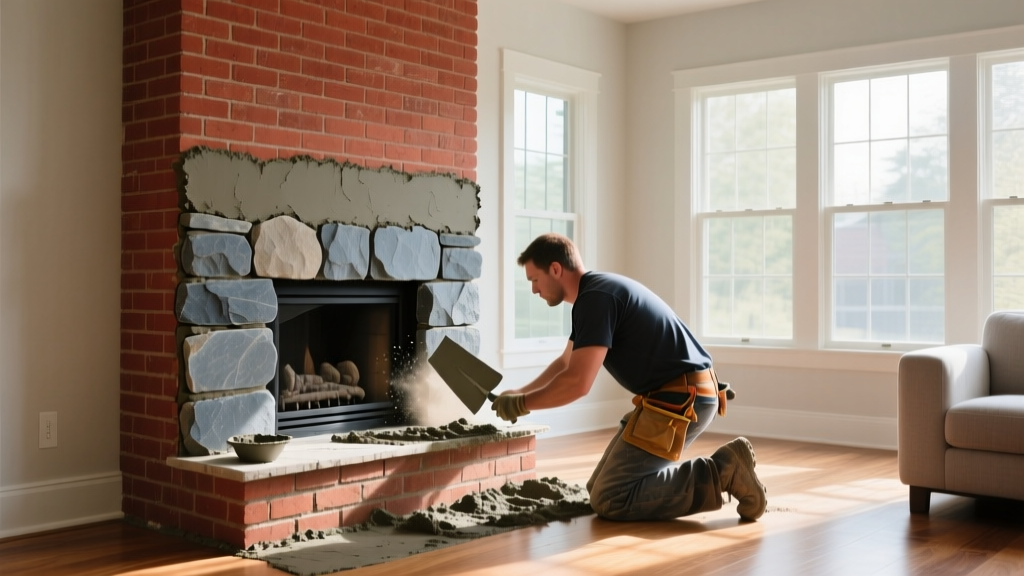
The Mandatory Prep Sequence for Mortared Systems
- Surface Profiling: The existing brick must be unpainted and free of sealers. If the brick was previously painted, sandblasting or mechanical grinding is required, adding $3.50 to $6.00 per square foot.
- Moisture Barrier: A layer of Grade D building paper or house wrap is applied to protect the interior brick from moisture migration.
- Metal Lath Installation: Self-furring galvanized wire mesh (minimum 2.5 lbs per square yard) is mechanically fastened to the brick using masonry nails or Tapcon screws spaced every 6 inches.
- Scratch Coat: A 3/8-inch layer of Type S mortar is troweled over the lath and scored horizontally. This must cure for 24 to 48 hours before the stone is set.
Many online DIY tutorials suggest applying Type S mortar directly to unpainted brick to save time. According to installation standards published by Eldorado Stone, bypassing the metal lath and scratch coat on rigid masonry substrates violates building codes and voids manufacturer warranties. Brick expands and contracts at a different rate than the veneer mortar; without the lath acting as a structural cleavage membrane, the veneer will eventually shear and crack.
Hidden Costs and Edge Cases
Budgeting solely for the face of the fireplace guarantees overruns. Professional estimators account for the following peripheral costs:
- Corner Pieces: Manufactured stone requires specialized L-shaped corner pieces to wrap around the firebox edges and return walls. These are sold by the linear foot, not the square foot, and cost 30% to 50% more per unit than flat pieces. Budget an extra $250 to $400 for corners.
- Hearth Extension Modification: If the new veneer adds 1.5 to 2 inches of depth to the surround, the existing hearth may need to be extended or rebuilt to maintain proper clearances and visual proportion. A new poured concrete or stone hearth extension adds $600 to $1,200.
- Mantel Clearance Adjustments: Building codes (NFPA 211) mandate a minimum 6-inch clearance between the firebox opening and any combustible mantel. Adding 2 inches of stone veneer reduces this clearance. Relocating or replacing the mantel adds $300 to $800 in carpentry labor.
- Efflorescence Treatment: If the underlying brick retains moisture, white salt deposits (efflorescence) can migrate through the new mortar joints. Professional application of a silane/siloxane penetrating sealer post-installation costs $1.50 to $2.50 per square foot but prevents long-term staining.
Regional Labor Rate Variations (2026 Data)
Masonry is a highly localized trade. The national average labor rate of $21 per square foot fluctuates significantly based on regional union densities, cost of living, and local demand for custom interior finishing.
| Region | Average Labor Rate (Per Sq. Ft.) | Total Installed Cost Multiplier | Market Dynamics |
|---|---|---|---|
| Northeast (NY, MA, CT) | $26.00 - $34.00 | 1.35x | High union presence, strict permitting, premium custom homes. |
| West Coast (CA, WA, OR) | $24.00 - $32.00 | 1.25x | High cost of living, strong demand for high-end natural stone. |
| Midwest (IL, OH, MI) | $16.00 - $22.00 | 0.90x | Competitive market, lower overhead for independent masons. |
| South (TX, FL, GA) | $15.00 - $21.00 | 0.85x | Lower labor costs, but high demand for moisture mitigation in humid climates. |
ROI and Home Value Impact
From an investment perspective, fireplace upgrades consistently yield strong returns. Data from the National Association of Realtors indicates that fireplace renovations recover approximately 100% of their cost at resale, while significantly increasing the perceived value and marketability of the living space. The Masonry Society (masonrysociety.org) also highlights that modern manufactured stone veneer offers the same aesthetic longevity as natural stone, ensuring the ROI holds up over decades without requiring the structural reinforcement that full-thickness natural stone demands.
Step-by-Step Budgeting Framework
To calculate your exact project cost, use this formula:
Total Cost = (Face Sq. Ft. × 1.15 for waste) × (Material Cost + Labor Cost) + Linear Ft. of Corners × Corner Price + Prep/Hidden Costs
Example Scenario: A 40 sq. ft. fireplace in the Midwest using mid-tier Eldorado MSV ($11/sq ft) with standard prep.
- Materials (46 sq ft adjusted): $506
- Corners (12 linear ft @ $16/ft): $192
- Labor (40 sq ft @ $18/sq ft): $720
- Prep (Lath, scratch coat, barrier): $250
- Total Estimated Budget: $1,668
FAQ: Stone Veneer Over Brick Specifics
Can I install stone veneer over a painted brick fireplace?
No. Mortar will not bond to paint or masonry sealers. The paint must be entirely removed via sandblasting, grinding, or chemical stripping before the metal lath can be properly anchored to the raw brick substrate.
Does the firebox itself get covered in veneer?
Never. The firebox interior must remain intact, utilizing original firebrick and refractory mortar. Stone veneer is strictly for the exterior surround and hearth facade. Applying standard veneer inside the firebox will result in immediate thermal cracking and toxic off-gassing.
How long does the installation take?
A professional two-person masonry crew will typically complete a standard 40-square-foot surround in 3 to 4 days. Day 1 is dedicated to demolition of existing trim, lath installation, and the scratch coat. Days 2 and 3 involve setting the stone and grouting the joints. Day 4 is reserved for final cleanup and sealing.
Written by
Sarah WhitfieldSarah Whitfield is a chartered quantity surveyor (MRICS) and construction cost analyst with 15 years of experience in material pricing, procurement strategy, and project budgeting. She earned her degree in Construction Management from the University of Reading (UK) and has worked on projects ranging from $2M custom homes to $180M mixed-use developments across North America and Europe. Sarah currently leads cost estimating for BuildMat Insight, maintaining a proprietary database of 4,000+ material price points updated quarterly. She is a frequent contributor to RSMeans cost data panels and has presented at the International Cost Engineering Council (ICEC) congress. Based in Denver, CO, Sarah is an avid trail runner and volunteer mentor for Women in Construction.
More from Sarah Whitfield
View all
Wood & Lumber
What Are the Different Types of Wood? A Builder's Guide
Compare structural softwoods, finish hardwoods, and engineered lumber. Analyze Janka ratings, MOE values, and 2026 pricing for construction.
Aug 4, 2026

Walls & Panels
Steel Framing vs Wood Framing: Corrosion and Moisture Defense
Compare steel framing vs wood framing for moisture resistance. Learn about galvanized coatings, condensation risks, and corrosion protection strategies.
Jul 21, 2026

Stone & Masonry
How to Cut Stone Veneer: Wet Saw vs Grinder Comparison
Compare the best tools for cutting stone veneer. We review wet saws, angle grinders, and chop saws to help you achieve clean, chip-free cuts.
Jul 21, 2026