How Design Styles Affect the Cost to Install Veneer Stone
Discover how your chosen design style impacts the cost to install veneer stone. Compare prices for ledgestone, fieldstone, and manufactured options.

The Intersection of Aesthetics and Budget
Stone veneer remains one of the most sought-after architectural finishes for both interior accent walls and exterior facades. However, homeowners and contractors frequently encounter a massive gap between initial material estimates and final project invoices. The reality is that the cost to install veneer stone is rarely a flat rate per square foot; it is a dynamic figure heavily dictated by your chosen design style, material profile, and structural preparation requirements. A rustic fieldstone wainscot and a sleek, modern ledgestone fireplace surround demand entirely different installation methodologies, labor hours, and accessory components. Understanding these design-driven variables is the only way to accurately forecast your budget in the current 2026 construction market.
Material Selection: Natural vs. Manufactured Veneer
The foundational design decision—natural versus manufactured stone—sets the baseline for your entire budget. Natural stone veneer is quarried and sliced, offering unparalleled authenticity and geological variation. Manufactured stone veneer (often referred to as Architectural Stone Veneer or ASV) is cast in molds from real stone and colored with iron oxide pigments.
Expert Insight: The Weight Factor
Natural stone veneer weighs between 15 to 25 pounds per square foot, whereas high-quality manufactured options like Eldorado Stone or Cultured Stone weigh roughly 10 to 12 pounds per square foot. This weight differential directly impacts structural reinforcement costs. Installing heavy natural stone on an upper-story exterior wall often requires hiring a structural engineer to verify load-bearing capacity, adding $500 to $1,500 to your pre-installation costs.
According to industry data compiled by Fixr's Stone Veneer Siding Cost Report, natural stone materials range from $15 to $25 per square foot, while manufactured alternatives sit between $8 and $14 per square foot. However, material cost is only half the equation; the design profile you choose dictates the labor premium.
Profile Styles and Their Installation Premiums
The visual style of the stone—its profile—determines how quickly a mason can lay it. Complex, geometric patterns require meticulous cutting, leveling, and dry-fitting, driving up labor costs significantly.
| Design Profile | Aesthetic Style | Labor Cost (per sq. ft.) | Installation Complexity |
|---|---|---|---|
| Ledgestone / Stackstone | Modern, Linear, Contemporary | $16 - $22 | High (Requires strict horizontal leveling) |
| Fieldstone / Cobble | Rustic, Traditional, Craftsman | $11 - $15 | Low (Random organic pattern hides flaws) |
| Ashlar / Cut Stone | Classic, Formal, Tudor | $14 - $19 | Moderate (Requires precise corner cuts) |
| Mosaic / Magma | Artistic, Eclectic, Organic | $18 - $25 | Very High (Puzzle-like fitting required) |
The Hidden Cost: Linear Foot Corner Pieces
The most common budgeting error in stone veneer projects is calculating flat wall square footage while ignoring outside corners. Design styles that feature prominent architectural corners (like Craftsman columns or Tudor-style exterior pillars) require specialized 90-degree interlocking corner pieces. These are priced per linear foot, typically ranging from $15 to $28 per linear foot depending on the profile. A design with multiple protruding corners can increase total material costs by 15% to 20% over a flat-wall estimate.
Substrate Preparation: Interior vs. Exterior Requirements
Your design's location fundamentally alters the preparation phase, which accounts for roughly 20% to 30% of the total cost to install veneer stone.
- Exterior Applications: Require a rigorous moisture management system. The substrate must be covered with a Weather-Resistant Barrier (WRB) like Tyvek, followed by corrosion-resistant metal lath (minimum 2.5 lb galvanized), and a 1/2-inch Type S mortar scratch coat. Type S mortar is mandated for exteriors due to its high compressive strength (approx. 1,800 psi) and superior bonding in freeze-thaw cycles.
- Interior Applications: Designs like fireplace surrounds or media wall accents are far less labor-intensive. If the existing wall is drywall, it must be stripped to the studs and replaced with 1/2-inch cement backer board (e.g., Durock or HardieBacker). For manufactured stone, a polymer-modified thin-set mortar can sometimes be applied directly to properly primed cement board, bypassing the metal lath and scratch coat entirely, saving $3 to $5 per square foot in labor.
When designing a stone veneer fireplace surround, always consult the specific clearances mandated by your fireplace insert manufacturer. While the stone itself is non-combustible, the mortar and substrate adhesives require specific curing times and heat tolerances. Maintain a minimum 6-inch clearance from the firebox opening unless a non-combustible hearth extension is engineered into the design.
The Mortarless Revolution: Interlocking Veneer Systems
For contemporary, clean-line designs where budget and speed are paramount, mortarless interlocking systems have disrupted the traditional masonry market. Brands like GenStone and ClipStone utilize high-density polyurethane or specialized metal-clip backing systems that screw or nail directly into OSB, plywood, or drywall.
While the material cost for mortarless systems is higher ($18 to $28 per square foot), the installation labor plummets. A skilled carpenter or advanced DIYer can install mortarless panels at a rate of 15 to 20 square feet per hour, compared to the 3 to 5 square feet per hour achieved by a master mason laying traditional ledgestone. According to Angi's Stone Veneer Cost Guide, bypassing masonry labor can reduce overall project costs by up to 40%, making high-end design aesthetics accessible for interior accent walls and non-load-bearing exterior wainscots.
Real-World Design Scenarios and Total Project Costs
To illustrate how design choices synthesize into final pricing, consider these three common 2026 residential projects. All estimates assume a 100-square-foot coverage area with 10 linear feet of outside corners.
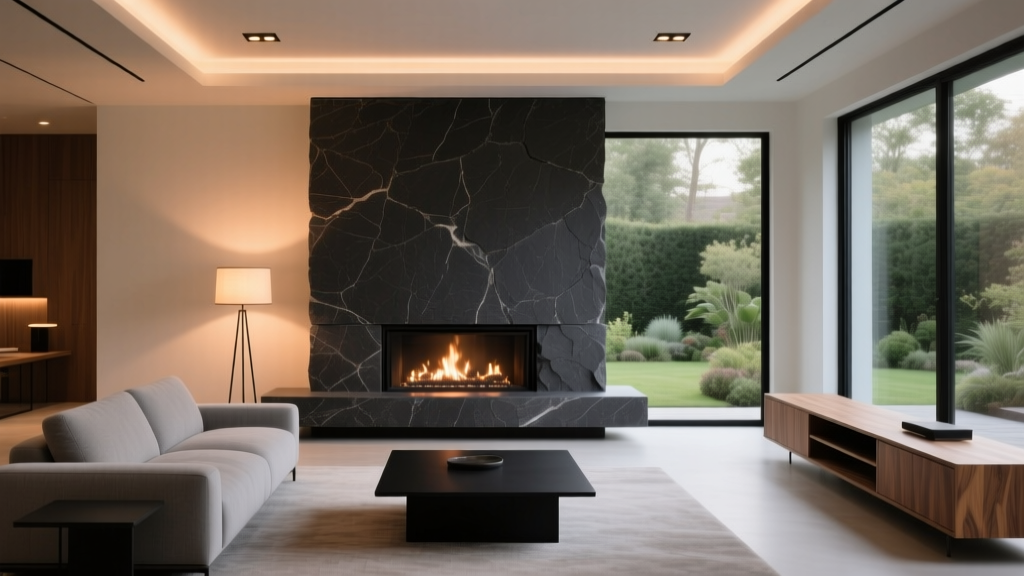
Scenario A: The Modern Fireplace (Interior Manufactured Ledgestone)
- Design: Floor-to-ceiling fireplace surround using dark charcoal manufactured ledgestone.
- Material: $1,100 (Flat panels) + $220 (Corner pieces) = $1,320
- Prep & Labor: Drywall removal, cement board installation, and meticulous leveling of horizontal lines = $1,600
- Total Estimated Cost: $2,920 ($29.20 / sq. ft. blended rate)
Scenario B: The Craftsman Exterior Wainscot (Natural Fieldstone)
- Design: 3-foot high exterior wainscot wrapping a front porch using natural mossy fieldstone.
- Material: $1,800 (Flat natural stone) + $180 (Corner pieces) = $1,980
- Prep & Labor: WRB, metal lath, scratch coat, and organic pattern laying (faster labor) = $1,400
- Total Estimated Cost: $3,380 ($33.80 / sq. ft. blended rate)
Scenario C: The Contemporary Media Wall (Mortarless Interlocking)
- Design: TV accent wall using interlocking polyurethane stackstone panels.
- Material: $2,400 (Panels and trim) = $2,400
- Prep & Labor: Direct-to-stud screwing, minimal cutting, no mortar mixing = $450
- Total Estimated Cost: $2,850 ($28.50 / sq. ft. blended rate)
Final Sourcing and Authority References
Executing a successful stone veneer project requires adhering to manufacturer specifications and industry standards. Always reference the Eldorado Stone Installation Guidelines or equivalent manufacturer documentation for exact mortar mix ratios, curing times, and weep screed placement. By aligning your aesthetic vision with a realistic understanding of profile-specific labor and substrate requirements, you can achieve stunning architectural results without compromising your financial blueprint.
Written by
Marcus ChenMarcus Chen is a licensed structural engineer (PE) and building materials analyst with over 12 years of experience across residential, commercial, and industrial construction. He holds a Master of Science in Civil Engineering from UC Berkeley and spent six years at Thornton Tomasetti before transitioning to independent consulting and technical writing. Marcus specializes in material selection for seismic-prone regions, concrete reinforcement strategies, and lifecycle cost analysis. His work has been cited by the American Concrete Institute (ACI) and the Structural Engineers Association of California (SEAOC). When he is not on a job site or at his desk, you will find him hiking the Sierra Nevada or restoring a 1920s craftsman bungalow in Oakland, CA.
More from Marcus Chen
View all
Construction Cost
How Much Did the Eiffel Tower Cost to Build?
How much did the Eiffel Tower cost to build in 1889? We adjust for inflation and compare its budget to modern skyscraper construction.
Aug 4, 2026

Fire Resistance
What Is a Fire Resistant Material? Testing & Certification Guide
Discover what is a fire resistant material through ASTM and UL testing. Learn how fire ratings, certifications, and assemblies work in construction.
Aug 4, 2026

Construction Cost
How Much Did the Burj Khalifa Cost to Build?
How much did the Burj Khalifa cost to build? We break down the $1.5B project and extract 5 money-saving strategies for your next build.
Jul 30, 2026