Vetting Stone Veneer Contractors: 2026 Hiring Guide
Compare stone veneer contractors using 2026 labor rates, technical vetting questions, and contract minimums to prevent delamination and moisture failure.

The Economics of Masonry Labor: 2026 Rate Breakdown
Hiring specialized stone veneer contractors requires understanding the bifurcated pricing structure of modern masonry. Labor rates in 2026 vary drastically based on whether the project utilizes Manufactured Stone Veneer (MSV) or natural quarried stone. MSV installation labor typically ranges from $14 to $22 per square foot. Natural stone veneer, which requires selective cutting, heavier material handling, and precise mortar joint tooling, commands $28 to $45 per square foot for labor alone.
However, the base square-footage rate rarely reflects the final invoice. Specialized contractors will itemize critical prep work that general handymen often omit. Expect line items for scaffolding erection ($1.50–$3.00 per sq. ft.), existing siding demolition, and Weather Resistive Barrier (WRB) integration. According to the National Association of Home Builders (NAHB), improper substrate preparation accounts for over 60% of premature veneer failures. A legitimate contractor will never apply veneer directly over painted brick, unsealed concrete, or existing wood siding without a complete tear-down to the sheathing.
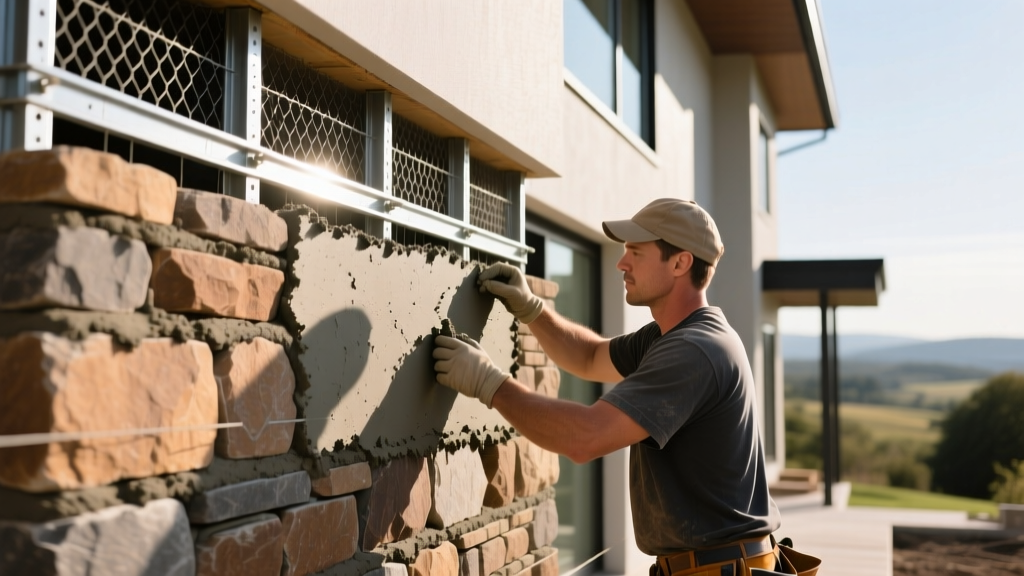
If a contractor's bid is more than 20% below the regional average, they are likely cutting corners in three specific areas: omitting the metal lath scratch coat, using unmodified Type N mortar instead of polymer-modified blends, or skipping the weep screed at the foundation line. These omissions guarantee moisture entrapment and eventual delamination.
The Technical Interrogation: 5 Questions That Expose Amateurs
Do not rely on portfolio photos to verify competence. Portfolio images cannot reveal the hidden structural mechanics behind the stone. During the initial site walk, ask these five highly specific technical questions to separate certified masons from general landscapers attempting masonry work.
1. "What weight lath do you use, and what is your fastener spacing pattern?"
The Expert Answer: The contractor must specify 2.5 lb self-furring galvanized metal lath. It must be overlapped a minimum of 1 inch horizontally and 2 inches vertically. Fasteners (1.5-inch galvanized roofing nails or corrosion-resistant screws) must penetrate directly into the wall studs every 6 inches on center, not just into the OSB or plywood sheathing. The self-furring dimples must face outward to allow the scratch coat mortar to wrap behind the lath.
2. "How do you manage the WRB lap sequence at the weep screed?"
The Expert Answer: Proper moisture management dictates that the WRB (house wrap or fluid-applied membrane) must lap over the top flange of the weep screed, acting like shingles to shed water out and away from the framing. The weep screed itself must maintain a minimum 4-inch clearance from soil grade and a 2-inch clearance from paved surfaces to prevent capillary action and splash-back degradation.
3. "What mortar mix do you use for the scratch coat versus the setting bed?"
The Expert Answer: A traditional Type S mortar mix is standard for the scratch coat, applied at a 3/8-inch thickness and horizontally raked to create a mechanical key. For the setting bed, top-tier contractors now use polymer-modified mortars (such as LATICRETE MVIS or PROSOCO anchors) which offer superior flexural strength and bond retention. Furthermore, they must confirm they "back-butter" every individual stone, applying mortar to the back of the veneer piece before pressing it into the setting bed to eliminate air pockets.
4. "How do you handle control joints and expansion gaps on long runs?"
The Expert Answer: Manufactured and natural stone veneers are susceptible to thermal expansion and structural settling. The Masonry Veneer Manufacturers Association (MVMA) guidelines require soft joints (sealed with a high-grade polyurethane sealant) at floor lines, roof intersections, and anywhere the substrate changes material (e.g., transitioning from wood framing to a concrete foundation).
5. "What is your curing protocol for the scratch coat before setting stone?"
The Expert Answer: The scratch coat requires a minimum of 24 to 48 hours of curing time, depending on ambient humidity and temperature. Applying the setting bed while the scratch coat is still green (uncured) pulls moisture out of the setting mortar, resulting in a weak, chalky bond that will fail under freeze-thaw cycles.
Direct Hire vs. General Contractor: Sourcing Matrix
Deciding whether to hire a specialized masonry subcontractor directly or route the project through a General Contractor (GC) impacts both cost and quality control. Use this matrix to determine the optimal hiring path for your specific project scope.
| Criteria | Direct Hire (Specialized Mason) | General Contractor (Managed) |
|---|---|---|
| Cost Structure | Lower overall cost. You pay the mason's direct rate. | 15% to 25% markup added by the GC for overhead and scheduling. |
| Quality Control | High, provided you understand the MVMA specs to inspect their work. | Variable. Depends entirely on the GC's specific masonry subs. |
| Scheduling | You must coordinate scaffolding, material delivery, and weather delays. | GC manages logistics, material staging, and trade sequencing. |
| Warranty Routing | Direct line to the installer for labor warranty claims. | GC acts as middleman; can delay resolution if the sub is unresponsive. |
| Best For | Single-facade accents, interior fireplaces, retrofit projects. | Full exterior envelope replacements, new construction, complex roofing ties. |
Insurance, Licensing, and Contractual Safeguards
Masonry is a high-liability trade. The physical weight of stone veneer (ranging from 10 lbs to 15 lbs per square foot) poses severe structural and safety risks if improperly anchored. Before signing any agreement, verify the following minimum thresholds:
- General Liability Insurance: Minimum $1,000,000 per occurrence and $2,000,000 aggregate. Request a Certificate of Insurance (COI) directly from their broker, naming you as the certificate holder.
- Workers' Compensation: Non-negotiable. If an uninsured mason is injured on your property while hauling 80-pound stone boxes, the liability falls directly on the homeowner.
- Masonry Contractor License: Verify their specific masonry or structural license through your state's contractor board. A general home improvement license is insufficient for load-bearing or heavy veneer applications.
The contract must explicitly state adherence to the Masonry Contractors Association of America (MCAA) standards and the specific stone manufacturer's installation manual. If the contractor deviates from the manufacturer's printed guidelines (e.g., failing to use the recommended polymer additive in the mortar), the material warranty—often 50 years for premium brands like Cultured Stone or Eldorado—is immediately voided.
Failure Modes: What to Inspect During the Build
Do not wait until the scaffolding comes down to inspect the work. Conduct a mid-build inspection immediately after the scratch coat is applied and before the stones are set. Look for these critical failure precursors:
- Lath Telegraphing: If you can see the shadow or outline of the wall studs through the scratch coat, the mortar layer is too thin. It must be a uniform 3/8-inch to 1/2-inch thick, fully encapsulating the metal lath.
- Missing Weep Holes: Inspect the bottom edge of the weep screed. The weep holes must be clear of dried mortar droppings. If they are clogged, hydrostatic pressure will build up behind the veneer, leading to interior drywall rot.
- Improper Corner Pieces: Amateurs will attempt to miter-cut flat stones to create corners, resulting in visible, fragile seam lines. Professional contractors use factory-molded corner pieces that wrap the edge, providing a structural interlock and a natural aesthetic.
- Efflorescence Traps: Ensure the contractor is not using unbuffered masonry cleaners or excessive water during the final wash-down. Acid washing manufactured stone veneer destroys the color pigments and accelerates efflorescence (the white, powdery salt deposit that ruins the facade).
Selecting the right stone veneer contractors is an exercise in risk mitigation. By enforcing strict technical standards, verifying specialized insurance, and understanding the true cost of proper substrate preparation, you ensure the structural longevity and aesthetic permanence of your masonry investment.
Written by
Marcus ChenMarcus Chen is a licensed structural engineer (PE) and building materials analyst with over 12 years of experience across residential, commercial, and industrial construction. He holds a Master of Science in Civil Engineering from UC Berkeley and spent six years at Thornton Tomasetti before transitioning to independent consulting and technical writing. Marcus specializes in material selection for seismic-prone regions, concrete reinforcement strategies, and lifecycle cost analysis. His work has been cited by the American Concrete Institute (ACI) and the Structural Engineers Association of California (SEAOC). When he is not on a job site or at his desk, you will find him hiking the Sierra Nevada or restoring a 1920s craftsman bungalow in Oakland, CA.
More from Marcus Chen
View all
Construction Cost
How Much Did the Eiffel Tower Cost to Build?
How much did the Eiffel Tower cost to build in 1889? We adjust for inflation and compare its budget to modern skyscraper construction.
Aug 4, 2026

Fire Resistance
What Is a Fire Resistant Material? Testing & Certification Guide
Discover what is a fire resistant material through ASTM and UL testing. Learn how fire ratings, certifications, and assemblies work in construction.
Aug 4, 2026

Construction Cost
How Much Did the Burj Khalifa Cost to Build?
How much did the Burj Khalifa cost to build? We break down the $1.5B project and extract 5 money-saving strategies for your next build.
Jul 30, 2026