Stone Veneer Chimneys Cost Guide: 2026 Pricing & ROI
Analyze 2026 stone veneer chimneys costs, including manufactured vs. natural pricing, labor rates, hidden structural expenses, and ROI data.

The True Cost of Stone Veneer Chimneys in 2026
Cladding a chimney in stone veneer dramatically elevates a home's architectural profile, but the financial commitment extends far beyond the sticker price of the stone itself. Whether you are upgrading a builder-grade vinyl-sided chimney or constructing a new exterior chase, understanding the 2026 cost variables is critical for accurate budgeting. This analysis breaks down material selection, specialized masonry labor, structural prerequisites, and long-term return on investment for stone veneer chimneys.
2026 National Cost Snapshot
Average Total Cost (1-Story Chimney, 120 sq ft): $3,800 – $6,200
Average Total Cost (2-Story Chimney, 220 sq ft): $7,500 – $13,500
Material Cost Range: $8 – $24 per square foot
Labor Cost Range: $18 – $32 per square foot
Material vs. Labor: Where Your Budget Actually Goes
The most common miscalculation in chimney veneer projects is underestimating the labor-to-material ratio. Unlike horizontal flooring, vertical chimney installations require meticulous gravity management, scaffolding, and precise moisture detailing.
Manufactured Stone Veneer (MSV)
Manufactured stone, governed by ASTM C1670 standards, remains the most popular choice for chimney applications due to its consistent thickness and lighter weight. Premium brands like Boral Cultured Stone and Eldorado Stone offer profiles specifically engineered for vertical applications. Expect to pay between $8.50 and $14.00 per square foot for the material. MSV typically weighs 10 to 12 pounds per square foot, which rarely requires structural footing reinforcement for standard wood-framed chimney chases.
Natural Thin Stone Veneer (NTSV)
Natural thin veneer (sawn to 1-inch thickness) provides unmatched geological authenticity. Materials like Oklahoma fieldstone or Wisconsin limestone range from $13.00 to $24.00 per square foot. While the raw material is more expensive, NTSV requires a higher skill level to install. Because natural stone varies wildly in thickness, masons must spend significantly more time adjusting the mortar bed to maintain a plumb surface, driving labor costs up by 15% to 25% compared to MSV.
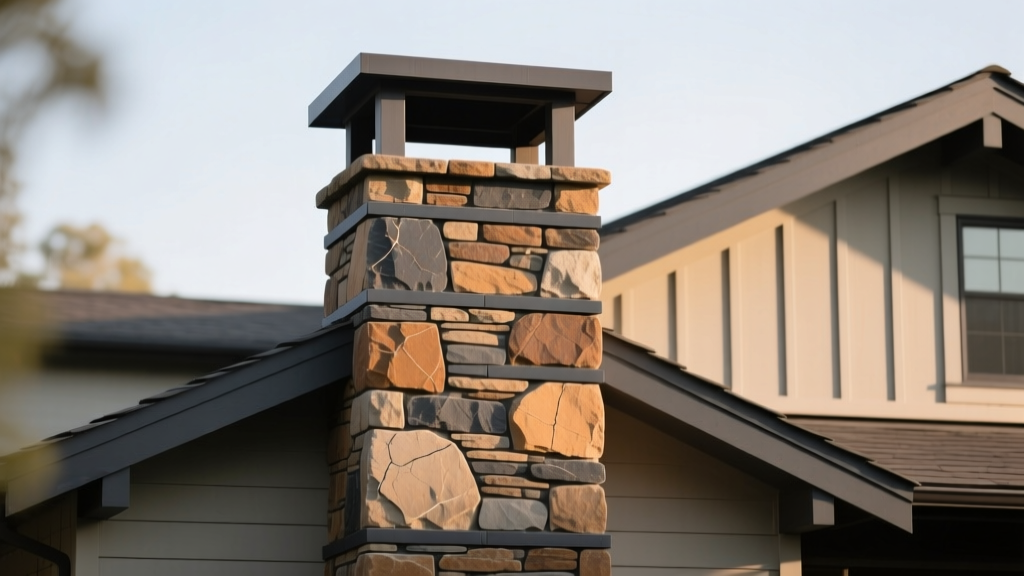
2026 Pricing Matrix: Chimney Dimensions and Stone Profiles
The following matrix outlines estimated total costs (materials, labor, and basic prep) based on chimney height and the complexity of the stone profile. Complex profiles like Ledgestone require tight, dry-stacked fitting, while Ashlar patterns involve more cutting and mortar joint tooling.
| Chimney Type & Area | Profile: Ashlar / Fieldstone | Profile: Ledgestone / Dry-Stack | Scaffolding & Prep Adder |
|---|---|---|---|
| 1-Story (approx. 120 sq ft) | $3,800 – $4,900 | $4,500 – $5,800 | $300 – $500 |
| 1.5-Story (approx. 170 sq ft) | $5,400 – $7,100 | $6,300 – $8,200 | $600 – $900 |
| 2-Story (approx. 220 sq ft) | $7,500 – $9,800 | $8,800 – $11,500 | $1,200 – $1,800 |
Hidden Costs and Structural Edge Cases
Budget overruns on chimney veneer projects almost always stem from three overlooked structural and moisture-management requirements. According to Angi's stone veneer cost guide, failing to account for site-specific prep work can inflate final invoices by up to 20%.
- Weather-Resistive Barrier (WRB) & Weep Screeds: You cannot adhere stone directly to plywood or OSB. The assembly requires a WRB (like Tyvek), a layer of Grade D paper, corrosion-resistant metal lath, and a Type S scratch coat. Crucially, a weep screed (per ASTM C2288) must be installed at the base of the chimney to allow trapped moisture to escape. Budget $3.50 to $5.00 per square foot for this complete prep assembly.
- Scaffolding and Hoisting: For chimneys exceeding 14 feet, OSHA regulations and basic masonry safety require erected scaffolding. Renting and erecting a 3-tier scaffolding system adds $800 to $1,500 to the project. Hoisting heavy pallets of natural stone to second-story rooflines may require a specialized material lift or crane, adding another $400 to $750.
- Flashing Integration: Where the stone veneer meets the roofline and the chimney cap, step flashing and counter-flashing must be meticulously integrated into the mortar joints. If your existing roof flashing is degraded, a roofer must be brought in before the mason starts, costing an additional $600 to $1,200.
Decision Framework: Manufactured vs. Natural Veneer
Choosing between MSV and NTSV requires balancing aesthetic demands with structural realities. Use this framework to guide your specification:
Choose Manufactured (MSV) If:
- The chimney chase is wood-framed and cannot support loads exceeding 15 lbs/sq ft.
- You require a specific, uniform color palette that natural stone cannot guarantee.
- The budget is strictly capped, and you want to minimize specialized cutting labor.
- You are installing a dry-stack (mortarless) profile, where MSV interlocking edges hide gaps better.
Choose Natural (NTSV) If:
- The home features high-end, bespoke architecture where geological authenticity is paramount.
- The chimney is built on a reinforced concrete or block masonry foundation that can handle 20+ lbs/sq ft.
- You live in an extreme freeze-thaw climate and are specifying high-density natural granite or quartzite.
- You prefer the subtle color variations and mineral veining that only real stone provides.
Avoiding Expensive Failure Modes
A stone veneer chimney is only as durable as its moisture management system. The most catastrophic failure mode is efflorescence and freeze-thaw spalling. This occurs when masons use a mortar mix that is too hard.
Critical Masonry Specification: Never use Type S mortar (1,800 PSI) for the setting bed of stone veneer. Type S is too rigid and will trap moisture, causing the stone faces to pop off during freeze-thaw cycles. Always specify Type N mortar (750 PSI), which is softer, more permeable, and allows the assembly to breathe and flex with thermal expansion.
Additionally, ensure the mason leaves a minimum 2-inch clearance between the bottom of the stone veneer and the final grade or roof surface. Burying the bottom edge of the veneer in soil or roofing tar invites capillary water action, which will wick moisture behind the WRB and rot the chimney framing from the inside out.
ROI and Resale Value Impact
From an investment perspective, upgrading a chimney with stone veneer yields strong returns. Data from the NARI Remodeling Impact Report consistently ranks exterior stone veneer upgrades among the top tier for cost recovery. In 2026, homeowners can expect to recoup 75% to 88% of the project cost at resale, depending on the regional market and the architectural cohesion of the stone profile with the rest of the home's exterior. A striking stone chimney serves as a primary focal point for curb appeal, often accelerating the sales cycle in competitive suburban housing markets.
Written by
Elena RodriguezElena Rodriguez is a civil engineer and technical writer specializing in concrete technology, masonry systems, and ASTM/ACI compliance. She earned her B.S. in Civil Engineering from Texas A&M University and spent a decade at a materials testing laboratory, performing over 2,000 concrete compressive strength tests and masonry prism evaluations. Elena is an ACI-certified Field Testing Technician (Grade I) and a member of ASTM Committee C12 on Natural Building Stone. She currently consults on forensic engineering cases involving concrete failures and moisture intrusion. Based in San Antonio, TX, Elena is a proud member of the Society of Women Engineers (SWE) and coaches her daughter's FIRST Robotics team.
More from Elena Rodriguez
View all
Walls & Panels
Cost Analysis: Light Gauge Steel Framing Advantages and Disadvantages
Evaluate light gauge steel framing advantages and disadvantages through a strict cost analysis lens, comparing material, labor, and lifecycle expenses.
Aug 4, 2026

Walls & Panels
Gypsum Board Types: Exact Specifications, Thickness & Dimensions
Compare standard, Type X, and moisture-resistant gypsum board types. Get exact specifications, thicknesses, dimensions, and ASTM standards for your project.
Aug 4, 2026

Fire Resistance
Best Fire-Resistant Outdoor Decking Materials: 2026 Buyer Guide
Discover the best fire-resistant outdoor decking materials for 2026. Compare Class A PVC, aluminum, and hardwood options for WUI compliance and safety.
Aug 4, 2026