White Granite Countertops: 2026 Brand & Product Line Deep-Dive
Explore top white granite countertop brands and product lines for 2026. Compare Alaska White, River White, and Bianco Romano for your kitchen remodel.
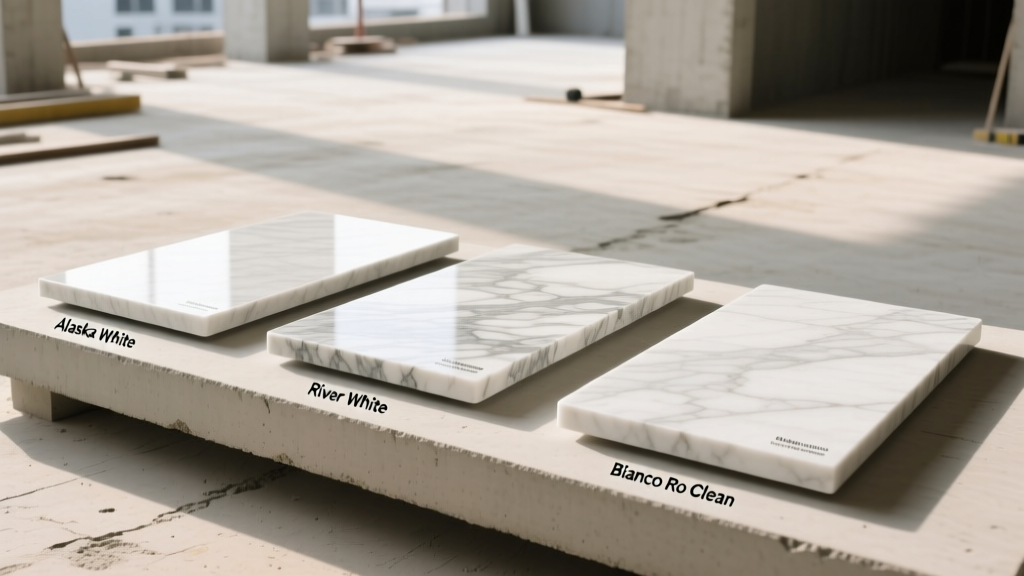
The Geological Reality of White Granite
When architects and homeowners specify white granite countertops, they are rarely ordering true granite in the strict petrological sense. True granite requires a specific ratio of quartz, alkali feldspar, and plagioclase. Most commercial 'white granites' are actually charnockites, anorthosites, or highly metamorphosed quartzites. Understanding this geological distinction is critical because it dictates the stone's porosity, hardness, and reaction to acidic cleaners.
For 2026, the market is dominated by three primary product lines, each sourced from specific global quarries and distributed by major slab wholesalers. This deep-dive analyzes the brand offerings, fabrication nuances, and performance metrics of the most specified white stone product lines in the industry.
Tier 1 Product Lines: The Market Leaders
1. Alaska White (The High-Movement Charnockite)
Marketed heavily by MSI Surfaces and Cosmos, Alaska White is geologically a charnockite sourced from the Rajasthan region of India. It features a macro-crystalline structure with large, interlocking feldspar crystals that create dramatic, high-contrast movement.
- Brand Variants: MSI Alaska White, Cosmos Himalayan White, Levantina White Macaubas (often mislabeled).
- Mineral Hardness: 6.5 to 7 on the Mohs scale (harder than true granite due to quartzite/chrockite metamorphism).
- Porosity: Extremely low. The dense crystalline matrix naturally resists liquid penetration, reducing the frequency of required sealing compared to lighter marbles.
2. River White (The Resin-Treated Veined Classic)
River White, often branded as Colonial White by distributors like Cosmos Surfaces, originates from Indian quarries and is prized for its soft, cream-colored background intersected by burgundy and slate-grey veining. It is the industry's primary alternative to white marble.
3. Bianco Romano (The Brazilian Workhorse)
Sourced primarily from the Espírito Santo state in Brazil, Bianco Romano is one of the few commercial white stones that closely aligns with the true granite classification. Brands like Pokarna and MSI offer this in multiple grades based on the density of the brown and grey speckling.
Unlike the high-movement Alaska lines, Bianco Romano offers a micro-crystalline, consistent particulate pattern. This makes it highly forgiving for complex edge profiles (like ogee or dupont) because the pattern does not require meticulous bookmatching or vein-matching at the seams.
2026 Pricing Matrix: Material & Installed Costs
Pricing for white granite countertops fluctuates based on the slab grade (Level 1 through Level 4), block yield, and ocean freight surcharges. The following matrix reflects Q1 2026 national averages for material and professional installation.
| Product Line | Wholesale Grade | Material Cost (Per Sq. Ft.) | Installed Cost (Per Sq. Ft.) | Typical Edge Profile Upcharge |
|---|---|---|---|---|
| Bianco Romano | Level 1 / 2 | $35 - $45 | $75 - $95 | $15 - $25 (Standard Ogee) |
| River White | Level 2 / 3 | $45 - $60 | $90 - $115 | $20 - $30 (Requires Epoxy) |
| Alaska White | Level 3 / 4 | $65 - $85 | $110 - $145 | $25 - $40 (Vein-Matching Labor) |
Edge Profile Compatibility & Structural Limits
The mineral composition of white granite dictates how well it holds intricate edge profiles without chipping or blowout during the CNC routing process.
- Bianco Romano: Excellent for complex profiles (Ogee, Dupont, Cove). The uniform, micro-crystalline feldspar matrix cuts cleanly, yielding sharp, defined edges that polish to a high-gloss finish without requiring manual touch-ups.
- River White: Moderate suitability. The intersecting veins represent changes in mineral density. When the CNC bit transitions from hard quartz to softer mica or calcite veins, micro-chipping can occur. Fabricators should use a 3/8-inch radius on the top edge to minimize blowout, reserving sharp eased edges only for the most premium, hand-finished slabs.
- Alaska White: Poor for intricate profiles. The massive, interlocking charnockite crystals are prone to 'grain blowout' when routed with complex bits. Stick to eased, pencil round, or simple bevel edges. Attempting a deep ogee on Alaska White often results in a jagged, pitted edge profile that traps grease and requires extensive manual filling.
Sealing Protocols & Chemical Compatibility
According to the Natural Stone Institute, impregnating sealers are mandatory for natural stone, but the chemical carrier dictates performance on white granites. Because white stones reflect light, solvent-based sealers that leave a surface residue will create a visible, cloudy haze.
Recommended Sealer Specifications
- For Bianco Romano (True Granite): Standard water-based siloxane sealers (e.g., 511 Impregnator) are sufficient. Reapply every 18 to 24 months based on water-drop testing.
- For River White (High Fissure Content): Use a high-penetration, solvent-based fluoropolymer sealer like Dry-Treat Stain-Proof. The smaller molecular structure penetrates the micro-fissures that water-based carriers cannot reach.
- For Alaska White (Dense Charnockite): Requires a reactive sealer. Because the stone is incredibly dense, standard sealers will pool on the surface. Use a specialized dense-stone impregnator and allow a minimum 4-hour dwell time before wiping the excess.
Fabrication & Seam Placement Strategy
The visual success of white granite countertops relies heavily on the fabricator's template strategy. High-movement stones like Alaska White cannot be seamed arbitrarily.
- Digital Templating: Insist on laser or digital photo-templating (e.g., Breton or Park Industries systems) rather than physical stick templates. This allows the fabricator to overlay the digital slab image onto the kitchen layout.
- Vein Flow Mapping: For Alaska White, seams should be placed in low-traffic visual zones (e.g., returning into a corner or behind a cooktop) rather than across the primary prep island. The fabricator must use a slab-preview software to ensure the macro-crystals flow continuously across the joint.
- Mechanical Support: White granites, particularly River White, have natural weak points along the veining. Any overhang exceeding 10 inches for a breakfast bar, or any span over a dishwasher, must be supported with concealed steel brackets or structural corbels to prevent shear failure.
Expert Verdict: Selecting Your Product Line
Choosing the right white granite product line requires aligning the stone's geological properties with your household's usage patterns. If your priority is a low-maintenance, highly durable surface for a heavy-cooking kitchen, Bianco Romano offers the best structural integrity and lowest lifecycle cost. If you desire the aesthetic of Calacatta marble but require granite-level hardness, River White is the optimal choice, provided your fabricator strictly adheres to UV-stable epoxy protocols. For high-end architectural statements where dramatic movement is the focal point, Alaska White remains the premier specification, justifying its Level 4 pricing through sheer visual impact.