White Marble Countertops: Application Fit & Scenario Guide
Evaluate white marble countertops for your kitchen. We match specific marble types to usage scenarios, analyzing etching risks, sealing protocols, and costs.
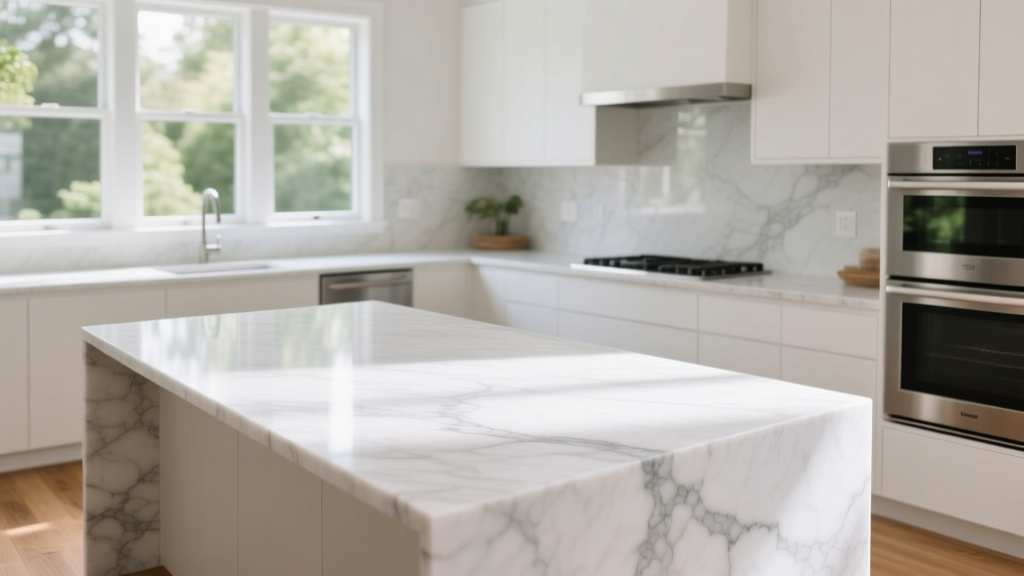
The Reality of White Marble in High-Traffic Kitchens
White marble countertops remain a benchmark for luxury kitchen design, but their calcium carbonate composition demands strict application matching. Unlike quartz or granite, marble is a metamorphic rock with a Mohs hardness of 3 to 4, making it inherently susceptible to both physical scratching and chemical etching. According to the Natural Stone Institute, the primary failure mode in residential kitchens is not structural, but cosmetic: acidic substances with a pH below 7 (such as lemon juice, tomato sauce, and vinegar) dissolve the polished surface layer, leaving dull, light-reflecting marks known as etches.
Specifying white marble requires shifting the evaluation from purely aesthetic preferences to a rigorous assessment of household cooking habits, maintenance tolerance, and psychological acceptance of natural aging. This guide maps specific white marble varieties to their optimal kitchen scenarios, providing exact fabrication, sealing, and maintenance parameters.
Scenario Matching: Where White Marble Countertops Thrive and Fail
Scenario A: The Baker's Station (High Application Fit)
Marble possesses high thermal mass and low thermal conductivity, allowing it to maintain a surface temperature roughly 5°F to 10°F cooler than ambient room temperature. This makes white marble the premier material for dedicated baking zones. The cool surface prevents butter from melting prematurely when rolling pastry dough and provides an ideal slab for tempering chocolate. For this scenario, a 2cm or 3cm polished Carrara slab is optimal, as the occasional flour dusting and neutral-pH baking ingredients pose zero etching risk.
Scenario B: The Heavy-Cooking Entertainer (Low Application Fit)
Kitchens that frequently process high-acid ingredients (citrus, wine, tomatoes) or utilize aggressive cleaning chemicals are hostile environments for polished white marble. A splash of balsamic vinegar (pH 2.5) will etch a polished marble surface in under 60 seconds. If the client insists on marble in this scenario, the fabricator must apply a honed finish and treat the surface with a permanent topical urethane or epoxy coating (such as MORE Anti-Etch), which physically isolates the stone from acids. Note that topical coatings alter the tactile feel of the stone and require professional reapplication every 5 to 7 years.
Scenario C: The Low-Use Show Kitchen (Perfect Fit)
For secondary kitchens, wet bars, or primary kitchens used primarily for light meal prep and entertaining, white marble excels without the need for aggressive chemical protections. A standard penetrating impregnating sealer is sufficient to prevent oil and wine staining, while the lack of heavy acidic cooking preserves the polished finish indefinitely.
Material Breakdown: Carrara vs. Calacatta vs. Statuario
Not all white marble performs identically. The density, background color, and veining contrast dictate both the visual impact and the visibility of future etching. The National Kitchen & Bath Association (NKBA) frequently notes that high-contrast marbles show etching more prominently under direct overhead lighting.
| Marble Variety | Background & Veining | Cost Range (Installed) | Etch Visibility | Best Application Scenario |
|---|---|---|---|---|
| Carrara (C/CD Grade) | Light gray background, soft feathery gray veining | $75 - $110 / sq.ft. | Low (gray background masks dull spots) | High-traffic kitchens, baking stations, budget-conscious luxury |
| Calacatta Gold | Stark white background, bold gold and gray veining | $160 - $250+ / sq.ft. | High (bright white background highlights etches) | Show kitchens, island waterfalls, low-acid prep zones |
| Statuario | Pure white background, dramatic, thick charcoal veining | $200 - $300+ / sq.ft. | Very High | Master bath vanities, wet bars, formal entertaining spaces |
| Thassos | Crystalline pure white, minimal to no veining | $120 - $180 / sq.ft. | Moderate (uniform color makes etching blend if honed) | Minimalist modern kitchens, seamless backsplashes |
The Etching Tolerance Matrix & Sealing Protocols
A common misconception in the stone industry is that "sealing" prevents etching. Standard penetrating sealers (like Miracle Sealants 511 Porous Plus or Tenax Ager) are designed to fill the microscopic pores of the stone to block liquid intrusion (staining). They sit below the surface and do absolutely nothing to stop the chemical reaction between acid and the calcium carbonate surface.
Decision Framework for Surface Protection
- If the client accepts a living patina: Specify a honed finish. Apply a high-quality penetrating siloxane sealer to prevent oil stains. Etching will occur but will blend seamlessly into the matte texture.
- If the client demands a polished look but cooks with acids: Specify a polished finish, but mandate the application of a clear, topical anti-etch coating (e.g., MORE Anti-Etch or Stone Armor). This adds $15 to $25 per square foot to the fabrication cost but provides a physical barrier against pH-reactive spills.
- If the client wants zero maintenance and zero etching: Abort the marble specification. Pivot the client to a high-end quartzite (e.g., White Macaubas or Taj Mahal) or a premium sintered stone (e.g., Neolith Calacatta) which mimics marble visually but offers a Mohs hardness of 7 and complete acid resistance.
Edge Profile Selection and Structural Integrity
The edge profile of white marble countertops heavily influences both the visual weight of the installation and its long-term durability against chipping.
Fabricator Warning: Mitered apron edges (where a 2cm slab is cut at a 45-degree angle and epoxied to create the illusion of a 5cm+ thick block) are highly popular in modern design. However, the sharp 90-degree outer corner created by a miter is the most vulnerable point on the slab. A dropped cast-iron skillet will easily chip a mitered marble edge. For households with young children or heavy cookware, specify an eased edge with a 3mm radius or a subtle bevel to distribute impact force.
Cost Analysis: Fabrication and Long-Term Upkeep
Budgeting for white marble countertops must extend beyond the initial slab purchase. Proper installation and ongoing maintenance carry specific financial requirements to ensure the material performs as intended.
| Cost Category | Specification Details | Estimated Cost Range |
|---|---|---|
| Slab Material (Mid-Range) | Carrara or standard Calacatta, 2cm or 3cm thickness | $60 - $180 per sq.ft. |
| Fabrication & Installation | Cutting, polishing, seam epoxying, and structural support | $40 - $80 per sq.ft. |
| Honing (Optional) | Matte finish to mask etching (reduces polishing labor) | $10 - $15 per sq.ft. |
| Topical Anti-Etch Coating | Professional application of urethane/epoxy barrier | $15 - $25 per sq.ft. |
| Annual Maintenance | pH-neutral cleaners (e.g., StoneTech Revitalizer) and microfiber care | $50 - $100 per year |
| Professional Re-polishing | Required every 7-10 years for polished stone without topical coatings | $400 - $800 per kitchen |
Frequently Asked Questions
Can I use white marble countertops with an undermount sink?
Yes, but the sink cutout requires meticulous sealing. The exposed, unpolished edge of the marble inside the cutout is highly porous and constantly exposed to water and acidic food scraps. Fabricators must saturate this exposed edge with a high-solids impregnating sealer and ensure the silicone bead bonding the sink to the stone is completely continuous to prevent water from migrating behind the sealant and causing subsurface staining.
How do I remove an etch mark from polished white marble?
Because etching is physical material loss (not a stain), it cannot be wiped away. Minor etches can be buffed out using a specialized marble polishing powder (such as Tenax Marble Polish Powder) and a low-speed buffing pad. Deep etches or widespread dulling require a professional stone restoration specialist to mechanically re-hone and re-polish the surface using diamond abrasive pads ranging from 100 to 3000 grit.
Is white marble suitable for outdoor kitchens?
White marble is generally not recommended for exterior applications in climates with freeze-thaw cycles. The stone's natural porosity allows water absorption; when this water freezes, it expands and can cause spalling (surface flaking) or micro-fractures. Furthermore, UV exposure and acid rain will rapidly degrade polished finishes outdoors. For exterior white countertops, specify a UV-stable porcelain slab or white quartzite instead.