The True Cost of Discount Stone Veneer: Budget vs. Premium Analysis
Analyze the true cost of discount stone veneer. We break down hidden expenses, labor variables, and durability metrics to see if budget MSV is worth it.
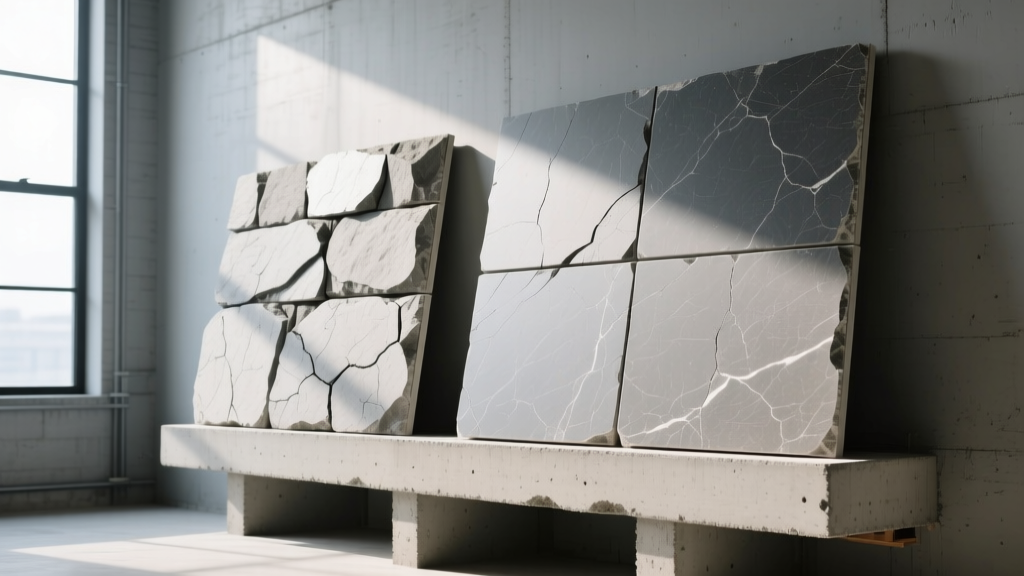
The Economic Reality of Budget Manufactured Stone
When estimating a masonry facade project, discount stone veneer presents an immediate upfront advantage. Budget-tier manufactured stone veneer (MSV) typically costs between $3.50 and $5.50 per square foot, compared to $9.00 to $14.00 for premium architectural MSV and $15.00+ for natural thin stone veneer. However, evaluating the financial viability of discount stone veneer requires looking past the initial material invoice. The true cost of adhered masonry systems is dictated by waste factors, mortar consumption, labor inefficiencies, and long-term maintenance. This analysis deconstructs the hidden multipliers that frequently erase the initial savings of budget-tier stone products.
Upfront Material Cost Matrix
The market segments MSV into distinct tiers based on molding precision, pigment integration, and aggregate quality. Below is the baseline material cost per square foot for the veneer itself, excluding corner pieces, mortar, and lath.
| Material Tier | Cost per Sq. Ft. (Materials Only) | Pigment Type | Molding Precision |
|---|---|---|---|
| Discount / Builder-Grade MSV | $3.50 - $5.50 | Surface stains or low-grade oxides | Low (high repetition, flat backs) |
| Mid-Tier Residential MSV | $6.00 - $8.50 | Integral iron oxide pigments | Medium (varied textures) |
| Premium Architectural MSV | $9.00 - $14.00 | Deep integral oxides, color-fast | High (undercut edges, 3D relief) |
| Natural Thin Stone Veneer | $12.00 - $22.00+ | Natural geological coloration | Variable (requires skilled fitting) |
The Hidden Cost Multipliers
Purchasing discount stone veneer shifts costs from the material ledger to the installation and maintenance phases. Project managers and homeowners must account for the following variables to avoid budget overruns.
1. Elevated Waste and Breakage Factors
Budget MSV is often cast in lower-quality polyurethane molds and cured rapidly, resulting in brittle units with high void ratios. While premium manufacturers guarantee a 5% waste factor for cutting and breakage, discount stones routinely exhibit a 12% to 15% waste factor. On a 1,000-square-foot exterior project, this means purchasing an additional 70 to 100 square feet of material, instantly adding $245 to $550 to the baseline material cost.
2. Mortar and Adhesive Overconsumption
Discount stones frequently feature flat, poorly textured backings that lack the mechanical grooves required for optimal thin-set adhesion. To achieve the bond strength mandated by industry guidelines, masons must apply a thicker scratch coat and back-butter each unit heavily. Furthermore, irregular thicknesses in budget stones force installers to use up to 30% more Type S mortar or polymer-modified adhesive to maintain a plumb surface, increasing consumable costs by $0.40 to $0.75 per square foot.
3. Efflorescence and Sealing Requirements
Cheap MSV often utilizes unwashed aggregates and high-alkali cements to cut manufacturing costs. When exposed to moisture, these materials leach soluble salts to the surface, causing severe efflorescence. Mitigating this requires the application of a high-quality silane/siloxane penetrating sealer. While premium stones are often dense enough to resist water ingress without sealing, budget stones demand a sealer application costing an additional $0.60 to $1.10 per square foot, plus recurring reapplication every 3 to 5 years. For a deeper understanding of moisture-driven salt migration, the Building Science Corporation's technical digest on efflorescence details how porous masonry substrates accelerate this degradation.
Discount stones with high absorption rates (exceeding the limits set by ASTM C1670) are highly susceptible to spalling in freezing climates. Water enters the micro-voids, freezes, expands, and pops the face off the stone. Replacing spalled units on a finished wall costs upwards of $85 per hour in mason labor, entirely negating the initial material savings.
Labor Inefficiencies: The Mason's Perspective
Installation labor represents 50% to 65% of the total project cost for adhered masonry. Masons typically charge between $65 and $95 per hour. Premium MSV is engineered with interlocking profiles, varied returns, and consistent thicknesses, allowing a skilled crew to install 40 to 60 square feet per day.
Discount stone veneer lacks these engineered tolerances. Installers spend excessive time cutting, grinding, and shimming units to hide repetitive mold patterns and fit uneven edges. If a budget stone reduces the crew's daily output to 25 square feet, the labor cost per square foot effectively doubles. A $2.00 per square foot savings on the material can easily result in a $4.00 to $6.00 per square foot penalty in extended labor hours.
Durability Metrics: Pigments and UV Degradation
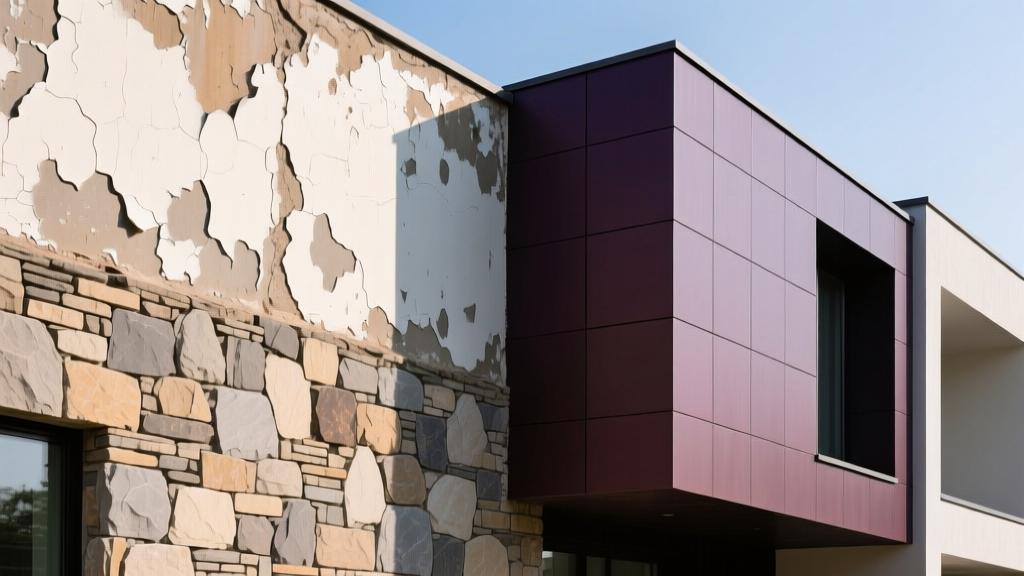
The visual lifespan of stone veneer is dictated by its coloring process. Premium manufacturers use integral iron oxide pigments mixed directly into the concrete slurry, ensuring the color remains consistent even if the stone is chipped or weathered. Discount manufacturers frequently use a base gray concrete and apply a surface-level acid stain or acrylic paint to mimic natural stone.
- UV Fading: Surface stains on budget stones begin to degrade under direct UV exposure within 3 to 7 years, resulting in a washed-out, artificial appearance.
- Chipping Visibility: When a surface-stained discount stone chips during installation or from impact, the bright gray concrete core is exposed, requiring manual touch-up with masonry dyes.
- Color Repetition: Budget lines often utilize only 3 to 5 mold variations per stone profile, creating an obvious, repeating 'wallpaper effect' on large facades that appraisers and buyers immediately recognize as cheap.
Application Decision Framework
Discount stone veneer is not universally inferior; it is simply miscategorized when used in high-performance environments. Use this matrix to determine where budget MSV yields a positive ROI and where it poses a financial risk.
| Application Scenario | Recommendation | Rationale |
|---|---|---|
| Interior Fireplace Accent (Low Traffic) | Approve | No UV exposure, no freeze-thaw risk, minimal moisture. Surface stains hold up well indoors. |
| Exterior Facade (Sunbelt / Mild Climates) | Conditional | Acceptable if sealed properly against efflorescence, but UV fading of surface stains remains a 5-year risk. |
| Exterior Facade (Freeze-Thaw Zones) | Reject | High risk of spalling due to porous aggregates. ASTM C1670 compliance is rarely verified in budget tiers. |
| Commercial Retail Build-Out (Short Lease) | Approve | Ideal for temporary staging or 5-year commercial leases where long-term durability is not the tenant's liability. |
| High-End Residential Resale | Reject | Appraisers and inspectors flag repetitive mold patterns and surface staining, negatively impacting perceived home value. |
Sourcing and Verification Checklist
If your project budget necessitates the use of discount stone veneer, protect your investment by enforcing the following procurement checks:
- Demand ASTM C1670 Certification: Require the supplier to provide a certificate of compliance for ASTM C1670 (Standard Specification for Adhered Manufactured Stone Masonry Veneer). This ensures minimum compressive strength and maximum absorption limits are met.
- Inspect the Cross-Section: Break a sample stone in half. If the color only penetrates the top 2 millimeters, it is surface-stained and will fade. Reject it for exterior use.
- Calculate the True Landed Cost: Add 15% for waste, 20% extra for mortar/adhesive, and factor in a penetrating sealer to your initial quote before comparing it against mid-tier options.
- Verify Mold Variation: Lay out 20 square feet of the sample on the floor. If you can easily spot repeating stones, the facade will look artificial on a large wall.
Frequently Asked Questions
Can I install discount stone veneer myself to save on labor?
DIY installation is possible for interior, mortarless applications using interlocking panel systems. However, traditional scratch-coat and mortar-set methods for exterior applications require knowledge of weather-resistive barriers (WRB), metal lath integration, and weep screed placement. Improper water management behind budget stone leads to structural rot, which costs thousands to remediate.
Does discount stone veneer come with a warranty?
Premium manufacturers typically offer 50-year to lifetime limited warranties against fading and spalling. Discount and builder-grade stones usually carry 1-year to 5-year warranties that strictly exclude efflorescence, UV fading, and freeze-thaw damage, rendering the warranty virtually useless for exterior claims.
How do current market prices compare for 2026 projects?
According to recent industry cost data from Angi, the national average for installing manufactured stone veneer ranges from $18 to $35 per square foot fully installed. When utilizing discount materials, the material portion drops, but the total installed cost rarely falls below $16 per square foot due to the fixed baseline costs of lath, mortar, WRB preparation, and skilled mason labor.
Written by
Sarah WhitfieldSarah Whitfield is a chartered quantity surveyor (MRICS) and construction cost analyst with 15 years of experience in material pricing, procurement strategy, and project budgeting. She earned her degree in Construction Management from the University of Reading (UK) and has worked on projects ranging from $2M custom homes to $180M mixed-use developments across North America and Europe. Sarah currently leads cost estimating for BuildMat Insight, maintaining a proprietary database of 4,000+ material price points updated quarterly. She is a frequent contributor to RSMeans cost data panels and has presented at the International Cost Engineering Council (ICEC) congress. Based in Denver, CO, Sarah is an avid trail runner and volunteer mentor for Women in Construction.
More from Sarah Whitfield
View all
Wood & Lumber
What Are the Different Types of Wood? A Builder's Guide
Compare structural softwoods, finish hardwoods, and engineered lumber. Analyze Janka ratings, MOE values, and 2026 pricing for construction.
Aug 4, 2026

Walls & Panels
Steel Framing vs Wood Framing: Corrosion and Moisture Defense
Compare steel framing vs wood framing for moisture resistance. Learn about galvanized coatings, condensation risks, and corrosion protection strategies.
Jul 21, 2026

Stone & Masonry
How to Cut Stone Veneer: Wet Saw vs Grinder Comparison
Compare the best tools for cutting stone veneer. We review wet saws, angle grinders, and chop saws to help you achieve clean, chip-free cuts.
Jul 21, 2026