Which Flooring Option Is Most Economical? A Life-Cycle Eco Analysis
Discover which flooring option is most economical over a 50-year lifespan. We analyze upfront costs, replacement cycles, and embodied carbon impacts.
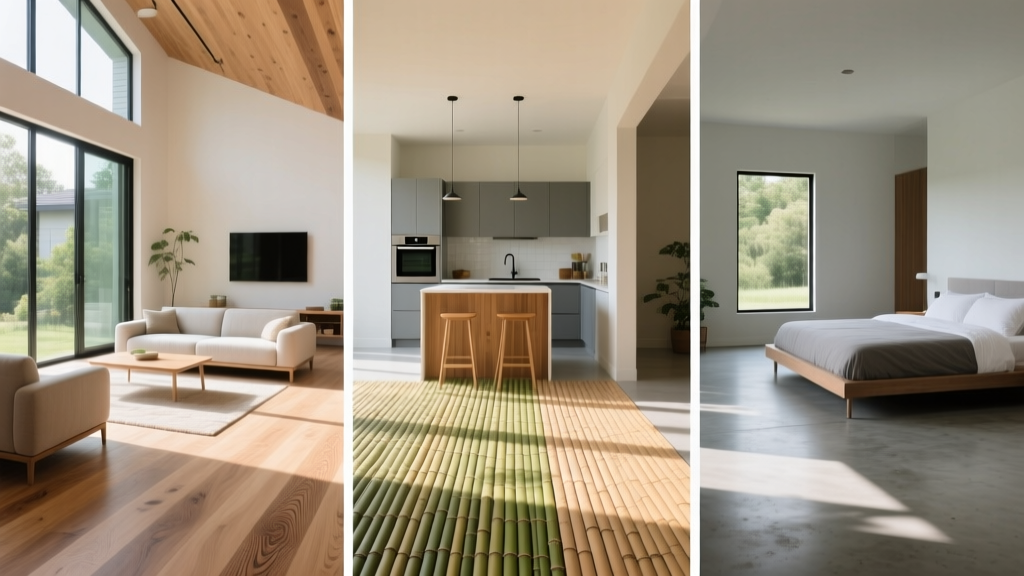
When homeowners and commercial developers ask which flooring option is most economical, the immediate instinct is to compare the price per square foot at the point of purchase. This is a fundamental miscalculation that inevitably leads to higher long-term expenses and severe environmental degradation. In sustainable construction, true economy is measured through Life-Cycle Costing (LCC) paired with an Environmental Product Declaration (EPD) analysis.
A floor that costs $3 per square foot but requires replacement every 12 years, emits volatile organic compounds (VOCs), and ends up in a landfill is vastly more expensive—both financially and ecologically—than a $9 per square foot floor that lasts 50 years and sequesters carbon. This guide dismantles the false economy of cheap flooring and identifies the most financially and environmentally sound options for 2026 and beyond.
The True Cost Metrics
Life-Cycle Cost (LCC): Upfront material + installation + maintenance + replacement cycles + end-of-life disposal over a 50-year building horizon.
Embodied Carbon: The total greenhouse gas emissions (measured in kgCO2e/m²) generated during the extraction, manufacturing, transportation, and disposal of the flooring material, as defined by EPA's Sustainable Materials Management frameworks.
The 50-Year Horizon: Material Breakdown and LCC Matrix
To accurately determine which flooring option is most economical, we must project costs and environmental impacts over a standard 50-year building lifecycle. The matrix below assumes a 1,000 sq. ft. installation area, factoring in average 2026 material costs, professional installation, and mandatory replacement cycles.
| Material Type | Upfront Cost (sq. ft.) | Lifespan | 50-Yr Replacements | 50-Yr LCC (sq. ft.) | Embodied Carbon (kgCO2e/m²) |
|---|---|---|---|---|---|
| Luxury Vinyl Plank (LVP) | $4.50 - $7.00 | 10-15 Years | 3 to 4 | $22.00 - $35.00 | 18.5 - 24.0 |
| Strand-Woven Bamboo | $6.00 - $9.00 | 25-30 Years | 1 | $14.00 - $20.00 | 6.0 - 9.5 |
| Natural Linoleum (Sheet) | $7.00 - $11.00 | 35-40 Years | 0 to 1 | $12.00 - $24.00 | -2.0 to 4.0 (Biogenic) |
| Polished Concrete (Existing Slab) | $4.00 - $8.00 | 50-100 Years | 0 | $6.00 - $12.00 | 1.5 - 3.0 (Marginal) |
Deep Dive: Analyzing the Top Contenders
1. Polished Concrete: The Undisputed LCC Champion
If your project involves a ground-level or basement space with an existing concrete slab, polished concrete is unequivocally the most economical and lowest-carbon option available. By utilizing the structural slab as the finish floor, you eliminate the embodied carbon of manufacturing a secondary flooring material entirely.
The Process: Mechanical grinding with progressively finer diamond abrasives (typically up to 3,000 grit), followed by the application of a penetrating silicate densifier. Environmental Edge: Zero VOC off-gassing, zero landfill waste at end-of-life, and immense thermal mass properties that can reduce HVAC loads by up to 15% in passive solar designs. According to the Department of Energy's High-Performance Green Buildings guidelines, leveraging thermal mass is a critical strategy for net-zero energy buildings.
2. Natural Linoleum: The Carbon-Negative Workhorse
Often confused with PVC vinyl, true linoleum is an entirely different, bio-based material. Premium brands like Forbo Marmoleum are manufactured from linseed oil, pine rosin, wood flour, and jute backing. The Economics: While the upfront cost ($8-$11/sq. ft. installed) is higher than LVP, its 40-year lifespan and near-zero maintenance costs (it requires no harsh chemical strippers or waxes, only neutral pH cleaners) make its 50-year LCC highly competitive. Environmental Edge: Because the primary ingredient is linseed oil derived from flax plants, natural linoleum actually sequesters carbon during the growth phase of the raw materials. When evaluated under ASTM E2921 standards for EPDs, many sheet linoleum products register as carbon-neutral or slightly carbon-negative at the factory gate.
3. Strand-Woven Bamboo: The Renewable Hardwood Alternative
For spaces requiring the aesthetic and acoustic warmth of hardwood, strand-woven bamboo is the most economically viable sustainable choice. Bamboo is a grass that reaches maturity in 3 to 5 years, compared to the 40 to 80 years required for oak or maple. The Economics: High-quality strand-woven bamboo (such as Cali Bamboo's GeoWood line) costs between $6 and $9 per square foot. It boasts a Janka hardness rating of over 4,000 lbf, making it significantly more dent-resistant than traditional red oak (1,290 lbf), thereby extending its functional lifespan and delaying replacement costs. Environmental Edge: Rapid renewability and high carbon sequestration rates during growth. However, buyers must strictly verify that the manufacturer uses formaldehyde-free or ultra-low-emitting phenolic resins to bind the strands, ensuring compliance with California Section 01350 indoor air quality standards.
4. Luxury Vinyl Plank (LVP): The False Economy
LVP dominates the market due to aggressive marketing and low initial price tags ($3 to $6 per square foot). However, from an LCC and environmental perspective, it is a liability. The Economics: LVP has a functional lifespan of 10 to 15 years in residential settings and even less in high-traffic commercial zones. Over 50 years, you will purchase and pay for installation of the floor 3 to 4 times. Furthermore, LVP cannot be refinished; minor damage requires plank replacement or total tear-out. Environmental Edge: Virtually nonexistent. LVP is a petroleum-derived PVC product. Its manufacturing process releases dioxins, and because it is a composite of plastic layers and photographic films, it is entirely non-recyclable at the end of its life. 100% of torn-out LVP goes to landfills, where it persists for centuries.
Warning: The Hidden Cost of Adhesives
When calculating the true cost and environmental impact of flooring, do not ignore the installation method. Glue-down installations require trowel-applied adhesives that can emit VOCs for months and make end-of-life recycling impossible. Whenever structurally viable, specify floating floor systems or click-lock mechanisms to eliminate adhesive toxicity and allow for non-destructive removal.
Decision Framework: Calculating Your Specific Floorprint
To determine which flooring option is most economical for your specific project, follow this four-step evaluation framework:
- Audit the Subfloor: If you have an existing, structurally sound concrete slab on grade, default to polished concrete or a floating floor over a high-R-value cork underlayment. Avoid penetrating sealers or adhesives that compromise the slab's future usability.
- Request the EPD: Do not rely on generic 'green' marketing labels. Require the manufacturer to provide a Type III Environmental Product Declaration (EPD) compliant with ISO 14025. This document will explicitly state the Global Warming Potential (GWP) in kgCO2e.
- Calculate the 50-Year LCC: Use the formula: Upfront Cost + (Installation Cost × Replacement Cycles) + (Annual Maintenance Cost × 50) + Disposal Fees. Factor in a 3% annual inflation rate for future material and labor costs.
- Verify IAQ Certifications: Ensure the product and any required underlayments carry the FloorScore or GREENGUARD Gold certification to protect indoor air quality and avoid future health-related liabilities.
Frequently Asked Questions
Is reclaimed hardwood more economical than new bamboo?
Financially, no. Reclaimed hardwood requires intensive labor for de-nailing, milling, and stabilization, pushing installed costs to $14–$22 per square foot. Ecologically, it is exceptional, but from a strict LCC perspective, new FSC-certified strand-woven bamboo offers a better balance of upfront cost, durability, and rapid renewability.
How does cork flooring compare in the LCC analysis?
Cork is an outstanding sustainable material—harvested from the bark of cork oak trees without killing the tree. However, its relatively soft surface makes it prone to denting in high-traffic or heavy-furniture environments. Its lifespan is typically 20-25 years, placing its 50-year LCC slightly higher than linoleum or polished concrete, though it offers superior acoustic and thermal insulation properties.
Can LVP be recycled if I pay for a specialized service?
While some specialized commercial recycling programs exist for homogeneous PVC, the multi-layer construction of modern LVP (wear layer, printed film, SPC/WPC core, attached cork/foam pad) makes separation economically unviable. For all practical purposes in 2026, LVP remains a linear, landfill-bound product.
Written by
James ThorntonJames Thornton is a construction industry veteran with 25 years of hands-on experience in wood framing, lumber grading, and residential building codes. He started as a framing carpenter in rural Oregon, earned his ICC Residential Building Inspector certification, and eventually became a senior plan reviewer for the City of Portland Bureau of Development Services. James holds a B.S. in Wood Science & Technology from Oregon State University and is a certified lumber grader through the West Coast Lumber Inspection Bureau (WCLIB). He has inspected over 3,000 residential construction sites and authored the city's internal guide on advanced framing techniques (2x6 at 24" O.C.). James lives in Bend, OR, where he builds custom timber-frame cabins and competes in lumberjack sports.
More from James Thornton
View all
Insulation
Best Home Insulation Materials: Complete 2026 Guide
Compare top home insulation materials for 2026. Find R-values, installed costs per square foot, and best uses for fiberglass, spray foam, and mineral wool.
Aug 4, 2026

Sustainable Building
Certify Your Green Building Material for LEED and WELL
Step-by-step guide to certifying a green building material for LEED v5 and WELL v2. Master EPDs, HPDs, and VOC limits for 2026 project specifications.
Aug 4, 2026

Stone & Masonry
Veneer Stacked Stone Panels: Interior Design & Style Showcase
Discover how veneer stacked stone panels transform interiors. Explore modern design profiles, material pairings, and technical installation specs.
Aug 4, 2026