Building Materials Ecommerce: Comparing Sustainable Insulation Options
Compare HempWool, sheep wool, and recycled glass insulation. Learn pricing, R-values, and building materials ecommerce logistics for 2026.

The Shift to Digital Procurement for Green Building
The procurement landscape for eco-friendly construction has fundamentally changed. Historically, sourcing specialized sustainable products required navigating fragmented regional distributors or paying steep premiums through local boutique green builders. Today, building materials ecommerce platforms have democratized access to high-performance, low-carbon products. Contractors and self-builders can now order full pallets of bio-based or high-recycled-content materials directly to the job site.
However, buying sustainable insulation online requires more than just comparing R-values. Digital storefronts often obscure the logistical realities of freight shipping, the nuances of material density, and the specific chemical binders used in manufacturing. This guide provides a deep-dive material comparison of three leading sustainable insulation products available via online procurement channels, analyzing their technical specifications, 2026 pricing, and ecommerce shipping logistics.
Contender Profiles: Top Eco-Friendly Insulation Materials
1. Hempitecture HempWool (Plant-Based Carbon Sink)
HempWool by Hempitecture is a bio-based batt insulation manufactured from industrial hemp fibers. Unlike traditional fiberglass, hemp is a rapidly renewable resource that sequesters carbon during its growth cycle, making the material carbon-negative before it even reaches the facility. The fibers are mechanically bonded and treated with a borate solution to achieve an ASTM E84 Class A fire rating and resist mold and pests.
- Thermal Performance: R-3.7 per inch.
- Density: 2.5 lbs/ft³, providing superior acoustic dampening compared to standard fiberglass.
- Vapor Permeability: Highly breathable, allowing walls to dry to the exterior, which is critical for unvented roof assemblies and mass timber enclosures.
- Ecommerce Profile: Primarily sold through specialized green building materials ecommerce sites and direct B2B portals. Rarely found on big-box retail sites.
2. Havelock Wool (Natural Moisture & Acoustic Control)
Havelock Wool utilizes 100% sheep wool, leveraging the natural keratin structure of the fibers. The standout feature of sheep wool is its hygroscopic nature; it can absorb and desorb up to 35% of its own weight in moisture without compromising its thermal resistance or structural integrity. This makes it an exceptional choice for high-humidity climates or historical masonry retrofits where trapped moisture is a primary concern.
- Thermal Performance: R-3.6 per inch.
- Density: 2.0 lbs/ft³ for standard batts; higher density options available for acoustic partitions.
- Chemical Profile: Zero VOCs, no synthetic binders, and naturally contains lanolin (though mostly washed out during processing, residual amounts aid in water repellency).
- Ecommerce Profile: Available via direct-to-consumer ecommerce channels and specialized sustainable building suppliers. Ships compressed in heavy-duty poly bags to reduce freight volume.
3. Knauf EcoBatt Glasswool (High-Recycled Content Mainstream)
For projects requiring a balance of sustainability and mainstream availability, Knauf EcoBatt Glasswool is the industry standard. Manufactured with up to 80% recycled post-consumer glass, it utilizes Knauf’s proprietary ECOSE Technology—a bio-based binder derived from rapidly renewable materials that completely eliminates the need for phenol-formaldehyde resins.
- Thermal Performance: R-3.7 per inch (standard R-13 and R-15 cavity batts).
- Density: 0.8 to 1.2 lbs/ft³, making it lighter and easier to install but less effective for soundproofing than hemp or wool.
- Certifications: GREENGUARD Gold certified and verified via third-party Environmental Product Declarations (EPDs).
- Ecommerce Profile: Widely available on major B2B and B2C building materials ecommerce platforms, including Home Depot Pro, Lowe’s Pro, and Ferguson, allowing for easy integration into bulk digital procurement workflows.
Technical & Procurement Comparison Matrix
The following matrix breaks down the critical specifications and current 2026 market pricing for these materials. Pricing reflects average digital storefront costs per square foot for standard 2x4 (R-13/R-15) cavity applications, excluding freight.
| Material | R-Value / Inch | Density (lbs/ft³) | Embodied Carbon | 2026 Avg. Cost / Sq Ft | Ecommerce Availability |
|---|---|---|---|---|---|
| Hempitecture HempWool | R-3.7 | 2.5 | Carbon Negative | $2.25 - $2.60 | Specialized Green Portals |
| Havelock Sheep Wool | R-3.6 | 2.0 | Very Low | $3.10 - $3.45 | Direct-to-Consumer / Niche |
| Knauf EcoBatt Glasswool | R-3.7 | 1.0 | Low (High Recycled) | $0.95 - $1.20 | Major B2B/B2C Platforms |
The Hidden Costs of Building Materials Ecommerce: Freight & Logistics
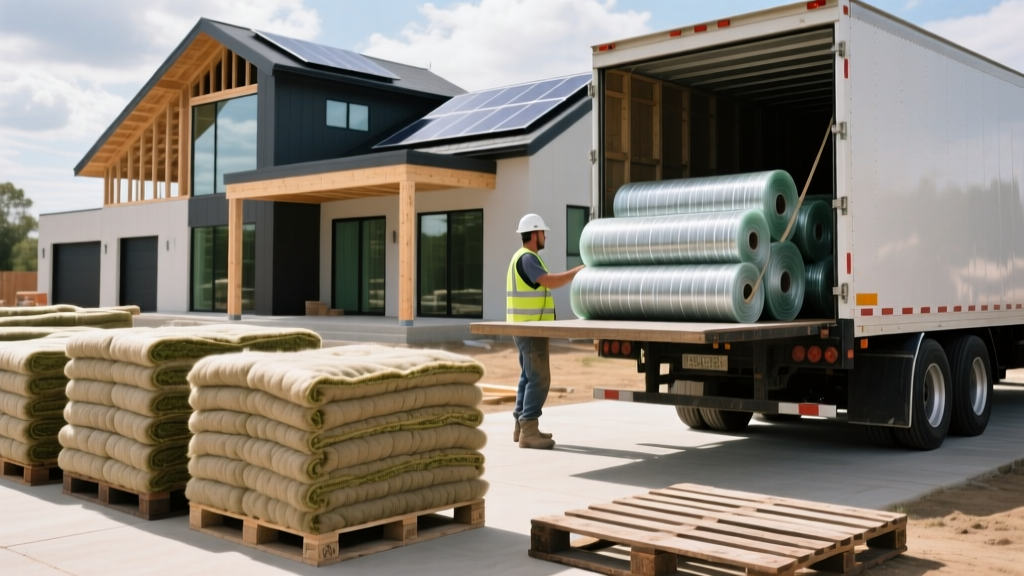
When sourcing bulky, low-weight items like insulation through building materials ecommerce platforms, the sticker price is only half the equation. Insulation typically falls under NMFC (National Motor Freight Classification) Class 125 or 150. Because it takes up significant cubic volume relative to its weight, Less-Than-Truckload (LTL) freight carriers charge a premium.
Ordering 15 bags of HempWool instead of a full pallet (usually 24-30 bags) can trigger minimum LTL freight charges that add $400 to $600 to your final invoice. Always calculate the total landed cost (material + freight) in the ecommerce cart before checkout. For bio-based materials, ensure the carrier uses a liftgate service if your job site lacks a loading dock, as manual unloading of 600 lb pallets is a severe safety risk.
Furthermore, moisture exposure during transit is a critical failure mode for natural fibers. While Knauf EcoBatt is wrapped in highly water-resistant polyethylene, Havelock Wool and HempWool rely on heavy-duty but potentially puncturable bags. When receiving deliveries, inspect the pallet wrap for tears immediately. If the outer poly bag is compromised and the batts have absorbed ambient humidity during transit, the R-value can temporarily drop, and the risk of mold introduction into the wall cavity increases significantly.
Decision Framework: Matching Material to Project Profile
Selecting the right material requires aligning the physical properties of the insulation with the specific architectural and environmental demands of your project. Use this framework to guide your digital procurement:
- Scenario A: High-Performance Passive House or Net-Zero Build
Recommendation: HempWool. The higher density (2.5 lbs/ft³) reduces convective looping within the wall cavity, and the carbon-negative profile is essential for meeting rigorous embodied carbon targets set by frameworks like the U.S. Green Building Council's LEED v4.1 materials credit. - Scenario B: Historical Masonry Retrofit or High-Humidity Climate
Recommendation: Havelock Sheep Wool. Interior insulation on solid masonry walls risks trapping moisture against the brick, leading to spalling and freeze-thaw damage. Wool’s ability to buffer moisture and release it back into the interior space protects the structural masonry while maintaining thermal resistance. - Scenario C: High-Volume Production Housing or Tight Budgets
Recommendation: Knauf EcoBatt. When margins are tight and procurement speed is critical, EcoBatt offers a massive cost advantage. Its availability on major building materials ecommerce platforms means you can leverage existing corporate accounts, qualify for bulk volume discounts, and utilize free or subsidized freight programs offered by big-box retailers.
Verifying Green Claims in Digital Storefronts
The digital nature of ecommerce makes it easy for distributors to use vague terms like "eco-friendly" or "green" without substantiation. As a professional buyer, you must verify environmental claims using standardized documentation. According to the U.S. Department of Energy's guidelines on insulation and building science, thermal performance must be verified by independent laboratory testing, not just manufacturer claims.
Before adding a specialized bio-based insulation to your cart, locate the product’s Environmental Product Declaration (EPD) and Health Product Declaration (HPD). Reputable green building materials ecommerce sites will host these PDF documents directly on the product specification tab. An EPD will detail the exact Global Warming Potential (GWP) per functional unit, while an HPD will disclose all chemical ingredients down to 1,000 parts per million, ensuring no hidden off-gassing chemicals are introduced into your building envelope.
Final Procurement Checklist
- Calculate total cavity volume (in board feet) to determine exact pallet quantities and avoid LTL minimum freight penalties.
- Verify the NMFC freight class and confirm if the ecommerce quote includes liftgate delivery for job-site drop-offs.
- Download and review the EPD to ensure the material's embodied carbon aligns with your project's specific sustainability mandates.
- Confirm the vapor permeability (perms) of the chosen insulation matches your wall assembly's hygrothermal modeling (e.g., WUFI analysis).
Written by
James ThorntonJames Thornton is a construction industry veteran with 25 years of hands-on experience in wood framing, lumber grading, and residential building codes. He started as a framing carpenter in rural Oregon, earned his ICC Residential Building Inspector certification, and eventually became a senior plan reviewer for the City of Portland Bureau of Development Services. James holds a B.S. in Wood Science & Technology from Oregon State University and is a certified lumber grader through the West Coast Lumber Inspection Bureau (WCLIB). He has inspected over 3,000 residential construction sites and authored the city's internal guide on advanced framing techniques (2x6 at 24" O.C.). James lives in Bend, OR, where he builds custom timber-frame cabins and competes in lumberjack sports.
More from James Thornton
View all
Insulation
Best Home Insulation Materials: Complete 2026 Guide
Compare top home insulation materials for 2026. Find R-values, installed costs per square foot, and best uses for fiberglass, spray foam, and mineral wool.
Aug 4, 2026

Sustainable Building
Certify Your Green Building Material for LEED and WELL
Step-by-step guide to certifying a green building material for LEED v5 and WELL v2. Master EPDs, HPDs, and VOC limits for 2026 project specifications.
Aug 4, 2026

Stone & Masonry
Veneer Stacked Stone Panels: Interior Design & Style Showcase
Discover how veneer stacked stone panels transform interiors. Explore modern design profiles, material pairings, and technical installation specs.
Aug 4, 2026