Eco-Friendly Building Material Case Studies: 2026 ROI Analysis
Analyze real-world ROI, performance data, and failure modes of top eco-friendly building materials like CLT, hempcrete, and mycelium in 2026 projects.

The Shift from Theoretical to Proven Performance
Specifying an eco-friendly building material based solely on its carbon-sequestering properties is no longer viable in the 2026 construction market. Developers, general contractors, and facility managers now demand rigorous, field-tested data regarding return on investment (ROI), lifecycle maintenance, and specific failure modes. Theoretical environmental benefits must translate into tangible schedule accelerations, energy savings, or LEED v4.1 credit optimization.
This analysis examines three post-occupancy case studies of advanced sustainable materials—Cross-Laminated Timber (CLT), pre-cast Hempcrete, and Mycelium-based insulation. By dissecting the actual procurement costs, installation nuances, and unexpected edge cases encountered on recent job sites, we provide a grounded framework for architects and builders evaluating these systems.
Case Study 1: Cross-Laminated Timber (CLT) in Mid-Rise Commercial
Project Profile: 45,000 sq. ft. Class-A Office Building, Pacific Northwest.
Material Specified: SmartLam NA 5-ply CLT (175mm thickness for floors, 125mm for shear walls).
The transition from structural steel to CLT in mid-rise commercial builds is heavily documented for its carbon benefits, but the financial ROI hinges entirely on schedule compression and specialized connection detailing. In this 2025-2026 project, the CLT superstructure was erected in 18 days, compared to the 35 days estimated for a traditional steel-and-deck equivalent.
Financial & Schedule Impact
- Material Premium: +11% upfront cost over structural steel.
- Labor Savings: -22% due to reduced crane time and smaller erection crews (4 ironworkers vs. 8).
- Net ROI Timeline: Achieved positive cash flow 4 months earlier due to accelerated tenant occupancy.
Failure Mode & Edge Case: Construction Moisture
The most critical risk identified during the build was moisture exposure prior to building envelope closure. The project experienced a 12-day weather delay. According to WoodWorks guidelines, CLT must not exceed 18% moisture content before enclosure. The top lamina of several floor panels reached 22%, requiring localized kiln-drying and the application of a penetrating silane-siloxane water repellent before the flooring underlayment could be installed.
Case Study 2: Hempcrete Block Systems in Residential Retrofits
Project Profile: 3,200 sq. ft. Historic Masonry Retrofit, Northeast Corridor.
Material Specified: IsoHemp pre-cast hemp-lime blocks (11.8" x 15.7" x 11.8").
While cast-in-place hempcrete is labor-intensive and highly dependent on the contractor's mixing expertise, pre-cast hemp-lime blocks have emerged as a reliable eco-friendly building material for deep-energy retrofits. This project utilized a 12-inch thick hempcrete block wall system furred out from the interior of an existing 1890s solid brick facade.
Hygrothermal Performance vs. Closed-Cell Foam
The architect initially considered closed-cell spray polyurethane foam (ccSPF) for its high R-value (R-6.5 per inch). However, applying ccSPF to the interior of historic mass masonry traps moisture, leading to freeze-thaw spalling of the exterior brick. Hempcrete, with an R-value of roughly R-2.4 per inch, required a thicker wall assembly but provided vital vapor permeability. The hemp-lime matrix actively buffers indoor humidity, maintaining interior relative humidity (RH) between 45% and 55% without mechanical dehumidification.
Procurement and Installation Realities
| Parameter | Hempcrete Blocks (IsoHemp) | Closed-Cell Spray Foam (ccSPF) |
|---|---|---|
| Installed Cost (per sq. ft. of wall) | $19.50 - $24.00 | $3.50 - $5.00 |
| Assembly Thickness for R-28 | 12 inches | 4.5 inches |
| Interior Finish Compatibility | Lime plaster only (e.g., Baumit RK39) | Standard gypsum drywall |
| Embodied Carbon | Carbon Negative (Biogenic) | High (HFC/Blowing agents) |
Edge Case: The general contractor attempted to use standard Portland cement-based stucco on the interior hempcrete walls. This resulted in hairline cracking and localized moisture trapping within 60 days. The finish had to be chipped off and replaced with a breathable, NHL 3.5 (Natural Hydraulic Lime) plaster, adding $4.10 per square foot in rework costs. Always mandate breathable mineral silicate or lime plasters in the specification manual.
Case Study 3: Mycelium-Based Acoustic & Thermal Insulation
Project Profile: 12,000 sq. ft. Open-Plan Tech Hub Interior Fit-Out.
Material Specified: Ecovative MycoBoard acoustic ceiling baffles and wall panels.
Mycelium—the vegetative root structure of fungi—grown on agricultural waste (like hemp hurds or corn stalks) represents the bleeding edge of bio-fabricated materials. In this commercial fit-out, the design team replaced traditional fiberglass and mineral wool acoustic treatments with mycelium-based panels to achieve aggressive Living Building Challenge (LBC) Red List-free requirements.
Acoustic and Fire Performance Data
The mycelium panels achieved a Noise Reduction Coefficient (NRC) of 0.85, matching high-end mineral wool. More importantly for commercial code compliance, the panels were treated with a non-halogenated borate solution during the growth phase, allowing them to pass ASTM E84 testing with a Class A rating (Flame Spread Index < 25, Smoke Developed Index < 450).
"The integration of bio-fabricated materials like mycelium shifts the paradigm from minimizing harm to actively regenerating ecosystems, provided the supply chain and installation protocols are strictly managed." — EPA Green Building Materials Division, 2025 Report.
Installation Failure Mode: Humidity Reactivation
Mycelium is grown in molds and then baked to deactivate the fungus. However, if installed in environments where ambient relative humidity consistently exceeds 80% without adequate HVAC conditioning, dormant mycelium spores can theoretically reactivate or harbor secondary mold growth. In this project, a localized HVAC failure in the server-adjacent breakroom caused RH to spike to 85% for three weeks. While the mycelium did not structurally degrade, surface condensation led to cosmetic staining. Actionable rule: Never specify mycelium insulation in below-grade applications, unconditioned attics, or high-moisture zones (commercial kitchens, indoor pools) unless encapsulated in a fully sealed, vapor-impermeable membrane.
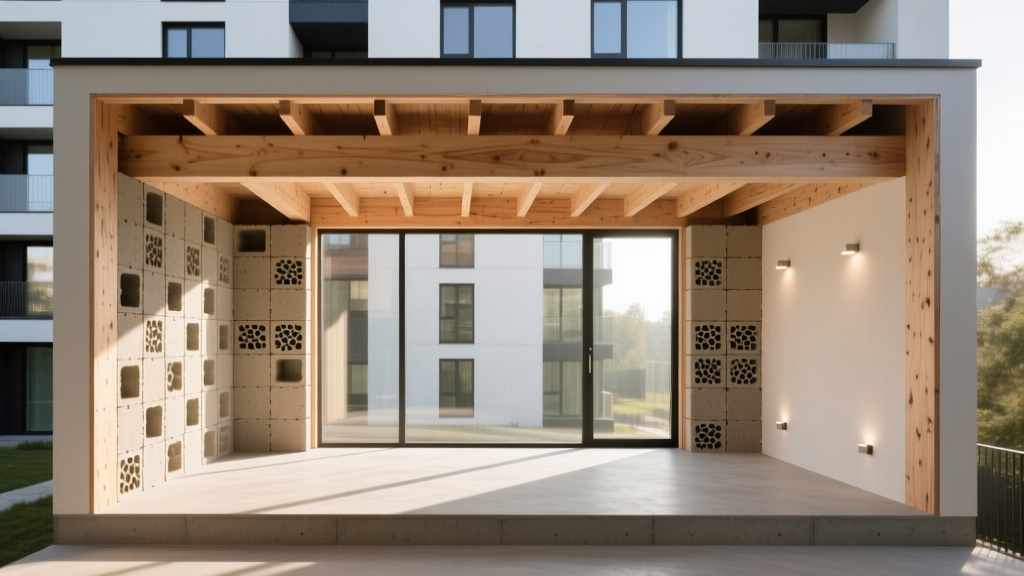
LEED v4.1 Optimization & Financial Matrix
Integrating these materials directly impacts the U.S. Green Building Council (USGBC) LEED v4.1 Materials and Resources (MR) credits. Below is a strategic matrix for optimizing credit acquisition based on 2026 supply chain data.
| Material | Primary LEED MR Credit Target | EPD Availability | Regional Sourcing (100mi Radius) |
|---|---|---|---|
| CLT (SmartLam) | MR Credit: Sourcing of Raw Materials (FSC Certified) | Industry-wide & Product-specific | High (Pacific NW, Southeast US) |
| Hempcrete Blocks | MR Credit: Material Ingredients (Declare Label) | Product-specific | Low (Limited US manufacturing) |
| Mycelium Panels | MR Credit: Material Ingredients (Cradle to Cradle) | Product-specific | Medium (Northeast US hub) |
Actionable Procurement & Specification Guidelines
To successfully deploy these eco-friendly building materials without eroding project margins through rework or delays, procurement teams must adjust their standard operating procedures:
- Adjust Lead Time Expectations: While fiberglass insulation and steel decking are typically available within 2-4 weeks, pre-cast hempcrete blocks and custom-grown mycelium panels require 8-12 weeks of manufacturing lead time. Initiate submittals during the schematic design phase, not construction documents.
- Mandate Climate-Controlled Storage: CLT and mycelium products cannot be stored in standard open-air staging areas. Budget for temporary, weather-sealed storage containers with desiccant dehumidifiers on-site to maintain moisture content below 16%.
- Specialized Subcontractor Vetting: Do not award hempcrete plastering or CLT connection detailing to the lowest-bid general framer or mason. Require bidders to submit proof of manufacturer-specific certification (e.g., IsoHemp certified applicator or SmartLam trained erector) as a mandatory prerequisite for bid consideration.
The data from these 2026 case studies confirms that sustainable materials are no longer experimental liabilities. When specified with an acute awareness of their hygrothermal boundaries, connection details, and supply chain realities, materials like CLT, hempcrete, and mycelium deliver superior lifecycle value, accelerated schedules, and verifiable environmental impact.
Written by
David NakamuraDavid Nakamura is a licensed architect (AIA) and construction technology writer focused on sustainable building methods, mass timber engineering, and high-performance building envelopes. He holds a Master of Architecture from the University of Washington and is a certified Passive House Consultant (CPHC). David spent eight years at the Seattle firm Mithun, where he led the design of three LEED Platinum projects, before founding his own practice specializing in net-zero residential design. He serves on the editorial advisory board of GreenBuilder Magazine and has authored peer-reviewed papers on cross-laminated timber (CLT) connections for the Journal of Structural Engineering. In his spare time, David teaches woodworking at Pratt Fine Arts Center and kayaks the Puget Sound.
More from David Nakamura
View all
Construction Cost
Labor Cost to Build a Deck Per Sq Ft: 2026 Installation Guide
Discover the exact labor cost to build a deck per sq ft in 2026. This installation guide breaks down contractor rates, complexity factors, and hidden fees.
Aug 4, 2026

Construction Cost
How Much Does It Cost to Build a 3 Bedroom House? Financing Guide
Learn exactly how much it costs to build a 3 bedroom house and explore 2026 financing options, construction loan types, and budget frameworks for your build.
Aug 4, 2026

Construction Cost
Cost to Build a Tennis Court: 2026 Guide
How much does it cost to build a tennis court in 2026? Breakdowns for asphalt, concrete, and synthetic surfaces plus fencing and lighting.
Jul 30, 2026