Board and Batten Siding Lifespan: Material Durability Analysis
Compare the true lifespan of board and batten siding across fiber cement, engineered wood, and cedar. Expert durability analysis and failure modes.
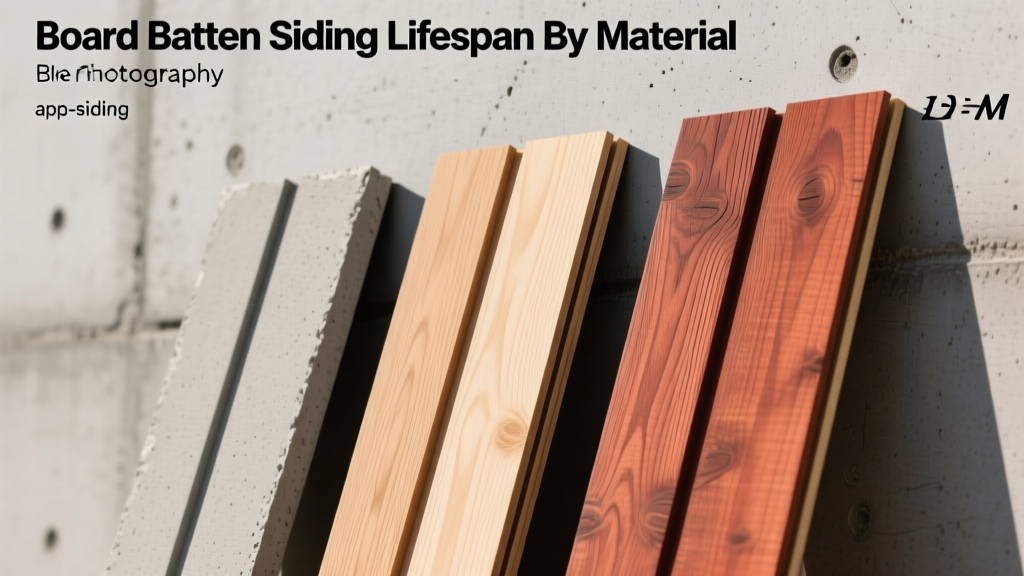
The True Lifespan of Board and Batten Siding: Beyond the Averages
When evaluating board and batten siding, manufacturer warranties often advertise 30- to 50-year lifespans. However, real-world durability is rarely dictated by the material alone. The actual service life of a board and batten facade depends on a triad of factors: substrate preparation, fastener metallurgy, and micro-climate moisture management. A premium fiber cement panel installed directly against unventigated oriented strand board (OSB) in a high-humidity zone will fail faster than a modest cedar installation utilizing a 3/8-inch ventilated rain screen gap.
2026 Baseline Lifespan & Cost Matrix
| Material Type | Expected Service Life | 2026 Installed Cost (per sq. ft.) | Primary Failure Mode |
|---|---|---|---|
| Fiber Cement | 40 - 60 Years | $9.50 - $14.00 | Freeze-thaw spalling at unsealed cuts |
| Engineered Wood | 30 - 50 Years | $7.50 - $11.50 | Edge swelling from unsealed field cuts |
| Western Red Cedar | 25 - 40 Years | $12.00 - $18.00 | UV degradation and moisture cupping |
| Steel (Standing Seam Profile) | 40 - 70 Years | $14.00 - $22.00 | Galvanic corrosion at dissimilar metal fasteners |
Material-by-Material Durability Breakdown
Fiber Cement: The 50-Year Benchmark
Fiber cement board and batten siding, dominated by manufacturers like James Hardie and Nichiha, consists of Portland cement, silica sand, and cellulose fibers cured in an autoclave. Its inherent resistance to rot, termites, and fire makes it the default choice for longevity. However, fiber cement is highly susceptible to moisture wicking. If the bottom edge of the horizontal boards or the end-cuts of the battens are left unsealed and rest near soil grade, the material will absorb ground moisture. In freezing climates, this trapped water expands, causing micro-fractures and eventual delamination known as freeze-thaw spalling. To achieve the advertised 50-year lifespan, all field cuts must be sealed with a 100% acrylic urethane sealant, and a minimum 2-inch clearance from the ground must be maintained.
Engineered Wood: The Engineered Contender
Products like LP SmartSide utilize Strand Substrate technology, treating wood strands with zinc borate to resist fungal decay and termites. Engineered wood is lighter and easier to mill than fiber cement, allowing for deeper, more authentic shadow lines on the battens. The critical vulnerability of engineered wood lies in its exposed edges. While the factory-primed faces are highly water-resistant, any rip-cut made on-site exposes the porous wood strand core. If installers fail to apply two coats of exterior-grade primer to these cuts before assembly, moisture intrusion will cause the edges to swell, creating a 'mushroom' effect that breaks the paint seal and accelerates localized rot.
Natural Wood Cedar: The Breathable Classic
Western Red Cedar and Redwood offer natural tannins and oils that resist decay without chemical treatments. According to the USDA Forest Products Laboratory, the heartwood of old-growth cedar possesses exceptional natural durability. However, modern second-growth cedar has lower tannin concentrations, reducing its innate weather resistance. The primary threat to wood board and batten is uneven moisture absorption. If the sun-facing side of a board dries and shrinks faster than the shaded, wall-facing side, the resulting tension will cause the board to cup or split. Back-priming all wood boards and battens before installation is non-negotiable for maximizing lifespan.
Critical Failure Modes: A Diagnostic Guide
When board and batten siding fails prematurely, it is almost always due to installation errors rather than material defects. Use this diagnostic framework to identify and correct systemic issues.
| Visible Symptom | Root Cause | Corrective Action |
|---|---|---|
| Black or rust-colored streaking below nail heads | Use of electro-galvanized nails instead of hot-dipped or stainless steel. | Extract rusted nails, treat tannin spots with oxalic acid, and replace with Type 304 stainless steel ring-shank nails. |
| Horizontal boards bowing outward between studs | Nails were driven too tight, restricting natural thermal expansion, or sheathing is uneven. | Leave a 1/32-inch gap between the nail head and the siding surface to allow for micro-movement. |
| Paint peeling exclusively on the bottom edges of boards | Capillary action drawing moisture up from the flashing or lack of a drip edge. | Install Z-flashing with a built-in drip edge behind the horizontal joints and maintain a 1/4-inch gap. |
| Batten strips warping or pulling away from the wall | Battens nailed only into the OSB sheathing rather than the structural studs. | Locate studs using a magnetic stud finder and ensure fasteners penetrate the framing by at least 1-1/4 inches. |
Environmental Stressors and Climate Degradation
The geographic location of a build drastically alters the degradation curve of exterior cladding. A material that lasts 50 years in a temperate, dry climate may fail in 20 years in a coastal or alpine environment.
- Coastal & Marine Zones (Salt Spray): Salt accelerates the oxidation of metal fasteners and degrades the acrylic binders in paint coatings. Fiber cement performs well here, provided all fasteners are upgraded to Type 316 marine-grade stainless steel. Steel board and batten requires a specialized PVDF (Kynar) coating to prevent salt pitting.
- Alpine & Freeze-Thaw Zones: Materials with high porosity suffer most. Wood and engineered wood can handle freezing well if kept dry, but fiber cement requires strict adherence to joint-flashing protocols to prevent water from freezing inside the matrix.
- Sunbelt & High-UV Zones: UV radiation breaks down the lignin in natural wood, causing it to turn silver-gray and become brittle. For wood siding in these zones, a penetrating semi-transparent oil stain must be reapplied every 3 to 5 years. Fiber cement and engineered wood with factory-applied acrylic finishes (like LP ExpertFinish) offer superior UV resistance, reflecting solar radiation without chalking.
Installation Tolerances That Void Warranties
Manufacturer warranties are strictly contingent on precise installation tolerances. Deviating by fractions of an inch can shift the liability for moisture damage entirely onto the homeowner or contractor.
The most common warranty-voiding mistake in board and batten installation is caulking the bottom lap joint. Caulking traps water that inevitably penetrates the siding via wind-driven rain, forcing it to rot the sheathing. Joints must be flashed, never caulked.
As detailed in the Building Science Corporation's guide on rain screen design, creating a capillary break behind the cladding is essential for long-term durability. For board and batten, this means installing vertical furring strips (minimum 1/4-inch thick, ideally 3/8-inch) over the weather-resistive barrier (WRB) before attaching the siding. This ventilated cavity allows hydrostatic pressure to equalize and provides a drainage plane for any water that bypasses the battens.
Non-Negotiable Clearance Measurements
- Grade Clearance: Minimum 2 inches from soil, mulch, or concrete flatwork to prevent splash-back and capillary wicking.
- Roof Clearance: Minimum 1 inch above any adjacent roof surface to prevent snow accumulation and ice damming from contacting the siding.
- Vertical Joints: Maintain a 1/8-inch to 1/4-inch gap at all vertical board joints to accommodate thermal expansion, covered by the batten strip.
- Fastener Penetration: Nails must penetrate the structural framing or solid wood sheathing by a minimum of 1-1/4 inches. If using rigid foam exterior insulation, fastener length must be increased proportionally to account for the foam thickness.
Fastener Selection: The Hidden Lifespan Killer
The siding material is only as durable as the metal holding it to the wall. Using standard electro-galvanized nails for exterior cladding is a catastrophic error. The zinc coating on these nails is measured in millionths of an inch and will corrode within 5 to 10 years when exposed to the alkaline environment of fiber cement or the acidic tannins of cedar.
For all board and batten applications, specify hot-dipped galvanized (HDG) nails meeting ASTM A153 standards, or upgrade to stainless steel. If using fiber cement, stainless steel is highly recommended, as the Portland cement in the siding is highly alkaline and will aggressively consume the zinc on HDG nails over a 20-year period. Always use ring-shank or screw-shank nails to provide withdrawal resistance against high wind loads, which frequently attempt to pull the wide boards and battens away from the shear wall.