Top Exterior Siding Materials for Maximum Energy Efficiency
Compare the energy efficiency of exterior siding materials. Discover R-values, insulated assembly costs, and thermal bridging solutions for modern builds.

The 'Whole-Wall' R-Value Reality
When evaluating exterior siding materials for energy efficiency, relying solely on the center-of-cavity R-value of your wall insulation is a critical mistake. The framing studs, top and bottom plates, and corners create thermal bridges that bypass cavity insulation, dropping the effective 'whole-wall' R-value by 15% to 25%. According to the U.S. Department of Energy, mitigating this thermal bridging requires a continuous insulation (ci) strategy where the cladding or an underlayment layer acts as a thermal break.
Thermal Performance Matrix: Bare vs. Insulated Assemblies
The table below contrasts the inherent thermal resistance of bare cladding against optimized, code-compliant insulated assemblies. Costs reflect 2026 national averages for fully installed residential systems.
| Siding Material | Bare R-Value | Optimized Assembly R-Value | Installed Cost (per sq ft) | Best Climate Zone |
|---|---|---|---|---|
| Insulated Vinyl | 0.61 | 2.0 - 3.5 | $9.50 - $14.00 | Zones 4-6 |
| Fiber Cement + CI | 0.37 | 5.0 - 7.5 (w/ ZIP-R) | $14.00 - $19.50 | Zones 5-8 |
| Stucco (Traditional) | 0.20 | 1.5 - 2.5 (w/ EPS) | $11.00 - $16.00 | Zones 2-4 |
| Metal Panels | 0.00 | 3.0 - 5.0 (w/ Polyiso) | $16.00 - $24.00 | All Zones (w/ thermal break) |
Deep Dive: Maximizing Insulated Vinyl Siding
Standard hollow-back vinyl siding offers virtually no thermal resistance and is prone to wind-driven rattling. Insulated vinyl siding solves this by permanently laminating an expanded polystyrene (EPS) foam contour to the back of the panel. This foam fills the stud cavities' exterior gaps, increasing the whole-wall R-value and providing a structural backing that withstands impacts up to 160 mph.
Product Spotlights & EPS Foam Densities
Not all insulated siding is created equal. The thermal performance hinges on the density and thickness of the EPS backing:
- Alside Prodigy One-Piece Integrated Foam: Features a 1.5 lb density EPS foam that yields an R-value of 3.0. The interlocking design creates a tight seal, reducing air infiltration by up to 28% compared to standard vinyl.
- Variform by Ply Gem (Insulated Series): Utilizes a thicker, 1.25-inch foam profile in premium lines, pushing the cladding R-value to 3.5. This is highly recommended for Climate Zones 5 and 6 where continuous insulation mandates are strict.
Crucial Specification: Ensure the EPS foam is treated with a borate-based termite deterrent. Untreated foam backing against wood sheathing is a known vector for carpenter ants and termites in humid climates.
The Fiber Cement Paradox: Zero R-Value, High Potential
Fiber cement (e.g., James Hardie, Allura) is the gold standard for durability, fire resistance, and moisture management. Thermally, however, it is a liability. With an R-value of just 0.37, fiber cement acts as a thermal sink, readily transferring exterior temperatures to the sheathing.
The Furring Strip & ZIP-R Strategy
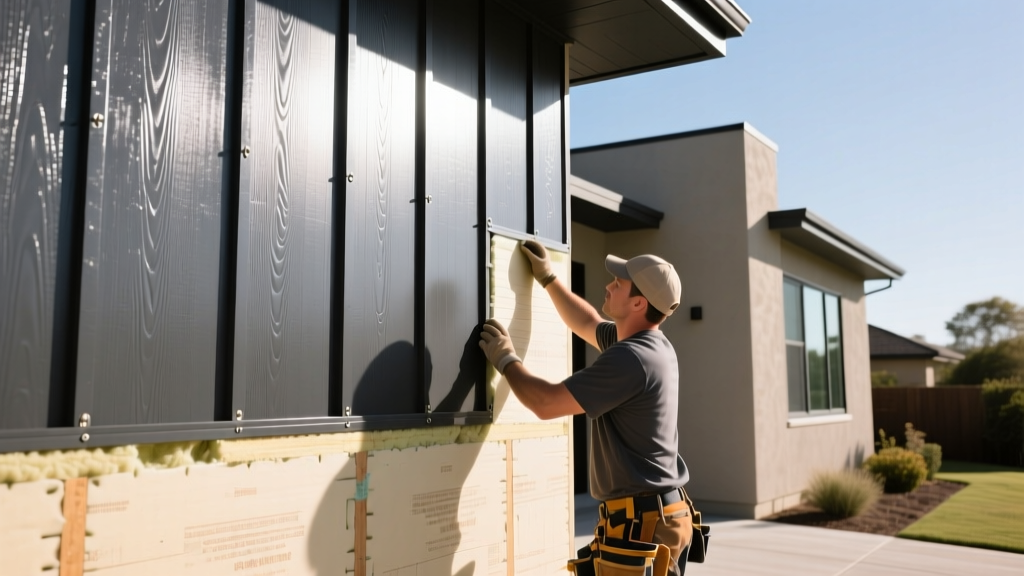
To make fiber cement energy-efficient, you must decouple it from the framing. The most robust 2026 methodology involves using Huber Engineered Woods' ZIP System R-sheathing. This product integrates polyisocyanurate foam directly to the structural panel, providing an R-3.6 to R-12.6 continuous thermal break.
Over the ZIP-R, install 3/4-inch treated wood or composite furring strips vertically, aligned with the studs. This creates a ventilated rain screen gap. The fiber cement is then fastened through the furring strips into the studs. This assembly not only meets the strict continuous insulation requirements outlined by the Building Science Corporation for high-performance walls, but it also allows bulk water to drain freely, protecting the high-cost cladding from efflorescence and freeze-thaw spalling.
Metal and Stucco: Managing Thermal Bridging and Mass
Metal siding (aluminum or steel corrugated panels) has an R-value of effectively zero and is highly conductive. If metal panels are screwed directly through rigid foam into steel or wood studs, the metal fasteners act as microscopic thermal bridges, negating up to 15% of the foam's R-value.
The Fix: Use thermally broken clips and structural gaskets (like EPDM pads) between the metal panel ribs and the sub-girts.
Stucco, conversely, relies on thermal mass rather than thermal resistance. Traditional 3-coat stucco absorbs heat during the day and releases it at night. In hot, arid climates (Zones 2 and 3), this time-lag effect reduces peak cooling loads. However, in mixed-humid climates, stucco must be applied over an Exterior Insulation and Finish System (EIFS) or a dimpled drainage mat over rigid EPS to prevent moisture trapping, as detailed by the North American Insulation Manufacturers Association (NAIMA).
3 Installation Failures That Destroy Energy Performance
Even the most expensive insulated siding will fail thermally if the installation ignores building science principles. Avoid these three critical errors:
- Compressing the Continuous Insulation: When installing furring strips over rigid foam boards, over-tightening the structural screws compresses the polyiso or EPS. Compressing 1-inch polyiso down to 3/4-inch reduces its R-value from R-6.5 to roughly R-4.8. Use pre-cut, high-density shims or structural washers to maintain the foam's factory thickness.
- Skipping the Fluid-Applied Flashing at Penetrations: Siding is only the first line of defense. Energy loss and moisture intrusion primarily occur at hose bibbs, exterior outlets, and light fixtures. Use a fluid-applied flashing membrane (like Prosoco R-Guard) to seal the rough openings to the continuous insulation layer before the siding goes up.
- Ignoring the Top and Bottom Air Seals: A ventilated rain screen gap behind fiber cement or wood siding is mandatory for moisture management, but it must be capped. Install corrosion-resistant mesh or specialized closure strips at the bottom course to block pests, and use a perforated Z-flashing at the soffit line to allow air exhaust while preventing wind-washing, which strips heat from the wall cavity.
Energy Efficiency Siding FAQ
Does dark-colored siding reduce energy efficiency?
Yes, but primarily in cooling-dominated climates. Dark fiber cement or metal siding can reach surface temperatures of 160°F to 180°F in direct summer sunlight, increasing the cooling load on the HVAC system by 3% to 5%. If you require dark aesthetics in Zones 1-3, specify a radiant barrier housewrap (like LP WeatherLogic with radiant properties) beneath the cladding to reflect infrared heat away from the sheathing.
Is insulated vinyl siding considered 'continuous insulation' by the IECC?
Generally, no. The International Energy Conservation Code (IECC) requires continuous insulation (ci) to be uninterrupted by structural framing. Because insulated vinyl siding panels have joints and are interrupted by trim and corner posts, most local building inspectors do not count it toward the mandatory ci R-value requirement. You will still need rigid foam sheathing or insulated sheathing panels to meet strict commercial or high-performance residential codes.
What is the most energy-efficient siding for a coastal home?
For coastal environments (high wind, salt spray, and humidity), fiber cement over a closed-cell spray foam cavity and a ZIP-R sheathing assembly offers the best balance. The fiber cement resists salt degradation, the closed-cell foam provides an impermeable vapor barrier against driving rain, and the ZIP-R polyiso eliminates thermal bridging, preventing interior condensation during high-humidity summer nights.
Written by
Priya KapoorPriya Kapoor is a real estate market analyst and construction economics researcher with expertise in housing affordability, development feasibility, and infrastructure investment. She holds a Master of Regional Planning from Cornell University and previously worked as a senior analyst at CBRE's Investment Properties group, where she modeled returns for $4B in mixed-use development pipelines. Priya now runs an independent research practice advising developers, municipalities, and REITs on construction cost forecasting and market timing. She publishes the quarterly "BuildMat Market Pulse" report tracking material price indices across 12 commodity categories. Based in Austin, TX, Priya serves on the board of Habitat for Humanity Austin and is a marathon runner.
More from Priya Kapoor
View all
Construction Cost
Cost to Build a 1600 Sq Ft Home in 2026: Full Breakdown
Accurate 2026 cost to build a 1600 sq ft home—material, labor, and regional pricing breakdowns included. Plan your budget with real-time estimates.
Aug 11, 2026

Wood & Lumber
Name the Types of Wood for Pressure Treatment and Preservation
Learn how to name the types of wood best suited for pressure treatment. Compare species treatability, chemical retention levels, and 2026 preservation costs.
Aug 4, 2026

Stone & Masonry
Stone Veneer Suppliers Lindenhurst: 2026 Cost Analysis
Analyze 2026 stone veneer costs in Lindenhurst, NY. Compare local supplier pricing, delivery fees, and Suffolk County installation labor rates.
Aug 4, 2026