Camper Siding Material Compared: Fiberglass vs Aluminum 2026
Comparing the best camper siding material options for 2026. We break down fiberglass vs aluminum RV exterior panels by cost, weight, and durability.

Selecting the correct camper siding material dictates the aerodynamic efficiency, structural longevity, and thermal performance of a recreational vehicle. Unlike residential construction, RV exteriors must withstand constant vibration, extreme thermal expansion, and high-velocity wind shear. As of 2026, the market remains dominated by two primary exterior claddings: Fiberglass Reinforced Plastic (FRP) and Aluminum sheeting. The choice between them is rarely about aesthetics alone; it requires a precise calculation of weight-to-strength ratios, substrate compatibility, and lamination methodologies.
The Physics of RV Cladding: Weight vs. Aerodynamics
Travel trailers and fifth wheels operate under strict Gross Vehicle Weight Rating (GVWR) constraints. Every pound of exterior cladding subtracts from the Cargo Carrying Capacity (CCC). Simultaneously, the exterior profile dictates fuel efficiency for the tow vehicle. Corrugated aluminum creates parasitic drag, reducing highway fuel economy by an estimated 4% to 7% compared to smooth FRP panels. However, aluminum's raw material weight is significantly lower than fiberglass, creating a complex engineering trade-off for manufacturers and DIY builders.
Material Matrix: Fiberglass (FRP) vs. Aluminum
| Specification | Fiberglass (FRP) - 0.090" | Aluminum - 0.024" Corrugated |
|---|---|---|
| Weight per Sq. Ft. | 0.38 lbs | 0.14 lbs |
| Material Cost (2026) | $2.80 - $4.50 | $1.60 - $2.40 |
| Aerodynamic Profile | Smooth (Low Drag) | Ribbed (High Drag) |
| Impact Resistance | High (Flexes and rebounds) | Low (Dents and creases) |
| Thermal Expansion | Moderate | High (Requires expansion joints) |
| DIY Installation | Difficult (Requires vacuum/roller press) | Moderate (Cleco fasteners and rivets) |
Deep Dive: Fiberglass Reinforced Plastic (FRP)
FRP, commonly referred to by the legacy brand name Filon, is the industry standard for modern travel trailers and motorhomes. The material consists of woven fiberglass strands suspended in a polyester or vinyl ester resin, topped with a UV-resistant gel coat.
Filon Max vs. Standard FRP
Standard FRP panels feature a pebbled or matte finish that hides minor substrate imperfections but traps road grime. Filon Max, a high-gloss variant, provides a smooth, automotive-like finish that improves aerodynamics and simplifies washing. However, high-gloss FRP is unforgiving; any imperfection in the underlying backer board will telegraph through the surface.
When installing FRP over traditional Luan plywood backers, the wood grain pattern can eventually show through the siding—a defect known as ghosting. This occurs when moisture causes the Luan grain to swell. To prevent this in 2026 builds, mandate the use of composite backers or apply a dedicated primer/sealer to the Luan before lamination.
Deep Dive: Aluminum Siding
Aluminum siding remains prevalent in budget-friendly travel trailers, utility campers, and vintage restorations (such as Airstream and Avion models). It is typically supplied in 0.024-inch or 0.030-inch thicknesses.
Corrugated vs. Flat Sheet Aluminum
- Corrugated Aluminum: Features horizontal ribs that add structural rigidity without increasing thickness. The ribs allow for hidden fastener tracks and accommodate minor frame flexing. The primary drawback is water channeling; debris and black streaks accumulate in the grooves.
- Flat Sheet Aluminum: Used primarily in vintage riveted campers. It requires a robust internal frame (often aluminum tubing) because the flat sheet provides zero structural rigidity on its own. Installation demands precise buck-riveting and extensive use of sealants at every seam.
The Hidden Variable: Substrate and Backer Boards
The camper siding material is only as durable as the substrate it is bonded to. Delamination—the separation of the exterior skin from the wall cavity—is the most catastrophic failure mode in RV construction.
Historically, manufacturers used Luan plywood as the backer board. When water breached a window seal, the Luan would rot, destroying the adhesive bond and causing the fiberglass to bubble outward. According to industry data from the Recreational Vehicle Industry Association (RVIA), modern manufacturers have largely transitioned to composite backers to mitigate this.
Azdel, a polypropylene and fiberglass composite, is now the premium standard. Azdel is entirely impervious to water, weighs 50% less than Luan, and provides superior thermal insulation. When specifying FRP siding for a custom build or major repair, pairing it with an Azdel backer and a polyurethane structural adhesive eliminates the risk of rot-induced delamination.
2026 Installation Costs and Adhesive Protocols
Replacing camper siding is not a simple peel-and-stick operation. The lamination process dictates the structural integrity of the wall cavity. Below is a breakdown of the material and chemical requirements for a standard 24-foot travel trailer side-wall replacement.
| Component | FRP Lamination Protocol | Aluminum Rivet Protocol |
|---|---|---|
| Skin Material Cost | $650 - $900 (Single side) | $350 - $500 (Single side) |
| Adhesive / Fasteners | $180 (Polyurethane lamination glue) | $85 (Buck rivets & butyl tape) |
| Sealant Requirements | Non-sagging polyurethane for edges | Modifying polymers or Dicor lap sealant |
| Equipment Needed | Pinch roller or vacuum bag press | Cleco fasteners, pneumatic rivet gun |
If you lack access to a factory-grade pinch roller or vacuum press, use the "weighted board" method. Apply a slow-cure polyurethane adhesive to the backer, lay the FRP sheet, and immediately cover the entire surface with 3/4-inch MDF boards weighted down with cinder blocks. This mimics the uniform PSI of a factory press and prevents air pockets that lead to future bubbling.
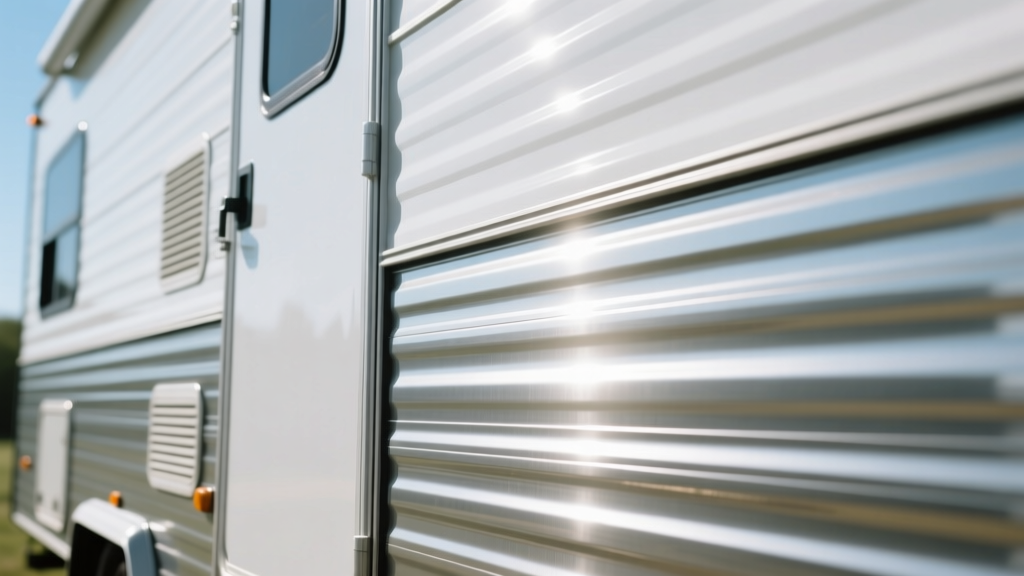
Decision Framework: Which Material Should You Choose?
The optimal camper siding material depends entirely on the operational profile of the vehicle and the capabilities of the builder.
Choose Fiberglass (FRP) If:
- You are building a modern, aerodynamic travel trailer: The smooth surface reduces tow-vehicle fuel consumption and allows for seamless vinyl decal application.
- The camper will face heavy brush or off-road conditions: 0.090-inch FRP will flex when struck by tree branches and return to its original shape, whereas aluminum will permanently dent.
- You are utilizing an Azdel composite backer: FRP bonds exceptionally well to Azdel using structural polyurethanes, creating a monolithic, waterproof wall cavity.
Choose Aluminum If:
- You are restoring a vintage riveted camper: Maintaining historical accuracy requires flat-sheet aluminum and traditional buck-rivet techniques.
- Weight is the absolute primary constraint: For ultra-lightweight teardrop trailers or truck campers where every pound of CCC matters, 0.024-inch aluminum saves roughly 15 lbs per side compared to FRP.
- You lack lamination equipment: Aluminum can be mechanically fastened using Cleco fasteners and rivets, completely bypassing the need for expensive adhesives, rollers, or vacuum presses.
Ultimately, the shift in the RV industry toward composite substrates has solidified FRP as the superior choice for longevity and aerodynamics in 2026. However, aluminum retains a vital niche in lightweight, mechanically fastened, and vintage applications where its unique physical properties outperform composite plastics.
Written by
Marcus ChenMarcus Chen is a licensed structural engineer (PE) and building materials analyst with over 12 years of experience across residential, commercial, and industrial construction. He holds a Master of Science in Civil Engineering from UC Berkeley and spent six years at Thornton Tomasetti before transitioning to independent consulting and technical writing. Marcus specializes in material selection for seismic-prone regions, concrete reinforcement strategies, and lifecycle cost analysis. His work has been cited by the American Concrete Institute (ACI) and the Structural Engineers Association of California (SEAOC). When he is not on a job site or at his desk, you will find him hiking the Sierra Nevada or restoring a 1920s craftsman bungalow in Oakland, CA.
More from Marcus Chen
View all
Construction Cost
How Much Did the Eiffel Tower Cost to Build?
How much did the Eiffel Tower cost to build in 1889? We adjust for inflation and compare its budget to modern skyscraper construction.
Aug 4, 2026

Fire Resistance
What Is a Fire Resistant Material? Testing & Certification Guide
Discover what is a fire resistant material through ASTM and UL testing. Learn how fire ratings, certifications, and assemblies work in construction.
Aug 4, 2026

Construction Cost
How Much Did the Burj Khalifa Cost to Build?
How much did the Burj Khalifa cost to build? We break down the $1.5B project and extract 5 money-saving strategies for your next build.
Jul 30, 2026