Exterior Backer Board Durability: Lifespan and Failure Analysis
Analyze the durability and lifespan of exterior backer board systems for cladding. Compare failure modes, material specs, and 50-year moisture performance.
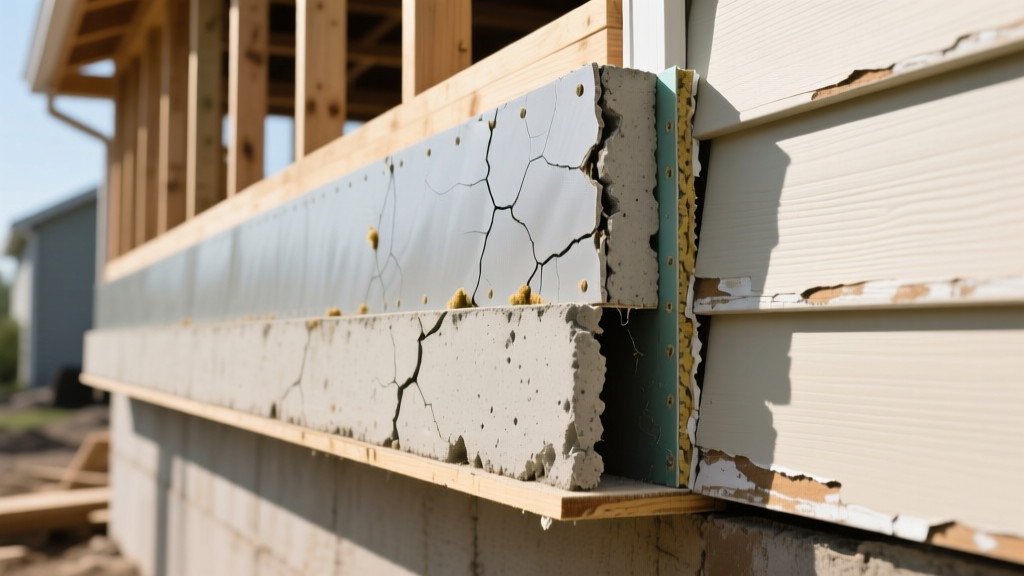
The Hidden Lifespan Multiplier in Cladding Systems
When evaluating the longevity of heavy exterior cladding systems—such as manufactured stone veneer (MSV), traditional stucco, or thick ceramic facades—the visible material rarely dictates the system's ultimate lifespan. Instead, the critical failure point is almost always the substrate. Exterior backer board serves as the structural and moisture-managing bridge between the weather-resistant barrier (WRB) and the cladding. While interior-rated cement boards or wood-based sheathing (OSB and plywood) may suffice for standard vinyl or lap siding, they introduce catastrophic failure risks when paired with moisture-retentive masonry cladding.
Material Breakdown: Wood Sheathing vs. Exterior Cement Backer Board
The transition from structural wood sheathing to dedicated exterior cementitious backer units (CBU) or fiber-cement backer boards is driven by the need to eliminate organic material from the cladding envelope. Wood-based products are inherently susceptible to fungal decay and dimensional swelling when exposed to the micro-climates created behind masonry veneers.
| Substrate Material | 24-Hr Water Absorption | Mold/Fungal Resistance | Dimensional Swelling | Expected Lifespan |
|---|---|---|---|---|
| OSB (Oriented Strand Board) | 15% - 25% | Poor (Organic) | High (Edge swelling) | 10-15 years (if wet) |
| CDX Plywood | 10% - 18% | Poor (Organic) | Moderate | 15-20 years (if wet) |
| Exterior Cement Board (CBU) | < 8% | Excellent (Inorganic) | Negligible (<0.1%) | 50+ years |
| Fiber-Cement Backer Board | < 12% | Excellent | Low | 50+ years |
Specific Product Performance Profiles
Not all backer boards are engineered for exterior cladding loads. Using interior-rated tile backer boards (which often contain gypsum cores or lack exterior-grade binders) behind exterior cladding violates building codes and voids manufacturer warranties. For exterior applications, specify products tested to ASTM C1325 (Standard Specification for Non-Asbestos Fiber-Mat Reinforced Cementitious Backer Units).
- USG Durock Exterior Cement Board: Features a polymer-modified Portland cement core with a fiberglass mesh on both sides. It exhibits a water absorption rate of less than 8% and provides a sheer strength capable of supporting heavy MSV without deflection. It must be paired with an exterior-rated WRB.
- National Gypsum PermaBase Exterior: Utilizes a unique edge design (EdgeTech) that prevents crumbling during fastening, a common failure point in standard cement boards. Its inorganic core guarantees zero mold food source, achieving a perfect 10 on the ASTM D3273 mold resistance test.
- James Hardie HardiePanel (Fiber-Cement Sheathing): While technically a fiber-cement panel rather than a traditional CBU, 5/16-inch or 1/4-inch HardiePanel is frequently used as a structural backer for stucco. It offers superior impact resistance but requires specialized carbide-tipped scoring tools and generates significant silica dust during cutting.
Primary Failure Modes and Edge Cases
Even when the correct exterior-rated backer board is specified, the system can fail prematurely if installation protocols ignore the chemical and physical realities of masonry cladding. According to forensic building envelope analyses documented by the Building Science Corporation, the following failure modes account for over 80% of backer board degradation in cladding systems:
- Alkali Degradation of Joint Tape: Standard fiberglass drywall tape is highly susceptible to the alkaline environment of Portland cement-based mortars and scratch coats. Within 3 to 5 years, the high pH (often 12.5 or higher) dissolves the glass fibers in standard tape. This leads to joint cracking, creating direct pathways for moisture to reach the WRB. Correction: Only use alkali-resistant (AR) fiberglass mesh tape embedded in polymer-modified mortar for all backer board joints.
- Fastener Corrosion and Pull-Through: Electroplated or standard galvanized screws will corrode when in contact with the alkaline moisture trapped behind masonry cladding. As the fastener head rusts away, it loses its clamping force, allowing the backer board to detach from the framing during freeze-thaw expansion cycles. Correction: Mandate hot-dipped galvanized or 304/316 stainless steel corrosion-resistant fasteners with a minimum 1/4-inch head diameter.
- The 'Bathtub' Effect (Missing Weep Screeds): If the backer board and WRB are terminated directly into the foundation or a concrete slab without a weep screed and capillary break, moisture wicks upward into the bottom edge of the backer board. While exterior CBUs resist water damage, the continuous wicking can degrade the bottom plate of the wood framing behind the board.
Moisture Management and the 50-Year Threshold
"The backer board is not the primary water-resistive barrier; it is the structural substrate that must survive when the primary barrier is tested. Designing the assembly to dry outward and inward is what pushes the lifespan past the 50-year mark."
To achieve a 50-year lifespan matching the cladding itself, the backer board must be integrated into a ventilated rainscreen assembly or a highly permeable WRB system. When heavy cladding like stone veneer is installed directly over the backer board and WRB (a 'face-sealed' or direct-applied approach), any moisture that penetrates the stone is trapped. Exterior cement backer boards will survive this moisture, but the hydrostatic pressure can cause the mortar scratch coat to delaminate from the board's surface. Incorporating a 3/8-inch to 1/2-inch drainage mat (rainscreen) between the WRB and the backer board relieves this pressure, ensuring the mortar bond remains intact for decades.
Installation Tolerances That Dictate Longevity
Precision during installation prevents micro-fractures that accelerate water ingress. Adhere strictly to these field-verified tolerances:
- Joint Spacing: Maintain a strict 1/8-inch gap between all board edges and at corners. Cement boards expand and contract with temperature fluctuations (approx. 1/16 inch per 10 feet over a 100°F range). Butting boards tightly guarantees edge spalling.
- Fastener Penetration: Screws must penetrate the wood framing by a minimum of 1-1/4 inches. For 1/2-inch backer board, this requires 1-5/8-inch or 1-3/4-inch screws. Under-penetration reduces sheer pull-out strength by up to 40%.
- Fastener Spacing: Maximum 8 inches on center along the edges and 12 inches on center in the field. Fasteners must be positioned no closer than 3/8 inch from the board edge to prevent blowout.
- Clearance to Grade: Maintain a minimum 2-inch clearance between the bottom edge of the backer board and finished grade, and a 4-inch clearance above paved surfaces to prevent capillary suction and splash-back degradation.
Cost-Benefit Analysis Over a 30-Year Horizon
Upgrading from standard OSB sheathing to a dedicated exterior cement backer board system adds upfront material and labor costs, but drastically alters the lifecycle cost of the building envelope.
Financial Breakdown (Per 1,000 Sq. Ft. of Cladding)
Upfront Premium: Exterior cement backer board materials cost approximately $45 to $65 per 3x5 sheet (15 sq ft), translating to an added material cost of $3.00 to $4.30 per square foot compared to OSB. With labor, the total installed premium is roughly $4.50 to $6.00 per square foot ($4,500 - $6,000 total).
Avoided Failure Costs: If an OSB substrate fails behind manufactured stone veneer due to moisture intrusion, the remediation requires complete demolition of the cladding, WRB replacement, framing repair, and re-installation. Industry remediation costs average $35.00 to $55.00 per square foot. A single failure event on a 1,000 sq ft facade costs $35,000 to $55,000.
ROI Conclusion: The 10x to 12x multiplier between the upfront backer board premium and the potential remediation cost makes exterior backer board an essential risk-mitigation investment for any masonry or heavy cladding project.
Ultimately, the durability of exterior cladding is only as robust as the backer board supporting it. By specifying ASTM C1325 compliant exterior cement boards, utilizing alkali-resistant joint treatments, and enforcing strict fastener and clearance tolerances, builders can ensure the cladding system achieves its maximum engineered lifespan without catastrophic substrate failure.