Vinyl Siding Removal Tool Guide: Salvage, Durability & Lifespan
Discover how the right vinyl siding removal tool preserves siding lifespan for salvage and protects your weather barrier during full tear-offs.
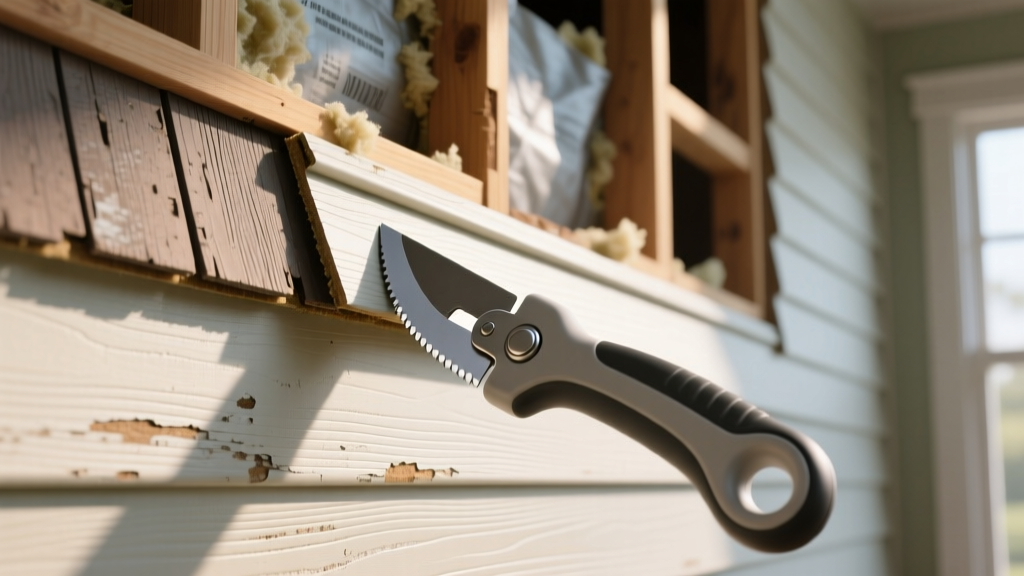
The Mechanics of Vinyl Interlocks and Tool Geometry
The interlocking mechanism of vinyl siding relies on a precise engagement between the top lock (hem) of the lower panel and the bottom lock (buttlock) of the overlapping panel. To remove a panel without destroying it, a vinyl siding removal tool—commonly referred to as a zip tool or siding unlock tool—must slide into a gap that often measures less than 3/16 of an inch (4.7mm). The geometry of the tool's hook is the single most critical factor in determining whether the siding's structural integrity survives the removal process.
Cheap, mass-produced removal tools often feature stamped hooks that are too thick (exceeding 2.5mm). Forcing a thick hook into the interlock stretches the PVC beyond its elastic memory limit. While this might successfully unhook the panel, it permanently deforms the buttlock, rendering the panel useless for salvage and reducing its wind-resistance rating if reinstalled. Professional-grade tools utilize milled or precision-cast hooks that taper to 1.5mm at the insertion point, allowing them to glide into the lock channel without inducing tensile stress on the aged vinyl.
Tool Material Lifespan: Stamped Carbon vs. Forged Stainless
The durability of the removal tool itself dictates its lifespan on the job site. A tool that bends or dulls after 500 square feet of use becomes a liability, increasing the physical force required by the installer and raising the risk of collateral damage to the wall assembly.
| Tool Material | Edge Retention | Estimated Lifespan (Sq Ft) | Price Range (2026) | Best Use Case |
|---|---|---|---|---|
| Stamped Carbon Steel | Poor (Edges roll after 1,000 sq ft) | 1,500 - 2,500 | $6 - $10 | One-off DIY tear-offs where salvage is not required. |
| Cast Aluminum Alloy | Moderate (Prone to snapping under torque) | 3,000 - 5,000 | $12 - $18 | Lightweight preference, but fails in cold weather. |
| Forged Stainless Steel | Excellent (Maintains 1.5mm profile indefinitely) | 15,000+ | $25 - $35 | Professional contractors, salvage operations, full home exterior replacements. |
Preserving Siding Lifespan: Avoiding Micro-Fractures
When removing aged siding for partial replacement, insurance claim repairs, or material salvage, preserving the remaining lifespan of the PVC is paramount. Ultraviolet (UV) exposure degrades the plasticizers in vinyl siding over a 15- to 20-year period, making the material highly susceptible to impact and tensile fracturing. According to testing standards maintained by the Vinyl Siding Institute (VSI), siding must withstand specific wind-load pressures. A micro-fracture—visible as a white stress mark along the lock channel—compromises this structural integrity.
Using a dull or improperly angled zip tool acts as a wedge rather than a hook. Instead of rolling the bottom lock out of the top lock, it pries the layers apart. This wedging action creates localized stress concentrations that manifest as stress whitening. Once a panel exhibits stress whitening along the hem, its interlocking tensile strength drops by up to 40%, meaning it will likely unzip during the next severe wind event.
The most catastrophic failure mode during siding removal is not damaging the vinyl, but damaging the underlying Water-Resistive Barrier (WRB). Cheap tools lack a knuckle guard or ergonomic offset. When the tool slips out of the lock channel, the installer's knuckles punch into the wall. A single puncture in a modern spunbonded polyolefin WRB (like Tyvek) compromises the drainage plane, directly reducing the lifespan of the wood sheathing and wall assembly by inviting hidden moisture intrusion.
Impact on the Building Envelope's Longevity
The relationship between the removal tool and the building envelope cannot be overstated. The Building Science Corporation emphasizes that the WRB is the secondary line of defense in a wall assembly's moisture management strategy. During a full tear-off, an installer will make thousands of unlocking strokes. If the tool lacks a specialized guide lip to keep the hook parallel to the wall, the sharp point of the tool will repeatedly score and slice the WRB.
Professional-grade tools feature a 'shoe' or a flattened baseplate behind the hook. This baseplate rides against the face of the lower siding panel, maintaining a strict parallel angle and physically preventing the hook's tip from digging backward into the weather barrier. Investing in a tool with a proper baseplate is effectively an insurance policy for the building envelope's 50-year expected lifespan.
Top-Rated Vinyl Siding Removal Tools for Professional Use
- Malco Sideswiper (SW1): The industry standard for high-volume tear-offs. Priced around $28-$32, it features a forged steel hook with a precise 1.8mm taper and an oversized, impact-resistant knuckle guard. The ergonomic handle reduces wrist extension fatigue during overhead eave work.
- Alligator Zip Tool: Features a unique dual-hook design and a lower profile head. It excels in tight spaces, such as removing siding around window flanges or working up into soffits where a standard handle would bind against the J-channel.
- Standard Generic 'S' Hook: Often sold in multi-packs for under $10. These lack a baseplate and feature a blunt, rolled-steel edge. They should only be used for demolition where the siding is destined for the landfill and the underlying WRB is being fully replaced.
Step-by-Step: Unlocking Brittle, Aged Vinyl Siding
Removing vinyl siding in ambient temperatures below 40°F (4°C) drastically increases the risk of shattering the interlock. PVC undergoes a ductile-to-brittle transition in cold weather. Follow this protocol to maximize salvage rates:
- Thermal Assessment: If the surface temperature of the siding is below 45°F, halt mechanical removal.
- Localized Tempering: Use a heat gun set to 200°F, keeping the nozzle 6 to 8 inches from the interlock channel. Sweep the heat laterally for 3 to 5 seconds to restore temporary ductility to the plasticizers. Do not exceed 220°F, or the PVC will warp and melt.
- Hook Insertion: Slide the tapered tip of the zip tool under the buttlock of the overlapping panel. Push inward until the baseplate rests flush against the siding face.
- The 'Roll-Down' Motion: Do not pull straight down. Instead, pull downward and slightly outward (away from the wall) in a rolling motion. This disengages the lock without stretching the hem.
- Lateral Travel: Slide the tool horizontally along the panel, repeating the roll-down motion every 12 inches. Never slide the tool while applying downward pressure, as this will shave the inside of the vinyl lock.
Salvage Rate Economics: Is Reusing Old Siding Viable?
For contractors and homeowners managing partial repairs (e.g., replacing a damaged section from a hail storm or vehicle impact), salvaging existing siding from less visible areas (like the rear or gable ends) is highly cost-effective, provided the correct removal tool is used.
| Removal Scenario | Tool Used | Expected Salvage Rate | Material Cost Offset (per 100 sq ft) |
|---|---|---|---|
| Demolition (Landfill) | Crowbar / Flat Bar | 0% | $0 |
| Careful Removal | Generic Stamped Zip Tool | 40% - 60% (High lock damage) | $60 - $90 |
| Precision Salvage | Malco SW1 / Forged Tool | 90% - 98% | $135 - $147 |
Given that premium vinyl siding materials cost between $1.50 and $2.50 per square foot in 2026, achieving a 95% salvage rate on a 200-square-foot gable end saves roughly $380 in material costs, easily justifying the $30 investment in a professional-grade removal tool.
FAQ: Vinyl Siding Unlock Tools
Can I use a flat pry bar instead of a zip tool?
No. A flat pry bar will crush the interlocking channels, permanently destroying the panel's ability to lock into adjacent pieces. Pry bars also concentrate point-loads against the underlying foam insulation or wood sheathing, causing severe denting and structural damage to the wall assembly.
How do I remove the bottom-most panel near the foundation?
The starter strip at the foundation holds the bottom lock of the first panel. You cannot use a zip tool here. Instead, use a specialized siding puller or a flat bar with a wooden block shim to gently lever the bottom hem out of the starter strip's metal or vinyl lip. Work slowly in 2-foot increments to avoid snapping the brittle bottom edge.
Why does my zip tool keep slipping out of the lock?
Slipping is usually caused by one of two issues: either the tool's hook is worn down and no longer catches the top lock's return lip, or you are not pushing the tool deeply enough into the channel before applying downward pressure. Ensure the tool's baseplate is fully seated against the face of the overlapping panel before pulling.