Which Exterior Siding Material Offers Top Weather Resistance?
Compare the weather resistance of top exterior siding material options. Analyze wind, hail, moisture, and UV performance for modern builds.

The Four Vectors of Siding Failure
Choosing the right exterior siding material requires looking beyond curb appeal and initial cost. The primary driver of siding replacement is premature failure due to environmental stress. According to the FEMA Building Science branch, building envelope failures account for a massive percentage of catastrophic weather-related insurance claims. To accurately evaluate weather resistance, structural engineers and building scientists test cladding against four specific vectors: kinetic impact (hail and debris), wind uplift, moisture intrusion (freeze-thaw cycles), and thermal/UV degradation.
A material that performs exceptionally in an arid, high-UV climate may catastrophically fail in an alpine freeze-thaw zone. This analysis breaks down the empirical performance data of modern cladding systems to help you specify the correct exterior siding material for your specific environmental threat profile.
The Weather Resistance Matrix
The table below synthesizes standardized testing data (ASTM, TAS, and UL) across the five most common residential and commercial cladding systems. Ratings reflect performance under extreme, code-maximum stress conditions.
| Material | Hail Impact (ASTM D3429) | Wind Uplift (TAS 100 / ASTM D3679) | Moisture Absorption | Thermal Expansion Coefficient |
|---|---|---|---|---|
| Fiber Cement (e.g., James Hardie) | High (Brittle at extreme velocities) | Excellent (Up to 150 mph HVHZ rated) | < 15% (ASTM C1185) | 5.0 x 10^-6 in/in/°F |
| Engineered Wood (e.g., LP SmartSide) | Excellent (Flexes, resists shattering) | Very Good (Requires specific blind-nailing) | Variable (Zinc borate treated) | 3.0 x 10^-6 in/in/°F |
| Vinyl (Insulated & Standard) | Poor to Fair (Shatters below 40°F) | Fair (Standard) / Good (Insulated) | 0% (Non-porous) | 3.3 x 10^-5 in/in/°F |
| Metal (24-Gauge Steel) | Fair (Dents, but maintains envelope) | Excellent (High pull-through strength) | 0% | 6.5 x 10^-6 in/in/°F |
| Traditional Stucco (3-Coat) | Poor (Cracks upon kinetic impact) | Excellent (Monolithic adhesion) | High (Requires weep screeds) | 5.0 x 10^-6 in/in/°F |
Kinetic Impact and Hail Resistance
Hail damage is highly dependent on ambient temperature and material ductility. Vinyl siding, governed by ASTM D3679, exhibits severe brittleness when temperatures drop below 40°F (4°C). In these conditions, a 1.75-inch hailstone striking at terminal velocity will easily puncture standard 0.040-inch thick vinyl panels, breaking the weather envelope and allowing water infiltration behind the cladding.
Engineered Wood vs. Fiber Cement in Hail Zones
Engineered wood siding, such as 3/8-inch LP SmartSide, utilizes a resin-saturated wood strand core that provides high ductility. When struck by hail, the material may dent slightly but rarely fractures, maintaining the secondary water-resistive barrier. Fiber cement, conversely, is highly rigid. While it will not melt or warp under intense heat, a direct strike from large hail (greater than 1.5 inches) can cause localized spalling or star-cracking. For regions with frequent, high-velocity hail (such as the U.S. Great Plains), engineered wood or heavy-gauge metal (22-gauge or thicker) provides the most reliable impact resistance.
Wind Uplift and HVHZ Fastening Protocols
Wind resistance is not solely a property of the exterior siding material itself; it is a function of the fastening schedule and substrate integration. In High-Velocity Hurricane Zones (HVHZ), such as Miami-Dade County, cladding must pass rigorous Notice of Acceptance (NOA) testing, which simulates cyclic wind pressure and debris impact.
The IBHS FORTIFIED Home standard outlines specific requirements for wind uplift mitigation. For fiber cement lap siding to achieve a 150 mph wind rating, installers must use blind-nailing techniques with hot-dipped galvanized or stainless steel ring-shank nails, driven into studs spaced no more than 16 inches on center. Face-nailing drastically reduces the pull-through resistance of the board. Metal siding systems utilizing concealed clip fasteners (like standing seam profiles adapted for walls) inherently resist wind uplift better than face-fastened corrugated panels, as the clips allow for lateral movement without compromising the structural grip.
Moisture Intrusion and Freeze-Thaw Spalling
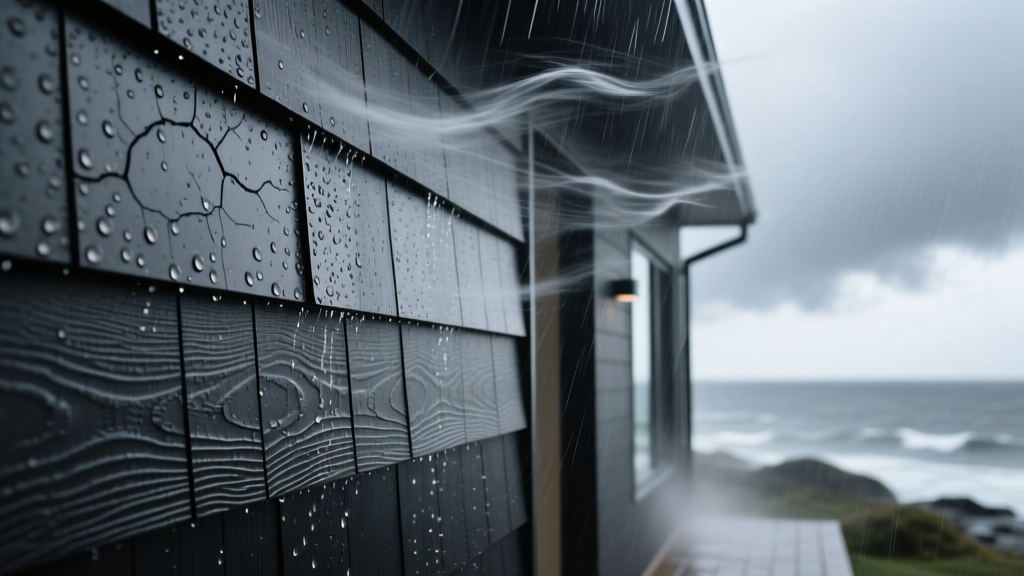
Water expands by approximately 9% when it freezes. If an exterior siding material absorbs moisture and is subjected to repeated freeze-thaw cycles, the internal hydraulic pressure will cause the face of the material to delaminate or spall. This is the primary failure mode for poorly mixed stucco and low-grade masonry.
Evaluating Absorption Rates
Under ASTM C1185, high-quality fiber cement is engineered to keep water absorption below 15%, with premium grades pushing below 7%. However, the vulnerability lies at the cut edges. If installers fail to prime field-cut fiber cement edges with a high-quality acrylic masonry primer, the exposed capillary network will wick water directly into the core, leading to localized freeze-thaw failure within three to five winters.
Traditional stucco (ASTM C926) is inherently porous. To survive in freeze-thaw climates, stucco systems must incorporate a continuous weather-resistive barrier (WRB), a minimum 1/4-inch air gap using furring strips or drainage mats, and a weep screed at the base to allow hydrostatic pressure to escape. Without this drainage plane, stucco will trap moisture against the sheathing, leading to structural rot regardless of the cladding's surface integrity.
Thermal Expansion and UV Degradation
The coefficient of thermal expansion dictates how much a material grows and shrinks with temperature fluctuations. Vinyl has an exceptionally high expansion rate (3.3 x 10^-5 in/in/°F). A standard 12-foot vinyl panel can expand by as much as 5/8 of an inch over a 100°F temperature swing. If the installer does not leave the manufacturer-specified 1/4-inch gap at all overlaps and trim edges, the siding will buckle, warp, and pull away from the fasteners during peak summer heat.
UV degradation is equally critical. Dark-colored exterior siding material absorbs significantly more solar radiation. While modern fiber cement and engineered wood utilize acrylic or polyurethane finishes with advanced UV inhibitors, dark-colored vinyl absorbs heat to the point of structural softening. On south- and west-facing elevations in high-UV zones (like the American Southwest), dark vinyl can reach surface temperatures exceeding 160°F, causing permanent sagging between studs. In these environments, light-colored stucco, fiber cement, or Galvalume-coated metal (which reflects solar radiation) are the only viable long-term options.
Regional Decision Framework
Use the U.S. Department of Energy's building envelope guidelines alongside this regional framework to finalize your material specification:
- Coastal and Hurricane-Prone Zones: Specify 5/16-inch fiber cement or 24-gauge steel with an AZ55 Galvalume coating (providing superior salt-spray corrosion resistance). Ensure all fasteners are 304 or 316 stainless steel. Avoid standard stucco due to wind-driven rain intrusion risks at micro-cracks.
- Alpine and Freeze-Thaw Zones: Specify 3/8-inch engineered wood or insulated vinyl siding. Prioritize materials with low water absorption and high ductility. Mandate the use of a high-performance fluid-applied WRB behind the cladding.
- Arid and High-UV Zones: Specify traditional 3-coat stucco, fiber cement with factory-applied high-reflectivity pigments, or metal cladding. Avoid dark colors entirely to mitigate thermal expansion and UV resin breakdown.
- Temperate / Mixed-Humid Zones: Fiber cement and engineered wood offer the best balance of impact resistance, moisture management, and aesthetic versatility. Ensure a ventilated rain screen gap (minimum 3/8-inch) is utilized to promote drying of the WRB.
Final Specification Directives
Weather resistance is not an inherent property of a brand name; it is the result of matching the material's physical limitations to the specific environmental loads of the site. When drafting your construction documents, explicitly state the required fastening schedule, the mandatory edge-priming protocols for cut materials, and the specific drainage plane assembly. A premium exterior siding material will fail prematurely if the installation details ignore the physics of water, wind, and thermal movement.
Written by
Elena RodriguezElena Rodriguez is a civil engineer and technical writer specializing in concrete technology, masonry systems, and ASTM/ACI compliance. She earned her B.S. in Civil Engineering from Texas A&M University and spent a decade at a materials testing laboratory, performing over 2,000 concrete compressive strength tests and masonry prism evaluations. Elena is an ACI-certified Field Testing Technician (Grade I) and a member of ASTM Committee C12 on Natural Building Stone. She currently consults on forensic engineering cases involving concrete failures and moisture intrusion. Based in San Antonio, TX, Elena is a proud member of the Society of Women Engineers (SWE) and coaches her daughter's FIRST Robotics team.
More from Elena Rodriguez
View all
Walls & Panels
Cost Analysis: Light Gauge Steel Framing Advantages and Disadvantages
Evaluate light gauge steel framing advantages and disadvantages through a strict cost analysis lens, comparing material, labor, and lifecycle expenses.
Aug 4, 2026

Walls & Panels
Gypsum Board Types: Exact Specifications, Thickness & Dimensions
Compare standard, Type X, and moisture-resistant gypsum board types. Get exact specifications, thicknesses, dimensions, and ASTM standards for your project.
Aug 4, 2026

Fire Resistance
Best Fire-Resistant Outdoor Decking Materials: 2026 Buyer Guide
Discover the best fire-resistant outdoor decking materials for 2026. Compare Class A PVC, aluminum, and hardwood options for WUI compliance and safety.
Aug 4, 2026