Maintaining and Repairing Composite Siding Materials
Learn expert techniques for maintaining and repairing composite siding materials, including poly-ash and WPC, with cost data and thermal expansion fixes.

The Anatomy of Composite Siding Failures
Composite siding materials bridge the gap between the low maintenance of vinyl and the authentic texture of wood or fiber cement. However, the term 'composite' encompasses distinct material chemistries, primarily Wood-Plastic Composites (WPC) and Poly-Ash composites. Understanding the specific failure modes of your siding type is the first step in effective repair.
WPC siding, which blends wood fibers with polyethylene or PVC resins, is highly resistant to impact but vulnerable to thermal expansion and surface scratching. If installed without adequate end-joint gaps, WPC panels will buckle and warp during peak summer temperatures. Conversely, Poly-Ash siding (such as Boral TruExterior) utilizes fly ash and polymers to create a highly dimensionally stable board. While it resists thermal movement, its rigid nature makes it susceptible to edge chipping and localized impact gouging from hail or landscaping equipment.
Routine Maintenance Protocol for Composite Siding
Unlike natural wood, composite siding materials do not require annual sealing or staining. However, they do require specific cleaning protocols to prevent surface degradation and moisture trapping.
- Pressure Washing Parameters: Never exceed 1,500 PSI when cleaning composite siding. Use a 40-degree fan tip and maintain a minimum distance of 12 inches from the surface. High-pressure streams can etch the polymer cap layer on WPC boards, creating microscopic grooves that trap dirt and accelerate UV fading.
- Vegetation Management: Trim all shrubs and vines at least 18 inches away from the siding face. Organic debris trapped against composite materials retains moisture and promotes mildew, which can permanently stain the porous wood fibers exposed at the cut ends of WPC boards.
- Joint Inspection: Annually inspect the sealant at all vertical and horizontal end joints. Polyurethane exterior sealants typically last 5 to 7 years. If the sealant has lost its elasticity or shows signs of adhesion failure, rake it out with a hook knife and reapply a paintable, high-movement exterior sealant.
Step-by-Step Repair Techniques for Common Damage
Fixing Surface Scratches on Wood-Plastic Composites (WPC)
Minor surface scratches on WPC siding often expose lighter-colored wood fibers beneath the polymer cap. Because WPC cannot be easily patched with traditional wood fillers, utilize a thermal repair technique:
- Clean the scratched area with isopropyl alcohol to remove surface oils and dirt.
- Set a variable-temperature heat gun to 250°F - 300°F (low setting).
- Hold the heat gun 4 to 6 inches from the scratch and sweep it continuously across the damage for 15 to 20 seconds.
- The heat will slightly melt the surrounding polymer matrix, allowing it to flow into the scratch and mask the exposed wood fibers.
- Wipe the area gently with a clean, damp microfiber cloth to smooth the melted resin before it cools.
Patching Poly-Ash Dents and Gouges
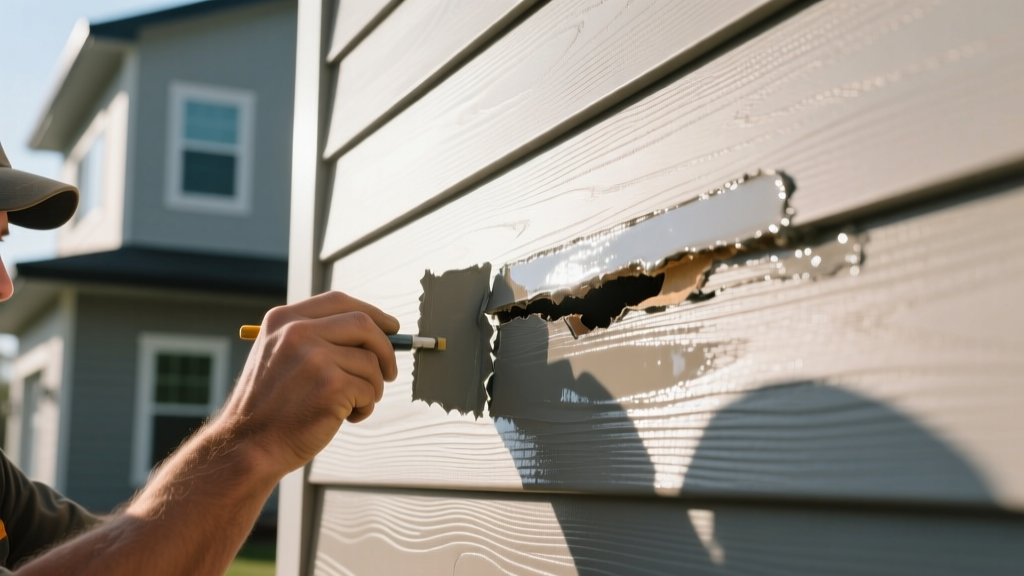
Poly-ash siding is typically painted rather than stained, making it easier to patch and blend. For deep gouges caused by impact:
- Remove any loose or flaking material around the gouge using a 5-in-1 painter's tool.
- Sand the immediate area with 80-grit sandpaper to create a mechanical profile for the filler.
- Apply a two-part exterior-grade polyurethane filler or high-density automotive body filler. Avoid standard latex spackling or interior wood fillers, as they lack the flexural strength to withstand exterior temperature swings and will crack.
- Once cured, sand the patch flush with the surrounding board texture using 120-grit sandpaper.
- Prime the patched area with a high-build acrylic latex primer, then topcoat with 100% acrylic exterior paint to match the existing finish.
Repair Material Selection Matrix
Choosing the wrong filler is the leading cause of failed composite siding repairs. Use the matrix below to select the correct material for your specific damage profile.
| Filler Type | Best Application | Sandability | Cure Time | Est. Cost (2026) |
|---|---|---|---|---|
| Two-Part Epoxy | Deep structural gouges, corner repairs | Excellent (Dust-free) | 2-4 Hours | $22 - $35 / kit |
| Polyurethane Caulk | End-joint gaps, expansion seams | Poor (Gummy) | 24 Hours | $8 - $12 / tube |
| Auto Body Filler | Poly-ash surface dents, hail damage | Excellent (Easy) | 20-30 Mins | $15 - $20 / tub |
| Acrylic Latex Filler | Nail hole overfills, minor seams | Good | 1-2 Hours | $6 - $9 / tube |
Thermal Expansion: Diagnosing and Fixing Buckled Panels
According to building envelope research documented by the Building Science Corporation, managing thermal and moisture-induced movement is critical for exterior cladding longevity. Wood-Plastic Composites have a significantly higher Coefficient of Thermal Expansion (CTE) than poly-ash or fiber cement. A 12-foot WPC board can expand up to 1/4 inch across a 100°F temperature swing.
If you notice WPC panels bowing outward or overlapping joints popping open, the installation lacked proper expansion gaps. To repair buckled composite siding without a full tear-off:
- Identify the buckled run and locate the fasteners (typically blind-nailed or face-screwed at the studs).
- Back out the fasteners on the affected board and the adjacent board using a drill with a clutch setting to prevent stripping.
- Cut a precise 3/16-inch gap at the nearest end joint using an oscillating multi-tool equipped with a bi-metal blade.
- Re-fasten the board, ensuring fasteners are driven exactly 3/4 inch from the board edges. Driving fasteners closer to the edge in composite materials causes 'blowout' and micro-fractures.
- Fill the newly created 3/16-inch expansion gap with a high-movement, color-matched polyurethane sealant.
When to Repair vs. Replace: A Decision Matrix
Determining whether to patch a damaged board or replace it entirely depends on the structural integrity of the siding's locking mechanism and the extent of the damage. Use the U.S. Department of Energy's building envelope guidelines as a baseline for assessing moisture risk.
Repair the Board If:
- The damage is localized to the face of the board and does not penetrate the nailing hem or interlocking lip.
- The gouge or dent covers less than 15% of the board's total surface area.
- The board remains firmly anchored to the sheathing with no signs of fastener pull-through.
- The damage is purely cosmetic (e.g., surface scratching, minor fading, or localized impact).
Replace the Board If:
- The interlocking lip or nailing hem is cracked, split, or crushed, compromising the weather-resistive overlap.
- Moisture has infiltrated the core of a WPC board, causing visible swelling, edge delamination, or fungal growth.
- Thermal buckling has permanently deformed the board's profile, preventing it from sitting flush against the adjacent panels.
- The damage spans across multiple fastening studs, requiring extensive cutting that would leave the remaining board segments too short to properly anchor (minimum 12-inch length required for secure fastening).
Frequently Asked Questions
Can I use a circular saw to cut out a damaged section of composite siding?
Yes, but you must use a fine-toothed finishing blade (minimum 60 teeth for a 7-1/4 inch blade) and cut with the finished face UP. Cutting face-down will cause the polymer cap to chip and splinter along the cut line. Always seal the newly exposed cut end with a manufacturer-approved end-sealant to prevent moisture wicking into the wood fibers.
Why is my poly-ash siding cracking at the nail holes?
Micro-cracking around nail holes in poly-ash siding is almost always caused by overdriving the fasteners or using nails with heads that are too small. Poly-ash requires a nail head diameter of at least 5/16 inch. If the nail is driven below the surface of the board, it crushes the internal polymer matrix, leading to radial stress cracks as the board undergoes seasonal temperature shifts.
Is it necessary to prime the back of composite siding before installation?
While most modern WPC and Poly-Ash products come pre-finished or are moisture-resistant throughout their cross-section, back-priming is highly recommended for boards installed in high-humidity zones or over unventilated rain screens. Applying a coat of exterior acrylic primer to the back and all cut edges reduces the board's equilibrium moisture content (EMC) fluctuation, minimizing seasonal movement.
Written by
Priya KapoorPriya Kapoor is a real estate market analyst and construction economics researcher with expertise in housing affordability, development feasibility, and infrastructure investment. She holds a Master of Regional Planning from Cornell University and previously worked as a senior analyst at CBRE's Investment Properties group, where she modeled returns for $4B in mixed-use development pipelines. Priya now runs an independent research practice advising developers, municipalities, and REITs on construction cost forecasting and market timing. She publishes the quarterly "BuildMat Market Pulse" report tracking material price indices across 12 commodity categories. Based in Austin, TX, Priya serves on the board of Habitat for Humanity Austin and is a marathon runner.
More from Priya Kapoor
View all
Construction Cost
Cost to Build a 1600 Sq Ft Home in 2026: Full Breakdown
Accurate 2026 cost to build a 1600 sq ft home—material, labor, and regional pricing breakdowns included. Plan your budget with real-time estimates.
Aug 11, 2026

Wood & Lumber
Name the Types of Wood for Pressure Treatment and Preservation
Learn how to name the types of wood best suited for pressure treatment. Compare species treatability, chemical retention levels, and 2026 preservation costs.
Aug 4, 2026

Stone & Masonry
Stone Veneer Suppliers Lindenhurst: 2026 Cost Analysis
Analyze 2026 stone veneer costs in Lindenhurst, NY. Compare local supplier pricing, delivery fees, and Suffolk County installation labor rates.
Aug 4, 2026