HardieBacker Board for Exterior Siding: Substrate Selection Guide
Discover if HardieBacker board works for exterior siding. Compare cement backer substrates, costs, and installation specs for outdoor cladding.
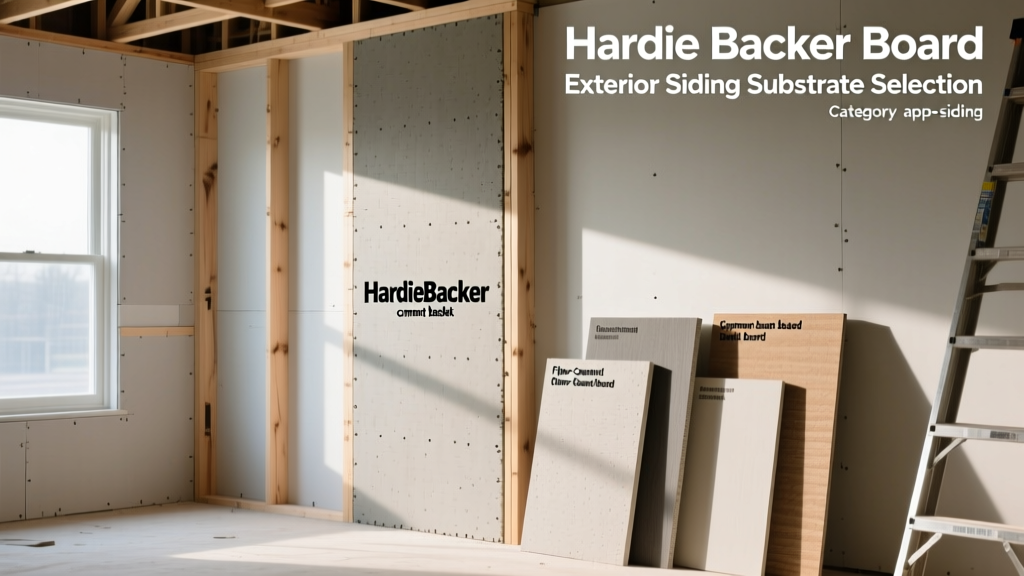
The Taxonomy of Cementitious Substrates in Exterior Assemblies
A pervasive point of confusion in exterior cladding selection is the conflation of fiber cement siding with cement backer boards. When builders and homeowners search for 'Hardie backer board' for exterior applications, they are typically navigating two distinct material categories within the James Hardie ecosystem and the broader building materials market. Understanding this taxonomy is critical, as misapplication leads to catastrophic moisture intrusion and immediate warranty voids.
Standard HardieBacker cement board is engineered primarily as an interior tile substrate. It lacks the factory-applied primer, UV-resistant pigments, and specific edge-detailing required to function as a standalone exterior siding product. However, it plays a vital role in exterior assemblies as a structural substrate behind heavy cladding materials like manufactured stone veneer (MSV), exterior ceramic tile, and traditional stucco.
Material Classification Matrix: Exterior Substrates
| Material Type | Brand / Product Example | Primary Exterior Function | Weight (psf) | 2026 Avg. Material Cost |
|---|---|---|---|---|
| Interior Cement Backer | HardieBacker 500 (1/2") | Substrate for stone/tile (requires WRB) | 4.5 lbs | $1.15 - $1.35 / sq ft |
| Exterior Fiber Cement Panel | HardiePanel Vertical Siding | Direct-to-wall finished cladding | 2.3 lbs | $2.50 - $3.80 / sq ft |
| Exterior Glass-Mat Gypsum | DensGlass / Securock | Stucco / EIFS substrate | 1.6 lbs | $0.85 - $1.10 / sq ft |
| Foam Backer Board | Wedi Building Panel | Lightweight exterior tile substrate | 0.5 lbs | $4.50 - $6.00 / sq ft |
When to Specify Cement Backer Boards for Exterior Cladding
While fiber cement panels (like HardiePanel) are the correct choice for painted or primed exterior walls, cement backer boards become mandatory when the design calls for high-mass, moisture-sensitive finishes. According to the Tile Council of North America (TCNA) guidelines, exterior installations of stone or porcelain require a dimensionally stable, non-combustible, and water-impervious substrate that will not rot, swell, or harbor mold when exposed to the elements.
Ideal Applications for 1/2" Cement Backer Substrates
- Manufactured Stone Veneer (MSV): Provides the necessary shear strength and alkaline environment for Type S mortar scratch coats.
- Exterior Porcelain Tile: Prevents the differential expansion issues common with plywood or OSB substrates in freeze-thaw climates.
- Direct-Applied Stucco Systems: Serves as a rigid base for three-coat stucco applications, outperforming standard water-resistant paper over wire lath in high-wind zones.
Step-by-Step Substrate Preparation & Fastening Protocols
The failure rate of exterior stone and tile assemblies rarely stems from the cladding itself; it almost always originates at the substrate fastening and moisture management layer. Follow this precise sequence for exterior cement backer installation.
1. Weather-Resistant Barrier (WRB) Integration
Cement backer board is not a waterproofing membrane. Water will migrate through the capillary pores of the cement matrix. You must install a code-approved WRB (such as Tyvek CommercialWrap or a fluid-applied membrane like Prosoco R-Guard) directly to the structural sheathing (OSB/Plywood) before mounting the backer board. In high-moisture climates, a dimpled drainage mat (e.g., Keene DriWall) over the WRB is recommended to create a capillary break.
2. Alkaline-Resistant Fastening
Portland cement is highly alkaline, typically registering a pH between 12 and 13. Standard zinc-plated drywall screws will undergo rapid galvanic corrosion, leading to rust jacking that cracks the overlying stone or tile.
3. Joint Treatment and Expansion Gaps
Exterior thermal cycling causes cement boards to expand and contract. Leave a strict 1/8-inch gap between all board edges. Fill these gaps with an exterior-grade polyurethane sealant or embed an alkali-resistant fiberglass mesh tape using a polymer-modified thinset mortar. Never use standard drywall joint compound, which will dissolve upon the first exterior wetting event.
Cost Analysis: Exterior Substrate Assemblies (2026 Pricing)
Budgeting for exterior cladding requires looking beyond the face material. The substrate, WRB, and specialized fasteners represent a significant portion of the assembly cost. Below is a breakdown for a standard 1,000 sq. ft. exterior wall elevation.
1,000 Sq. Ft. Substrate Assembly Cost Breakdown
- WRB (Fluid Applied): $450 - $600
- 1/2" Cement Backer Board (Material): $1,150 - $1,350
- Corrosion-Resistant Fasteners & Mesh: $180 - $250
- Labor (Substrate Installation Only): $1,200 - $1,800
- Total Substrate Cost: $2,980 - $4,000 ($2.98 - $4.00 / sq ft)
Note: This excludes the final cladding material (stone, tile, or stucco) and finish labor.
Decision Framework: Selecting the Correct Exterior Board
Use this conditional logic to specify the correct material for your exterior project:
- IF the design calls for painted, horizontal lap siding or vertical architectural panels THEN specify HardiePlank or HardiePanel (Fiber Cement Siding). Do not use backer board.
- IF the cladding is adhered manufactured stone veneer (MSV) under 15 lbs/sq ft THEN specify 1/2" HardieBacker 500 or equivalent cement board over a drainage WRB.
- IF the project is a commercial EIFS or traditional 3-coat stucco system THEN specify Exterior Glass-Mat Gypsum (DensGlass) due to its superior sheer strength and lighter weight for multi-story scaffolding.
- IF the exterior application involves large-format porcelain tile in a freeze-thaw climate THEN specify Wedi or Kerdi-Board foam backers to eliminate the weight load and provide a built-in waterproofing layer, reducing the risk of efflorescence.
Frequently Asked Questions: Exterior Backer Board Taxonomy
Can I use 1/4" HardieBacker for exterior stone veneer?
No. The 1/4" thickness (HardieBacker 250) lacks the flexural rigidity required to support the dead load of exterior masonry or stone veneers without deflecting between studs. Deflection will crack the mortar scratch coat and dislodge the cladding. Always use 1/2" (HardieBacker 500) for exterior load-bearing substrate applications, installed over 16-inch on-center framing.
Does cement backer board rot if it gets wet behind the stone?
Cement backer board is inorganic and will not rot, warp, or support mold growth when wet. However, if the cavity behind the board (the OSB/plywood sheathing and wall studs) becomes trapped with moisture due to a failed WRB, the structural framing will rot. The backer board survives, but the wall assembly fails. This is why a continuous drainage plane behind the backer board is non-negotiable.
Is fiber cement siding the same material as cement backer board?
They share a similar base chemistry (Portland cement, silica sand, and cellulose fibers), but their manufacturing processes and densities differ vastly. Fiber cement siding is autoclaved under high pressure to create a dense, weather-resistant face with integrated color or primer. Backer board is formulated for porosity and mechanical adhesion, allowing thinset and mortar to physically lock into the surface matrix.