Siding Materials Near Me: 2026 Local Sourcing Cost Breakdown
Searching for siding materials near you? Discover the 2026 cost breakdown, regional price variations, and hidden fees of local yards vs. big-box stores.

The True Cost of Sourcing Siding Materials Near You
When homeowners and general contractors search for "siding materials near me," the primary objective is usually to bypass the exorbitant Less-Than-Truckload (LTL) freight charges associated with online or out-of-state suppliers. In 2026, localized supply chains dictate your final per-square-foot cost just as much as the raw material itself. While buying locally eliminates long-haul shipping, it introduces a different matrix of localized fees, contractor-tier pricing structures, and inventory variables that can make or break your exterior renovation budget.
According to ongoing supply chain tracking by the National Association of Home Builders (NAHB), regional disparities in building material costs remain highly volatile, driven by local warehouse density and regional transportation tariffs. Understanding the exact breakdown of a local siding purchase is the first step toward accurate project estimating.
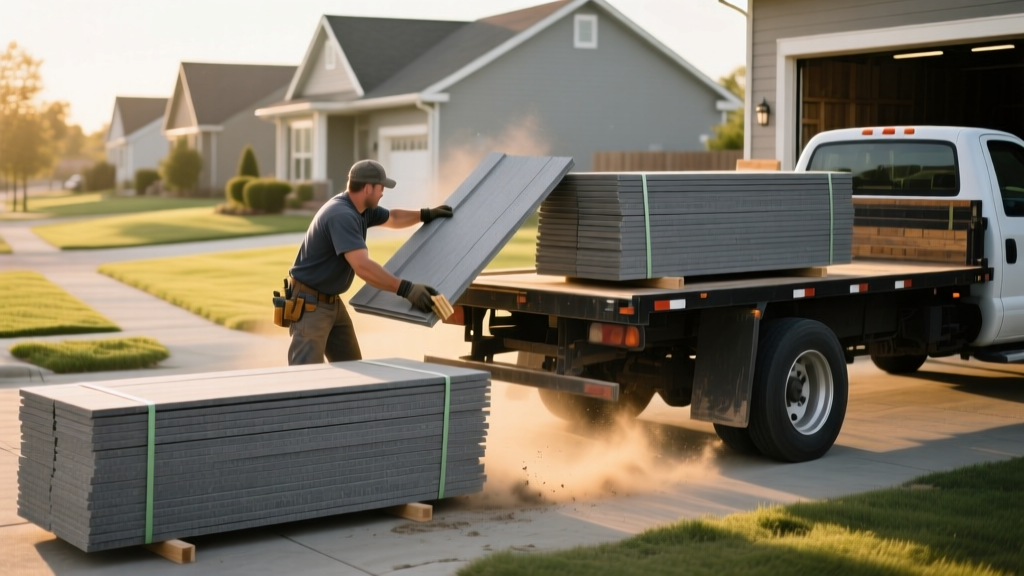
Ordering 1,500 square feet of fiber cement siding from an out-of-state distributor typically incurs $450 to $850 in LTL freight surcharges. Sourcing from a local pro yard eliminates this, replacing it with a localized flatbed delivery fee that averages between $95 and $175 within a 25-mile radius. However, local yards often apply a 4% to 7% "fuel and environmental surcharge" on the final invoice that big-box retailers absorb into their base price.
Regional Price Matrix: 2026 Siding Material Costs
The cost of siding materials near you is heavily influenced by your geographic region. Proximity to manufacturing plants, local building code requirements (such as impact resistance in coastal zones or fire ratings in wildfire-prone areas), and regional demand all shift the baseline price. Below is the 2026 regional cost breakdown for materials only, excluding installation labor.
| Material Type | Northeast | South | Midwest | West |
|---|---|---|---|---|
| Vinyl (Standard) | $3.10 - $4.80 | $2.60 - $4.10 | $2.85 - $4.30 | $3.40 - $5.20 |
| Fiber Cement (e.g., James Hardie) | $5.20 - $8.50 | $4.50 - $7.20 | $4.80 - $7.60 | $5.80 - $9.10 |
| Engineered Wood (e.g., LP SmartSide) | $4.10 - $6.80 | $3.60 - $5.90 | $3.80 - $6.20 | $4.50 - $7.40 |
| Steel / Metal Panels | $7.50 - $13.00 | $6.80 - $11.50 | $7.00 - $12.00 | $8.20 - $14.50 |
Local Pro Yards vs. Big-Box Retailers: A Sourcing Analysis
Typing "siding materials near me" into a search engine will yield two distinct types of suppliers: big-box home improvement centers (like Home Depot or Lowe's) and specialized local pro yards (such as ABC Supply, Beacon Building Products, or independent lumberyards). The cost and quality of your purchase will vary drastically depending on which route you choose.
The Big-Box Retailer Route
- Pros: Transparent, fixed pricing; easy online inventory checking; accessible return policies for small DIY projects; frequent consumer financing promotions.
- Cons: Shallow inventory depth; high risk of mixed dye-lots on the shelf; limited access to premium trim coils and specialized J-channels; retail pricing is typically 12% to 18% higher than contractor-tier pricing at pro yards.
The Local Pro Yard Route
- Pros: Deep, warehouse-scale inventory ensuring single dye-lot continuity; access to specialized tools and custom brake-metal bending; dedicated delivery fleets with boom trucks capable of lifting siding bundles directly to second-story scaffolding.
- Cons: Opaque pricing that requires negotiating or setting up a commercial account; strict restocking fees (often 15% to 25%) for unused materials; minimum order thresholds for free or discounted delivery.
Industry experts at the Fine Homebuilding project guides consistently recommend utilizing specialized exterior suppliers over general retailers for any project exceeding 1,000 square feet, primarily due to the logistical complexities of handling and storing heavy materials like fiber cement.
Hidden Costs and Edge Cases in Local Purchasing
When evaluating quotes from suppliers near you, the base price per square is only one piece of the financial puzzle. Failing to account for the following edge cases will result in budget overruns.
Fiber cement and engineered wood siding are manufactured in batches. If your local yard fulfills an order using 120 squares from Dye-Lot A and 30 squares from Dye-Lot B, your home will exhibit a visible color shift, particularly on sun-exposed elevations. Always include a clause in your purchase order requiring "single dye-lot continuity" for all colored finishes. If the yard cannot guarantee this, demand a discount on the mismatched batches or source elsewhere.
- Boom Truck Fees: Standard flatbed deliveries drop materials at the curb or driveway. If you require a boom truck (a crane-equipped flatbed) to hoist heavy fiber cement bundles onto a second-story deck or scaffold, expect an upcharge of $150 to $300 per drop.
- Restocking and Cut-Stock Fees: Returning unused full boxes of vinyl siding usually incurs a 10% to 15% restocking fee. However, returning "cut stock" (individual pieces or opened boxes) is almost universally rejected by local suppliers, rendering that material a total loss.
- Pallet and Banding Deposits: Some local lumberyards charge a $15 to $25 deposit per wooden pallet used to transport metal or wood siding. Ensure you clarify whether pallets are billable or returnable for a full refund.
4-Step Framework to Negotiate Local Siding Quotes
Securing the best price from a local supplier requires a strategic approach. Follow this framework to optimize your material costs.
- Calculate Exact Square Footage + Waste Factor: Measure your exterior wall square footage and add a precise waste factor. For standard horizontal lap siding, add 10%. For complex geometries, steep gables, or diagonal installations, add 15% to 18%. Presenting a highly accurate, professional takeoff to the supplier signals that you are an informed buyer.
- Request Contractor-Tier Pricing: Even if you are a DIY homeowner, ask to speak to the exterior desk manager and request "contractor pricing" or "multi-unit pricing." Many local yards will apply a 10% to 15% discount to the retail MSRP if you are purchasing over 1,500 square feet in a single transaction, regardless of your license status.
- Bundle Trim, Fasteners, and Housewrap: Local yards make their highest margins on accessories. If you buy your siding panels from them, leverage that volume to demand a 20% discount on the necessary accessories: stainless steel ring-shank nails, color-matched caulk, housewrap, and flashing tapes. Sourcing these from the same vendor often triggers a "total project package" discount.
- Negotiate the Delivery Threshold: Ask the supplier, "What is the exact dollar threshold to waive the flatbed delivery fee?" If your material total is $4,200 and the free delivery threshold is $5,000, it is often more cost-effective to add necessary future-maintenance materials (like extra trim coils or sealants) to your order to cross the threshold, rather than paying a $175 standalone delivery fee.
Frequently Asked Questions
Can I buy James Hardie or LP SmartSide directly from a local manufacturer?
No. Major manufacturers like James Hardie and Louisiana-Pacific do not sell directly to consumers or small contractors. They distribute exclusively through authorized regional dealers and large-scale pro yards. Searching for "siding materials near me" will connect you with these authorized local distributors, not the factory itself.
Do local yards carry B-grade or overstock siding for cheaper projects?
Yes, but it is rarely advertised. Many local lumberyards and specialized exterior suppliers have a "distressed" or "overstock" section in their warehouse. This includes discontinued colors, slightly damaged bundles, or overruns from large commercial jobs. Asking the yard manager if they have any "falling inventory" or "discontinued color lots" can yield material at 40% to 60% off retail, ideal for detached garages, sheds, or agricultural buildings where perfect color matching is not critical.
How do local building codes affect the siding materials available near me?
Local suppliers curate their inventory based on regional code enforcement. For example, if you live in a Wildland-Urban Interface (WUI) zone in California or Colorado, local yards will heavily stock fire-rated fiber cement and steel, while limiting or entirely excluding vinyl and untreated wood. Conversely, coastal suppliers in Florida will prioritize impact-rated engineered wood and heavy-gauge aluminum. Always verify your local municipal code requirements via the Journal of Light Construction or your local building department before finalizing a material order.
Written by
James ThorntonJames Thornton is a construction industry veteran with 25 years of hands-on experience in wood framing, lumber grading, and residential building codes. He started as a framing carpenter in rural Oregon, earned his ICC Residential Building Inspector certification, and eventually became a senior plan reviewer for the City of Portland Bureau of Development Services. James holds a B.S. in Wood Science & Technology from Oregon State University and is a certified lumber grader through the West Coast Lumber Inspection Bureau (WCLIB). He has inspected over 3,000 residential construction sites and authored the city's internal guide on advanced framing techniques (2x6 at 24" O.C.). James lives in Bend, OR, where he builds custom timber-frame cabins and competes in lumberjack sports.
More from James Thornton
View all
Insulation
Best Home Insulation Materials: Complete 2026 Guide
Compare top home insulation materials for 2026. Find R-values, installed costs per square foot, and best uses for fiberglass, spray foam, and mineral wool.
Aug 4, 2026

Sustainable Building
Certify Your Green Building Material for LEED and WELL
Step-by-step guide to certifying a green building material for LEED v5 and WELL v2. Master EPDs, HPDs, and VOC limits for 2026 project specifications.
Aug 4, 2026

Stone & Masonry
Veneer Stacked Stone Panels: Interior Design & Style Showcase
Discover how veneer stacked stone panels transform interiors. Explore modern design profiles, material pairings, and technical installation specs.
Aug 4, 2026