Hardie Plank Performance Specs: Fire, Wind, and Durability Ratings
Explore detailed Hardie Plank performance specifications, including ASTM fire ratings, wind resistance limits, and HZ climate zone technical data.
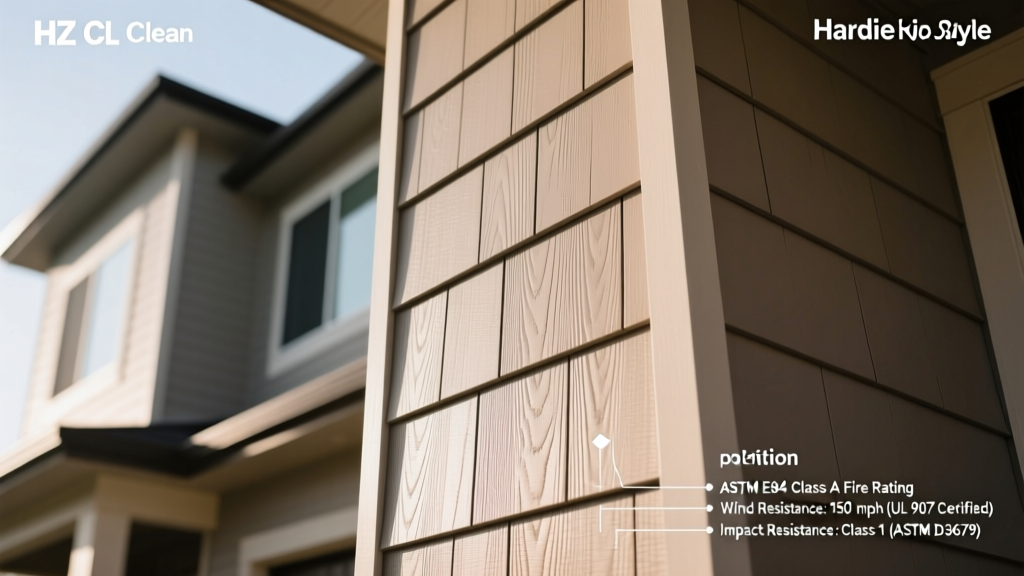
Core Material Composition & Dimensional Tolerances
James Hardie HardiePlank lap siding is engineered from a proprietary fiber cement matrix consisting of Portland cement, silica sand, and cellulose fibers. Unlike traditional wood or vinyl alternatives, this composition is subjected to an autoclave curing process, which utilizes high-pressure steam to accelerate the hydration of the cement. The result is a dense, dimensionally stable building envelope material with an average density of 75 to 85 pounds per cubic foot.
- Thickness: 5/16 inch (7.9 mm) nominal across all lap profiles.
- Widths: 5.25", 6.25", 7.25", 8.25", 9.25", and 12" (yielding 4" to 10.75" exposures depending on overlap).
- Lengths: 12, 16, and 20 feet.
- Weight: Approximately 2.3 lbs per square foot. A standard 12-foot board (8.25" width) weighs roughly 19 lbs, necessitating two-person handling or specialized lift equipment during installation.
The manufacturing tolerances for HardiePlank are exceptionally tight. Length variations are restricted to +/- 1/8 inch, and thickness variations do not exceed +/- 0.02 inches. This precision is critical for maintaining consistent shadow lines and ensuring that weather-resistant barriers are not compromised by uneven pressure points against the sheathing.
Fire Performance: ASTM E136 and WUI Compliance
One of the most significant performance advantages of HardiePlank is its non-combustible nature. The material is rigorously tested under ASTM E136, the standard test method for assessing non-combustibility in elementary materials. Because the core is primarily cementitious, it will not ignite, melt, or contribute fuel to a structural fire.
Furthermore, when tested in accordance with ASTM E84 (Standard Test Method for Surface Burning Characteristics of Building Materials), HardiePlank achieves a Class A fire rating. This translates to a Flame Spread Index (FSI) of 0 and a Smoke Developed Index (SDI) of 0. For builders operating in Wildland-Urban Interface (WUI) zones, particularly in states like California, HardiePlank complies with Chapter 7A of the California Building Code when installed over approved fire-rated sheathing or specific weather-resistant barriers. This compliance frequently qualifies homeowners for significant reductions in property insurance premiums.
Wind Load Resistance & Fastener Specifications
HardiePlank is tested under ASTM D3161 for wind resistance, achieving a Class F rating. This certifies the siding to withstand sustained wind speeds up to 130 mph when installed according to the manufacturer's high-wind fastening schedules. In High-Velocity Hurricane Zones (HVHZ), such as Miami-Dade County, specific Notice of Acceptance (NOA) protocols dictate enhanced fastening patterns, including reduced spacing and mandatory face-nailing at the top and bottom of the wall assemblies.
The PNNL Building America Solution Center emphasizes that fastener selection is the most common point of failure in fiber cement installations. Electro-galvanized nails will rapidly corrode when exposed to the alkaline environment of Portland cement, leading to rust bleed and structural pull-through.
| Fastener Attribute | Minimum Specification | Prohibited / Warning |
|---|---|---|
| Material | Stainless steel (Type 304/316) or Hot-Dipped Galvanized (HDG) | Electro-galvanized, aluminum, or standard bright wire nails |
| Shank Diameter | 0.113 inch minimum | Shank diameters below 0.100 inch (risk of shear failure) |
| Head Diameter | 0.27 inch minimum | Brad nails or narrow-crown staples (will pull through) |
| Penetration Depth | Minimum 1 inch into solid wood studs or blocking | Fastening only into OSB/plywood sheathing without stud penetration |
Blind Nailing vs. Face Nailing Load Limits
For standard 8.25-inch wide planks, blind nailing (driving the fastener through the top edge so it is covered by the overlapping plank) is permitted and aesthetically preferred. However, blind nailing reduces the withdrawal resistance of the fastener. If the exposure exceeds 7 inches, or if the siding is installed in regions with design wind speeds exceeding 110 mph, face nailing is strictly required at the bottom edge of the plank, approximately 3/4 inch from the lower edge, to prevent wind uplift and plank rattling.
HardieZone Climate Engineering: HZ5 vs. HZ10
James Hardie segments its product line into two distinct climate-specific formulations, known as HardieZone technology. Specifying the incorrect zone for a geographic location can lead to premature moisture degradation or UV-related coating failures.
HZ5 (Northern/Colder Climates)
Engineered for regions with severe freeze-thaw cycles, heavy snow loads, and prolonged moisture exposure. HZ5 features a proprietary surface treatment that enhances paint adhesion and resists moisture absorption. The core is optimized to pass ASTM C666 freeze-thaw testing without micro-cracking or spalling.
HZ10 (Southern/Hot Climates)
Designed for high UV exposure, extreme heat, and high humidity. The critical differentiator in HZ10 is the integrated, enhanced drip edge at the bottom of the plank. This 1/8-inch extended lip forces water to drip clear of the underlying plank, preventing capillary action and water wicking that can lead to rot in the underlying weather barrier.
Moisture Management & Expansion Coefficients
Unlike wood siding, which can expand and contract significantly across its width, fiber cement is highly dimensionally stable. The linear coefficient of thermal expansion for HardiePlank is approximately 5.0 x 10^-6 in/in/°F. Across a 12-foot board experiencing a 100°F temperature swing, the physical movement is less than 1/16 of an inch.
Despite this stability, James Hardie's official installation guidelines mandate a strict 1/8-inch gap at all end joints, corners, and where the siding abuts trim or masonry. This gap is not primarily for thermal expansion; it is a critical moisture management detail. Fiber cement is a porous material that will absorb water if left exposed. The 1/8-inch gap allows for the application of a high-quality, paintable exterior sealant (such as polyurethane or OSI Quad) that creates a flexible, watertight seal while accommodating minor structural settling and wind-driven rain deflection.
Expert Installation Tolerances & Real-World Failure Modes
Overdriving fasteners is the leading cause of field failures in HardiePlank installations. If the nail head fractures the cementitious surface (creating a 'blowout' or crater), the structural holding power is compromised, and water will pool in the depression. Pneumatic nailers must be calibrated to drive the nail head flush with the surface—never countersunk. If a nail is overdriven, it must be removed, and a new fastener driven 2 inches away, with the original hole patched with exterior-grade cementitious filler.
Common Field Failure Modes to Avoid
- Capillary Wicking at Grade: HardiePlank must maintain a minimum 6-inch clearance above soil grade and 2 inches above hard surfaces like concrete patios or rooflines. When fiber cement touches soil, it acts as a wick, drawing ground moisture up into the wall cavity, leading to lower-course swelling and paint delamination.
- Improper Flashing Integration: Kick-out flashing at the bottom of the wall assembly and Z-flashing at horizontal trim transitions must be installed behind the weather-resistant barrier (WRB) and extend over the siding below. Relying solely on caulk at horizontal transitions is a guaranteed failure point within 3 to 5 years.
- Silica Dust Mismanagement: Cutting HardiePlank with a standard abrasive masonry blade generates respirable crystalline silica, posing severe health risks and coating the job site in fine dust that ruins paint finishes. Installers must use fiber-cement specific polycrystalline diamond (PCD) blades attached to HEPA vacuum extraction systems, or utilize score-and-snap tools for cross-cuts to eliminate airborne silica entirely.
By strictly adhering to these performance specifications, fastener schedules, and climate-zone designations, builders can leverage HardiePlank's 30-year non-prorated substrate warranty, ensuring a resilient, fire-resistant, and structurally sound exterior envelope.